Sustainable Industrial Mixing Innovations That Pay
A mixer that reaches blend uniformity in less time, without damaging ingredients or forcing repeated cleaning cycles, improves more than a plant’s energy bill. Sustainable industrial mixing innovations address the operating costs that accumulate around every batch: power consumption, material loss, cleaning resources, maintenance labor, and unplanned downtime.
For manufacturers processing powders, granules, viscous pastes, and heat-sensitive materials, sustainability cannot be separated from process performance. A low-energy mixer that produces inconsistent blends is not sustainable. Neither is equipment designed for ideal material behavior but unable to manage real-world variations in bulk density, particle size, moisture, or flowability. The most valuable improvements deliver lower resource use while protecting repeatable product quality.
Why Sustainable Mixing Starts With the Process
Industrial sustainability is often discussed in terms of motors, energy ratings, and emissions targets. Those factors matter, but the mixing process itself determines whether energy is converted into useful agitation or wasted through excessive cycle time, poor material movement, and corrective rework.
A properly selected ribbon mixer uses a horizontal trough and counter-flowing inner and outer ribbons to move material in opposing directions. This creates broad circulation across the batch while helping distribute ingredients efficiently. When ribbon geometry, rotational speed, fill level, and discharge design are aligned with the product, the mixer can achieve homogeneous blending without unnecessary power draw or prolonged processing.
The alternative is familiar to many plant teams: operators extend the batch time to compensate for a marginal blend, run multiple passes, or stop production to address dead zones and segregation. Each workaround consumes additional electricity, labor, and production capacity. It can also increase the chance of product degradation, particularly with fragile particles, sensitive actives, or formulations containing liquids.
Energy Efficiency Is More Than Motor Size
A high-efficiency motor is a practical starting point, but it does not solve every energy issue. The required horsepower must match the material’s actual resistance to movement. A lightweight free-flowing powder behaves very differently from a dense mineral blend, a cohesive food premix, or a high-viscosity paste.
Oversized drives may add avoidable capital and operating cost. Undersized systems can struggle under load, increase wear, and limit production flexibility. Variable frequency drives provide a useful middle ground by allowing operators to adjust ribbon speed for the batch rather than running every product at a fixed maximum setting.
The right speed depends on the application. Faster is not automatically better. Higher speed may shorten mixing time for some formulations, yet it can also increase heat generation, particle attrition, or air entrainment. Process testing is the practical way to identify the operating window that provides superior mixing performance with the lowest reasonable energy input.
Sustainable Industrial Mixing Innovations in Equipment Design
The most meaningful improvements combine mechanical design with better process control. Rather than treating sustainability as an add-on, modern mixing systems can reduce waste at the point where it is created.
Optimized Ribbon Geometry and Batch Loading
Ribbon configuration has a direct effect on both blend quality and energy use. The pitch, width, clearance, and arrangement of the ribbons influence how material moves from the ends of the trough toward the center and back again. A configuration suited to the material minimizes stagnant areas and limits the need for extended cycle times.
Batch loading matters just as much. Operating far below or above the recommended working capacity can reduce mixing efficiency. Underfilled mixers may not develop enough material interaction. Overfilled units can restrict circulation and increase torque demand. A mixer sized around the expected batch volume and product density supports more predictable power use and more consistent results.
For plants with multiple formulations, configurable equipment can provide a stronger long-term return than a one-size-fits-all design. Optional choppers, liquid addition systems, jacketed troughs, specialized seals, and discharge valves should be selected based on a defined process need, not added by default. The objective is to create a capable system without introducing unnecessary complexity or maintenance requirements.
Better Liquid Addition Reduces Rework
Many dry blending processes require the controlled addition of oils, flavors, binders, colors, or other liquids. Poor distribution can create wet lumps, localized concentration issues, and batches that require further processing or disposal.
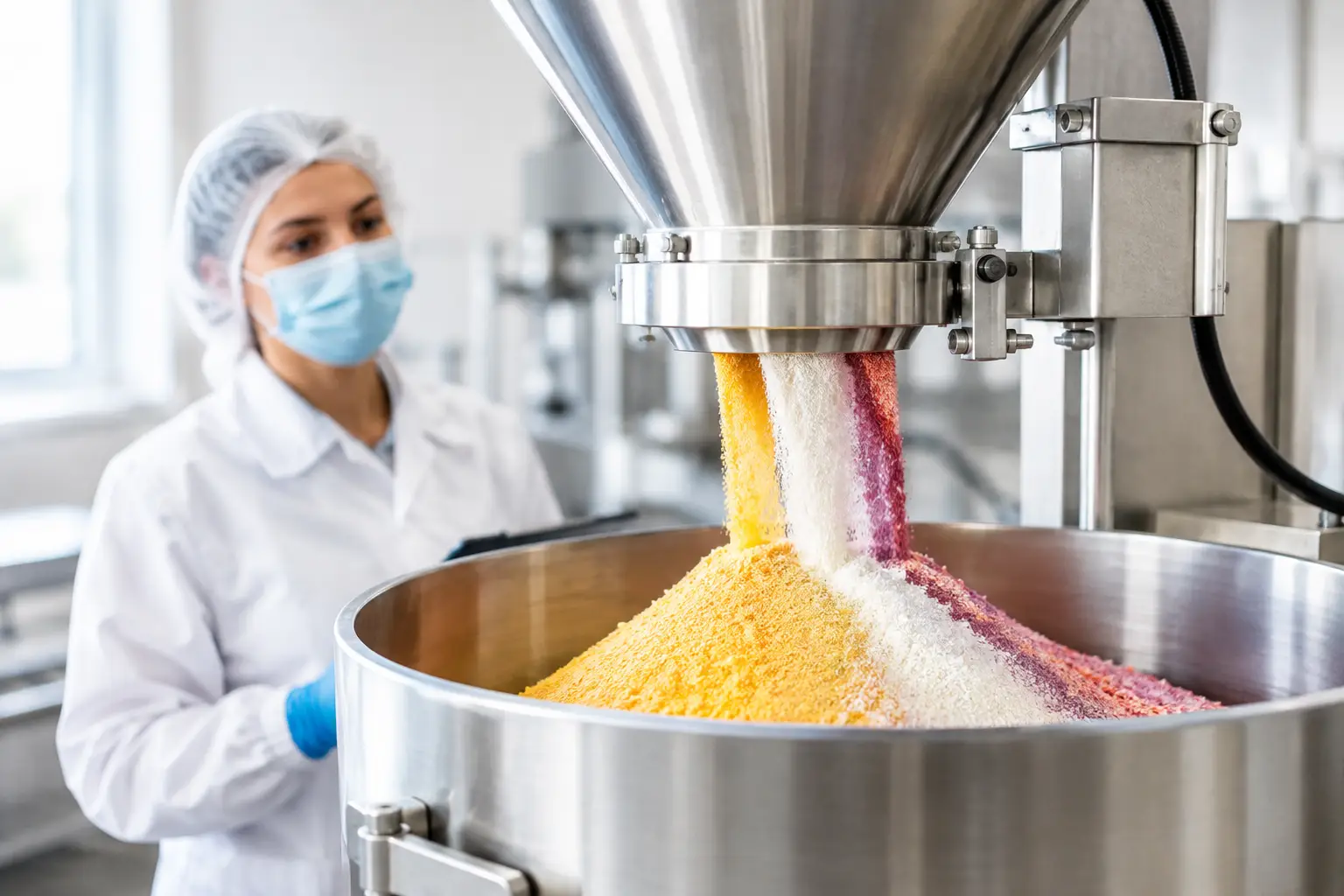
Spray bars, atomizing nozzles, and metered liquid addition systems improve distribution by applying liquid across a wider material surface during active mixing. The result can be more uniform absorption with less liquid overdosing and fewer quality corrections. For food, chemical, agricultural, and cosmetic applications, this also supports tighter control of formulation costs when high-value additives are involved.
The best approach depends on liquid viscosity, addition rate, batch temperature, and the material’s absorption characteristics. Thin oils may perform well with a basic spray system, while more viscous binders may require heated lines, specialized nozzles, or a different mixing sequence.
Vacuum Processing for Lower Thermal Stress
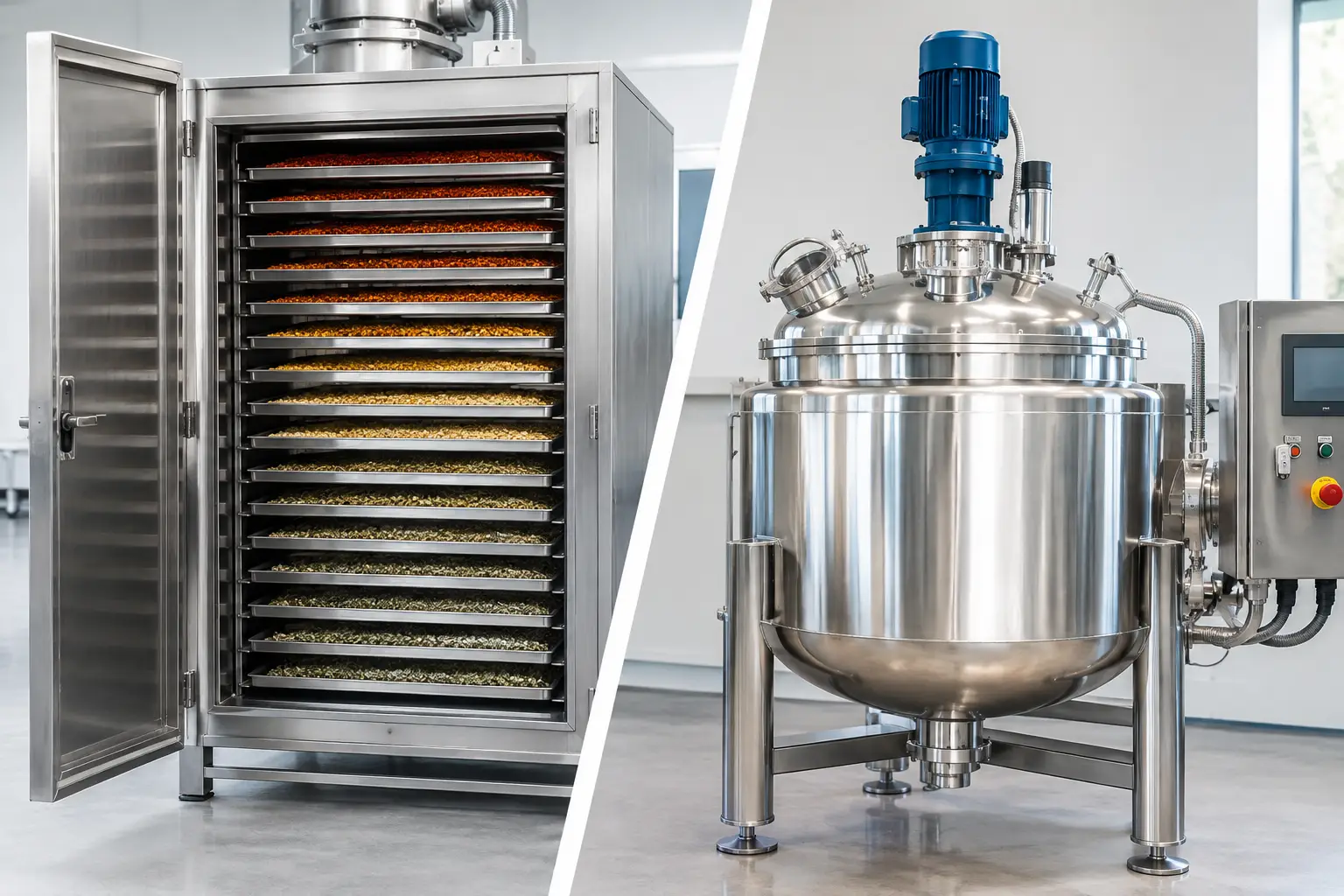
Vacuum ribbon mixers and dryers offer an important pathway for products that must be dried, deaerated, or processed under controlled conditions. By reducing pressure inside the vessel, vacuum systems can lower evaporation temperatures compared with atmospheric drying. This can help protect temperature-sensitive materials while reducing the time and energy associated with conventional thermal processing.
The sustainability advantage is application-specific. Vacuum equipment requires investment, operational knowledge, and supporting utility capacity. However, for heat-sensitive pharmaceuticals, specialty chemicals, fine powders, and paste products, the ability to combine mixing and drying in one enclosed system can reduce handling steps, product exposure, and transfer losses.
An integrated process also helps facilities reduce dust generation and improve containment. That can support both material recovery and cleaner working environments, particularly where fine powders are difficult to control.
Cleanability and Durability Are Resource Decisions
Energy use gets the most attention, but cleaning and maintenance can be major sources of water use, chemical consumption, downtime, and production loss. Equipment that is difficult to access or contains product-retention areas can turn changeovers into a costly operational burden.
A sanitary ribbon mixer design should consider smooth internal surfaces, accessible covers, appropriate seals, effective discharge, and clean-in-place capability where the application requires it. For dry products, a well-designed discharge valve and minimal residual material can reduce cross-contamination risk while limiting the amount of product discarded during changeover.
Material selection also matters. Stainless steel construction, properly specified finishes, and seals compatible with the process environment can extend service life and reduce premature component replacement. In corrosive, abrasive, or high-temperature applications, selecting the right materials at the start is generally more sustainable than repeatedly repairing equipment that was not designed for the duty.
Durability should not be confused with excessive weight or unnecessary features. The objective is dependable equipment engineered for the actual application, with components that can be inspected, maintained, and replaced efficiently when needed.
Data Makes Efficiency Repeatable
A sustainable mixing process must remain sustainable after commissioning. This is where monitoring and controls become valuable. Tracking batch time, motor load, speed, temperature, vacuum level, and discharge performance helps operators identify changes before they become quality or maintenance problems.
For example, a gradual increase in mixer amperage may indicate a formulation change, material buildup, bearing issue, or overloaded batch. A longer-than-normal mixing cycle may point to changes in moisture content or ingredient particle size. Without baseline data, these issues are often addressed only after a failed quality check or an equipment stoppage.
Process data also supports more disciplined optimization. Teams can compare energy per batch, batch-to-batch consistency, cleaning time, and product yield across formulations. That information makes it easier to distinguish a genuine equipment improvement from a change that simply shifts cost elsewhere in the operation.
Automation should be matched to plant needs. A high-volume facility running many repeat batches may benefit from recipe control, automated dosing, and integrated data collection. A lower-volume operation may gain more value from reliable variable-speed control and clear operating procedures. The right level of automation is the one that improves repeatability without creating an unnecessary support burden.
Selecting the Right Sustainable Mixing Solution
There is no universal mixer configuration that produces the lowest energy use for every material. Product behavior, production rate, sanitation requirements, batch size, and downstream handling all affect the decision. A ribbon mixer is highly effective for many bulk solids, powders, granules, and pastes, but the final design should be based on testing and application-specific engineering.
Before specifying equipment, define the material properties and the business outcome. Consider blend uniformity targets, maximum acceptable cycle time, particle sensitivity, liquid addition needs, required cleanout level, utility availability, and expected production schedule. It is also useful to examine the full process around the mixer. Inefficient loading, manual transfers, poor dust collection, and slow discharge can erase gains made inside the mixing chamber.
PerMix Ribbon Mixers applies this approach through configurable horizontal, vertical, and vacuum ribbon mixing solutions designed around real production requirements. The goal is not simply to supply a mixer, but to support a process that is more consistent, cost-effective, and practical to operate over its service life.
The most productive next step is to evaluate a representative material sample and production objective before committing to a configuration. A well-matched mixing system can reduce resource use every day, not through a single feature, but through thousands of efficient, repeatable batches.