Vacuum Dryer Selection Guide for Process Teams
A vacuum dryer that looks right on paper can still become a production bottleneck once it meets real material behavior, cleaning demands, and batch timing. That is why a practical vacuum dryer selection guide starts with the process, not the brochure. For plant teams evaluating capital equipment, the best choice is the one that dries consistently, protects product quality, fits the line, and stays dependable under daily operating conditions.
What a vacuum dryer must do in your process
Vacuum drying is rarely just about removing moisture. In many plants, it is a controlled thermal operation that affects particle integrity, solvent recovery, batch cycle time, and downstream flowability. A dryer may need to handle heat-sensitive actives in pharmaceuticals, sticky pastes in chemical production, or fine food powders that can degrade when exposed to oxygen or elevated temperatures.
That matters because two dryers with similar capacity can perform very differently once product characteristics are introduced. Bulk density, initial and final moisture levels, particle size distribution, solvent content, and tendency to cake all influence the right equipment design. If the process includes both drying and blending, that adds another layer. In those cases, a vacuum ribbon mixer and dryer can reduce transfer steps and improve overall line efficiency, but only if the agitation pattern aligns with the material.
A vacuum dryer selection guide should start with the material
The fastest way to narrow options is to define how the material behaves during the full drying cycle. Free-flowing powders are one case. Cohesive solids, fragile granules, and viscous wet cakes are another. The drying chamber, agitator style, and heat transfer surface all need to match that behavior.
A product that forms lumps as moisture drops may need active agitation to expose fresh surface area and maintain even heat transfer. A solvent-based slurry may require stronger vapor handling and a tighter system design. Hygroscopic materials often need close control of final moisture and discharge conditions so the dryer does not solve one problem and create another.
This is where many purchasing teams make avoidable comparisons. They look at vacuum level and installed horsepower first, when the more important question is whether the machine can keep the product moving and drying uniformly from start to finish.
Drying method, heat transfer, and agitation
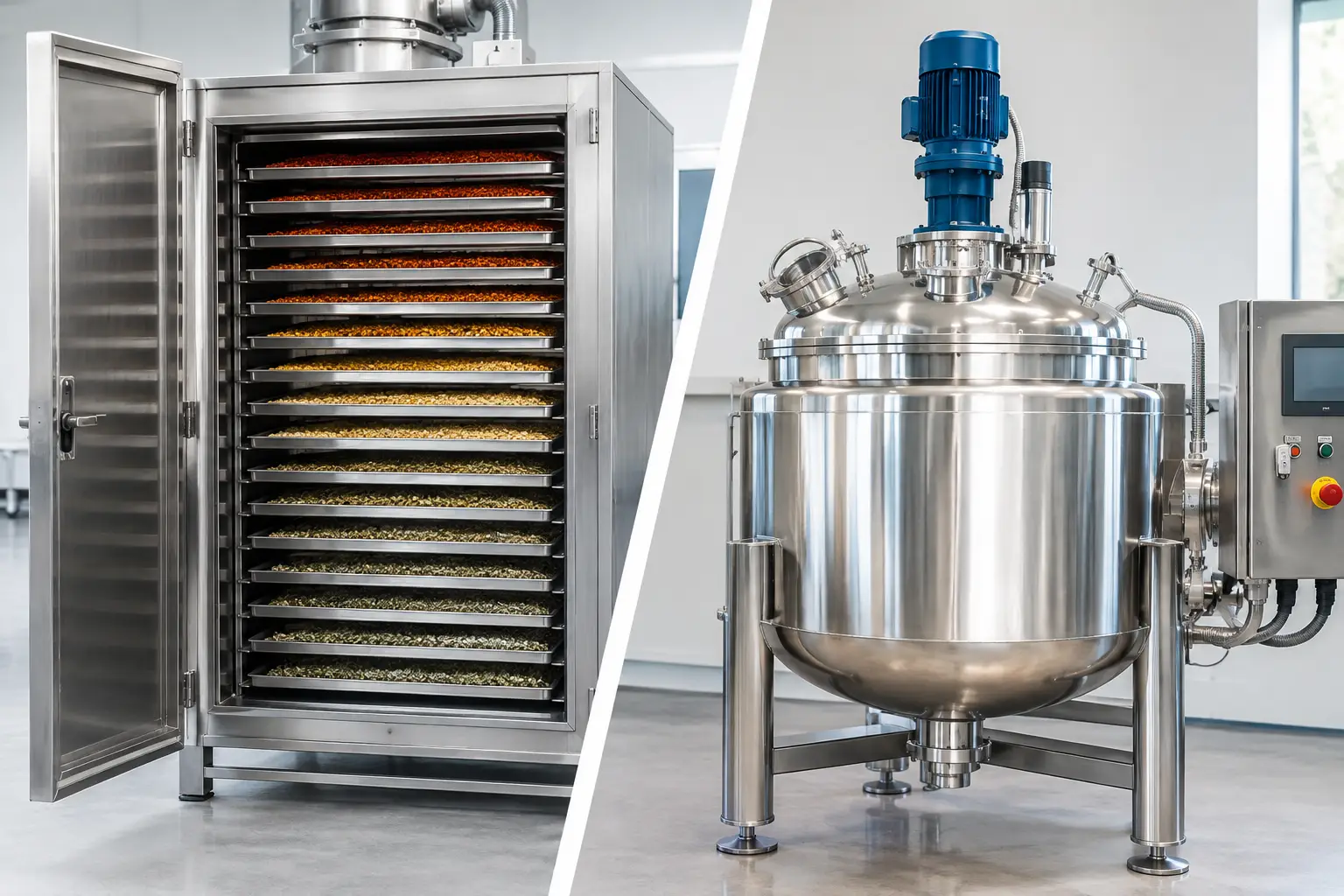
Most industrial vacuum dryers fall into a few broad operating approaches, and each has trade-offs. Static vacuum drying can work for some products, but batch times are often longer and heat distribution may be less uniform. Agitated vacuum dryers improve contact, reduce hot spots, and support more repeatable end-point control. That is especially useful when product quality depends on narrow moisture targets.
Heat transfer method matters just as much. Jacketed vessels are common and effective, but the available surface area, heating medium, and wall-to-product contact rate all affect performance. Internal heated elements can increase transfer rates, but they may complicate cleaning and maintenance. Higher heat input can shorten batch time, yet delicate products may need gentler conditions to avoid degradation, melting, or change in particle morphology.
For many manufacturers, the decision comes down to balance. Faster drying is valuable, but not if it causes more reject material, inconsistent discharge, or difficult cleanout between batches.
Capacity is not just vessel volume
One of the most common sizing mistakes is treating total vessel volume as usable process capacity. In practice, fill level, agitator performance, vapor release, and product expansion under vacuum all influence workable batch size. A dryer that is technically large enough may still underperform if the product mass is too shallow for efficient mixing or too deep for uniform heat transfer.
Cycle time should also be evaluated as part of real capacity. If a dryer handles the target batch weight but requires long heat-up, drying, cooling, discharge, and cleaning phases, the effective throughput may fall short of production targets. This becomes even more critical in multi-product facilities where changeovers are frequent.
A stronger selection approach is to calculate required output by finished product per shift, then work backward through actual batch cycle assumptions. That often leads to a different equipment choice than sizing from chamber volume alone.
Vacuum level, vapor load, and system integration
The dryer itself is only part of the system. Vacuum pump performance, condenser sizing, filtration, and controls all affect how well the process works under production conditions. If the vapor load is underestimated, drying slows down even when the vessel design is correct. If condensers are not matched to the solvent profile, recovery efficiency and pump protection can suffer.
Different applications also require different vacuum ranges. Some materials benefit from deeper vacuum to lower drying temperature and protect quality. Others do not need extreme vacuum and may be better served by a more economical configuration. The right answer depends on the boiling behavior of the liquid being removed, the thermal sensitivity of the solids, and the target cycle time.
This is where a complete equipment partner adds value. The dryer, vacuum source, condensation section, instrumentation, and safety features need to function as one process package rather than isolated components.
Cleaning, containment, and compliance requirements
In regulated industries, dryer selection has to account for more than process performance. Sanitary construction, surface finish, gasket materials, drainability, and access for inspection can all influence validation and routine operation. A design that dries well but takes too long to clean may create hidden cost through lost production hours.
Containment is another major factor. Fine powders, potent compounds, and solvent-bearing materials often require enclosed charging and discharge arrangements, dust control, or enhanced sealing. For food, pharmaceutical, and cosmetic applications, teams should evaluate cleanability and cross-contamination risk as seriously as drying speed.
There is no universal best configuration here. A highly polished, clean-in-place capable machine may be the right fit for one plant, while another operation values mechanical simplicity and manual access because the product suite is less sensitive and maintenance resources are strong.
Maintenance and long-term operating cost
Capital price gets attention early, but total cost of ownership usually decides whether the investment was sound. Bearings, seals, drive systems, heating jackets, vacuum components, and control hardware all influence reliability over time. An aggressive dryer design may promise performance, yet if wear parts are difficult to service or downtime is frequent, the real operating cost rises quickly.
Energy use should be considered in context. Vacuum drying can be efficient for heat-sensitive materials because lower pressure reduces required drying temperature, but the full system still consumes power through pumps, drives, and thermal utilities. Plants should compare not just nameplate ratings, but actual cycle efficiency and labor impact.
For that reason, durable construction and application-specific engineering tend to outperform generic equipment selection. A machine that matches the material well usually runs more predictably, needs fewer workarounds, and supports better production planning.
Questions that improve vacuum dryer selection
Before requesting quotes, process teams should be clear on several points: the material form at charging, the moisture or solvent to be removed, the acceptable product temperature, the target final moisture range, the required batch throughput, and the cleaning standard. It is also worth defining whether the equipment must only dry or also blend, heat, cool, react, or de-aerate.
Those details shape the recommended design more than broad labels like chemical grade or food grade. They also shorten the path to a useful supplier discussion. At PerMix, this is typically where the project becomes more productive, because equipment selection can shift from general catalog matching to a solution built around the actual application.
Choosing the right vacuum dryer with fewer surprises
A strong vacuum dryer selection guide is not about finding the most advanced machine. It is about selecting the dryer that fits your product, production targets, utility conditions, sanitation needs, and maintenance reality. The right design should improve drying consistency, protect product quality, and support dependable throughput without adding unnecessary complexity.
If there is one rule worth keeping through the evaluation process, it is this: treat vacuum drying as a full process decision, not a vessel purchase. When the material, mechanics, and operating conditions are aligned early, the result is a more reliable installation and a better return from every batch.