How to Troubleshoot Uneven Mixer Discharge
A mixer can produce an acceptable blend in the mixing zone and still create a costly quality problem at discharge. When early material is fine-rich, late material is coarse-heavy, or product remains trapped after the valve opens, the issue is rarely solved by simply extending mix time. To troubleshoot uneven mixer discharge, evaluate the complete system: material behavior, ribbon and vessel geometry, fill level, operating sequence, and the discharge arrangement itself.
For processors handling powders, granules, pastes, and formulated bulk solids, discharge consistency affects more than yield. It can alter package weights, downstream feeder accuracy, batch traceability, sanitation time, and confidence in the finished product. A disciplined investigation identifies the actual restriction before it becomes recurring downtime or unnecessary equipment modification.
Start by Defining the Discharge Pattern
Uneven discharge is not one failure mode. The pattern observed at the outlet provides the best starting point for diagnosis.
If the first portion of material is consistently different from the last portion, segregation is likely occurring before or during discharge. This is common when a blend contains particles with substantial differences in size, density, shape, or flowability. Fine powders may migrate toward the center or lower sections of the mixer, while larger particles can roll or percolate into different zones during transport and emptying.
If material flows well initially and then slows sharply, the problem may be related to bridging, ratholing, valve restriction, or insufficient material movement toward the outlet. If the discharge rate surges and stalls, air displacement, a poorly matched downstream hopper, or cohesive material behavior may be involved.
A useful diagnostic test is to take timed samples throughout the discharge cycle rather than comparing only the first and last samples. Record batch number, fill level, mixer speed, discharge gate position, sampling location, and material temperature. This creates evidence for determining whether the issue is repeatable, product-specific, or tied to a particular operator sequence.
Check the Material Before Changing the Mixer
Material characteristics often determine whether a standard discharge arrangement will perform consistently. A ribbon mixer is highly effective for many formulations, but no mixer can eliminate every tendency toward segregation or poor flow without the right process conditions.
Particle size distribution is a primary concern. A blend with broad size variation may remix effectively during agitation yet separate as it moves toward the outlet. Differences in bulk density can produce the same result. Fragile agglomerates, flakes, fibers, and irregular particles add further complexity because they do not flow or pack like free-flowing granules.
Moisture content deserves equal attention. A small increase in moisture can make a powder cohesive enough to stick to ribbons, vessel walls, or valve surfaces. Conversely, a very dry, aerated powder may flood through the outlet and create inconsistent flow into downstream equipment. Temperature can also change viscosity, fat content, tackiness, and static behavior in food, chemical, cosmetic, and polymer applications.
Before adjusting mechanical settings, compare the affected material lot with prior successful batches. Review incoming particle size, moisture, bulk density, additive loading, and storage duration. If the issue appears only with one formulation or supplier lot, the mixer may be exposing a material variation rather than causing it.
Inspect Mixer Fill Level and Operating Conditions
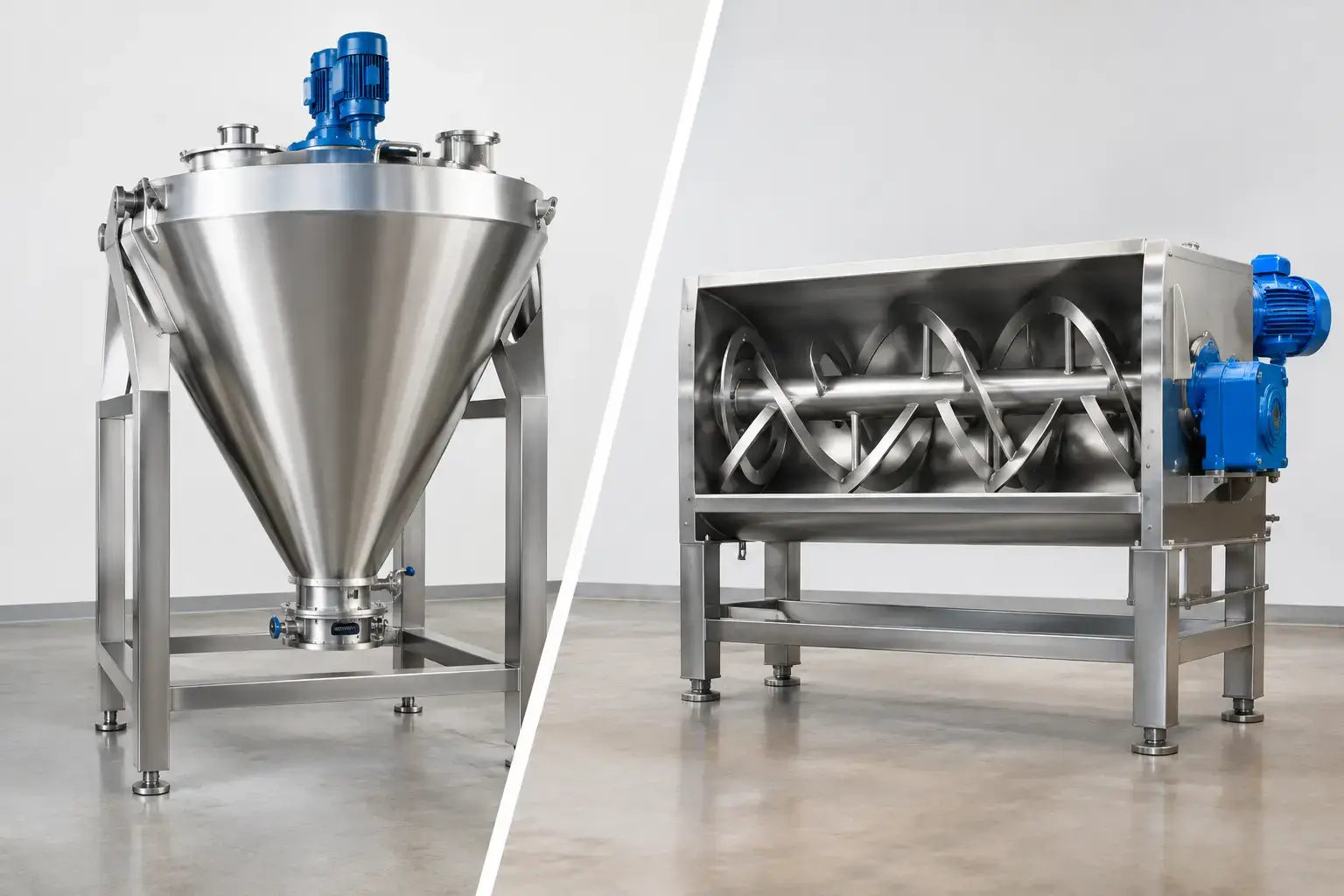
Horizontal ribbon mixers depend on the interaction between the inner and outer ribbons, the vessel walls, and the product mass. Operating too far below or above the intended working capacity can reduce circulation and create nonuniform movement toward the discharge port.
An underfilled mixer may not provide enough product bed depth for the ribbons to move material efficiently across the trough. An overfilled mixer can limit top-to-bottom turnover, increase power demand, and leave dead zones near the ends or discharge area. The correct operating volume depends on the product and mixer configuration, but it should remain within the equipment’s validated working range.
Mixer speed is another variable that should be controlled, not guessed. Higher speed does not always improve results. Excessive speed can aerate light powders, damage fragile particles, generate heat, or encourage segregation after the blend is achieved. Too little speed may not provide sufficient convective movement to sweep material toward the discharge opening.
Discharge timing matters as well. Stopping the agitator too early may leave material stranded near the outlet, while running it too long during emptying can continue separating ingredients in sensitive blends. Some applications benefit from continued low-speed agitation during discharge. Others perform better with a defined stop-and-open sequence. The correct approach depends on the material’s flow properties and the extent to which agitation affects segregation.
Review the Actual Batch Sequence
Operators should follow a repeatable sequence for charging, mixing, sampling, stopping, and discharging. Seemingly minor changes, such as adding a liquid at a different point in the cycle or opening the valve more slowly, can alter how material reaches the outlet.
Review whether ingredients are charged in the same order each time and whether the batch rests before discharge. Long hold times can allow dense materials to settle or cohesive products to compact. If process constraints require a hold period, validate the blend again at discharge rather than relying solely on an in-mixer sample.
Inspect the Discharge Valve and Outlet Geometry
The outlet is frequently the most direct cause of uneven mixer discharge. A valve that is undersized, partially obstructed, worn, or improperly aligned can restrict the product stream and leave residual material behind.
Inspect the valve seat, seals, actuator travel, and internal surfaces for buildup. Sticky products can accumulate at the valve perimeter and reduce the effective opening. Fine powders can pack into small gaps, while fibrous or irregular materials can hang up on sharp transitions. Even a small obstruction can change the composition of the material leaving the mixer if it selectively retains certain particles.
The discharge opening must also be compatible with the downstream process. If the mixer empties into a narrow chute, flexible connection, rotary valve, screw feeder, or small surge hopper, the restriction may be below the mixer rather than inside it. Product backing up beneath the outlet can reduce flow, trap air, and create intermittent discharge.
For sanitary or high-purity applications, frequent cleaning can introduce another issue: reassembled valve components may not return to the same alignment. Establish an inspection point after maintenance or washdown to confirm full valve travel and correct seal positioning before production resumes.
Evaluate Ribbon Condition and Internal Geometry
Ribbon condition affects both blend uniformity and discharge efficiency. Worn ribbons may no longer sweep material as designed. Bent sections, damaged welds, excessive clearance changes, or product buildup on the agitator can create localized stagnation zones.
Inspect the inner and outer ribbons for wear patterns, particularly near the discharge area. Confirm that the agitator shaft is properly aligned and that bearings are not introducing excessive movement. A shaft that runs out of true can alter ribbon clearance and reduce the predictable material circulation needed for consistent emptying.
Internal additions such as choppers, liquid spray bars, lump breakers, or special baffles should be evaluated in context. These features can improve performance for specific products, but they can also create retention points when applied without regard to material flow. The objective is not the most complex interior arrangement. It is a configuration that delivers reliable mixing and complete, controlled discharge for the specific formulation.
When Process Changes Are Not Enough
If material tests, operating procedures, and maintenance checks do not correct the problem, the application may require a different discharge design or mixer configuration. Larger or differently positioned outlets, slide gates, bomb-bay valves, twin discharge arrangements, or modified internal geometry can improve flow for difficult products. Vacuum capability, heating or cooling jackets, and specialized seals may also be relevant when temperature, moisture, or product containment is contributing to the issue.
There are trade-offs. A larger opening can improve discharge speed but may reduce the operator’s ability to meter product into downstream equipment. Additional agitation during emptying can reduce residuals but may damage sensitive particles. The right solution balances product integrity, cleaning requirements, batch cycle time, and downstream handling capacity.
PerMix Ribbon Mixers engineers systems around these application details rather than treating discharge as an afterthought. A review of representative material data, batch size, current mixer layout, and downstream equipment can determine whether a process adjustment or equipment modification will deliver the most cost-effective result.
Reliable discharge begins with measured observation. Sample the full emptying cycle, inspect the path from trough to downstream equipment, and make one controlled change at a time. That approach turns an inconsistent batch problem into a clear engineering decision.