Blending Validation in Manufacturing
A blend that looks uniform at discharge can still fail where it matters most – in assay results, content uniformity, downstream flow, or final product performance. That is why blending validation in manufacturing is not a paperwork exercise. It is the process of proving that a mixer, a material system, and an operating method can repeatedly deliver the blend quality your product requires.
For plant managers and process teams, the stakes are practical. Poorly validated blending leads to batch rejection, rework, segregation complaints, line delays, and unnecessary scrutiny during audits. A well-validated process does the opposite. It gives production a defined operating window, gives quality teams documented confidence, and gives procurement and operations leaders a clearer basis for selecting equipment that will hold up under real production conditions.
What blending validation in manufacturing really proves
At its core, blending validation demonstrates repeatability. The question is not whether one batch mixed well on a good day with ideal raw materials. The question is whether the process consistently produces an acceptable blend across normal operating variation.
That usually includes proving uniformity at defined batch sizes, fill levels, mixing times, and loading sequences. In regulated environments, it may also include showing that the blend remains acceptable through discharge and transfer. For many products, especially powders and granules, the true risk is not only inadequate mixing but post-blend segregation caused by differences in particle size, density, or flow behavior.
This is where many validation efforts become too narrow. A mixer may achieve a target result in a small trial, yet underperform in production because the product behaves differently at scale. Validation has to connect lab expectations with plant reality. It has to account for how materials enter the mixer, how long they are blended, how they are discharged, and how the blend moves to the next processing step.
Why mixer design has a direct impact on validation success
Blending results are strongly influenced by equipment geometry and agitation pattern. That matters because validation is only as strong as the process design behind it. If the mixer is not matched to the application, teams often end up trying to validate around a mechanical limitation.
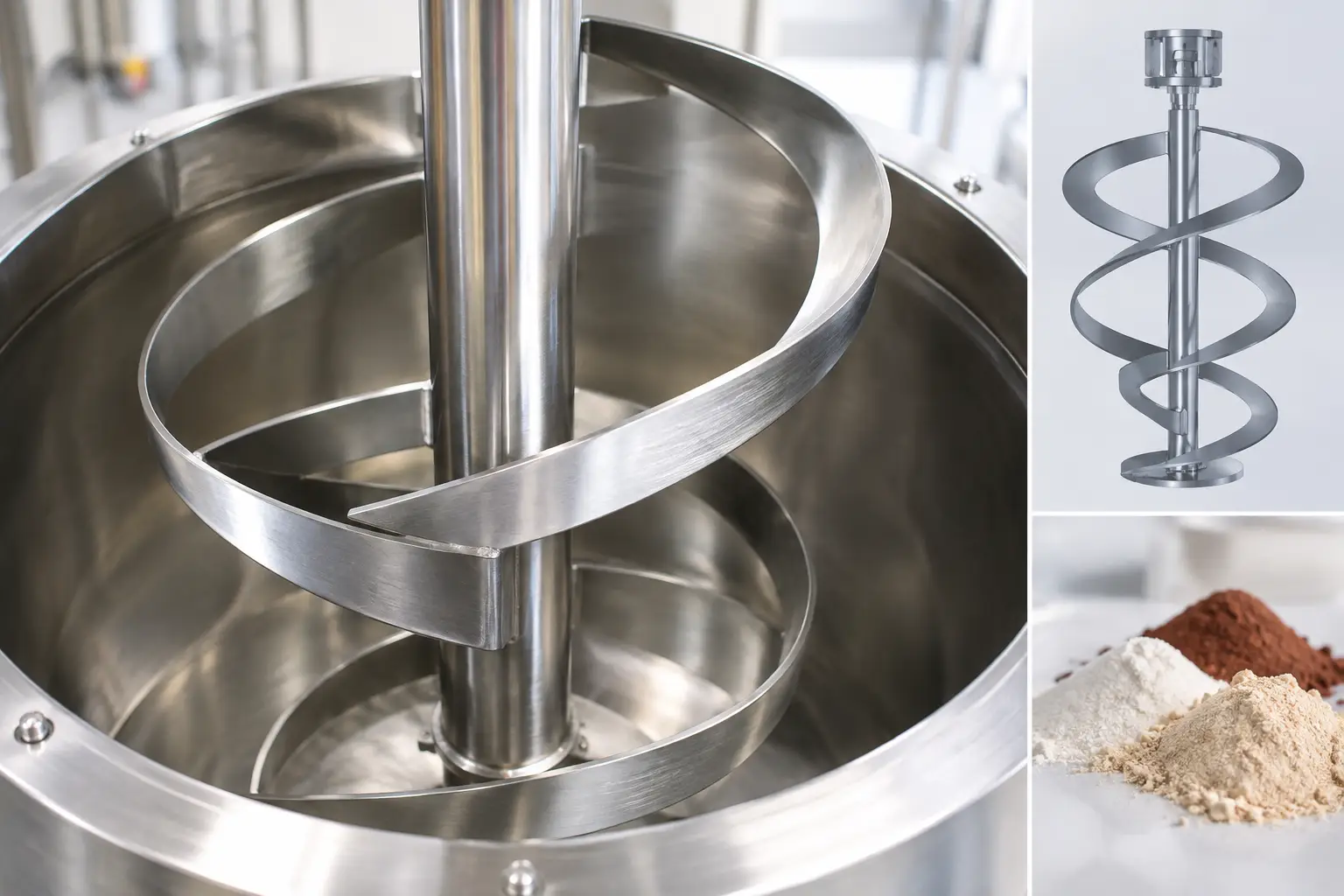
Ribbon mixers are a good example. In the right application, they provide strong convective movement and efficient turnover, making them highly effective for bulk solids, powders, granules, and some paste formulations. They can support short cycle times and high batch consistency when ribbon design, trough geometry, fill level, and drive configuration are aligned with the product.
But it depends on the material. Free-flowing powders behave differently from cohesive blends. Fragile particles may require gentler handling. Liquids added into a dry blend can improve homogeneity in one formula and create agglomeration risk in another. Validation should confirm not only that the target blend is reached, but that it is reached without damaging product quality or creating downstream handling problems.
For that reason, process engineers typically evaluate more than one factor during validation. They look at batch size range, residence time, power draw, cleanability, material adhesion, and discharge efficiency. They also examine whether dead zones, overmixing, or heat generation could affect the product. A strong validation outcome starts with equipment built for the actual process rather than a generic mixing assumption.
Building a practical validation protocol
The most effective validation protocols are specific enough to be useful and simple enough to execute consistently. They define what acceptable blending means for that product, on that equipment, under those operating conditions.
That starts with identifying critical product attributes. In pharmaceutical or nutraceutical applications, assay and content uniformity may be primary. In food processing, uniform distribution of seasoning, color, or minor ingredients may be the focus. In chemicals or plastics, the target might include additive dispersion, bulk density consistency, or downstream process stability.
Once those attributes are defined, the protocol should establish the operating parameters to test. These often include loading order, fill percentage, blend time, ribbon speed, liquid addition rate if applicable, and discharge method. It is also smart to include the expected production range rather than validating only one ideal batch size. A process that works at 70 percent fill may behave differently at 40 percent or 90 percent.
Sampling strategy is where many teams either gain confidence or create false confidence. If samples are taken only from convenient points, the data may miss variation inside the mixer or across the discharge stream. Good sampling plans consider multiple locations and multiple time points, especially when segregation risk is known. The objective is not to produce attractive averages. It is to identify whether the blend is consistently within specification.
Common problems that weaken blend validation
One recurring issue is treating validation as a one-time event instead of an extension of process understanding. A batch can pass validation while the process remains fragile. That often happens when raw material variation has not been accounted for.
Small changes in particle size distribution, moisture, bulk density, or ingredient lot characteristics can change mixing behavior significantly. If the validation program uses only one set of ideal raw materials, it may not represent normal production. The same is true when the protocol ignores realistic startup and shutdown conditions, operator variation, or sanitation-related reassembly differences.
Another common problem is confusing longer blend time with better blending. In some systems, extending the cycle improves uniformity. In others, overmixing increases segregation or degrades sensitive ingredients. Validation should identify the acceptable process window, not simply the longest possible runtime.
Equipment access and cleaning design also matter more than many facilities expect. If cleaning is difficult, residue can affect subsequent batches and complicate repeatability. If inspection points are limited, troubleshooting becomes slower and less precise. From a business standpoint, validation is not only about passing a technical test. It is about creating a stable process with manageable downtime and predictable maintenance.
How to connect validation with equipment selection
For buyers evaluating mixing systems, blending validation in manufacturing should influence equipment selection early, not after purchase. Too often, teams focus first on capacity and price, then try to solve blend performance later. That approach can increase commissioning time and expose the plant to avoidable production risk.
A better path is to evaluate the application in detail before finalizing mixer design. Product characteristics, target batch size, required uniformity, ingredient sequence, cleanout expectations, and plant constraints should all shape the specification. Horizontal ribbon mixers, vertical ribbon mixers, and vacuum ribbon mixers or dryers each serve different process needs. The best choice depends on how the material behaves and what the process must achieve.
For example, a plant handling high-volume dry powder blends may prioritize fast batch turnover and efficient discharge. A processor working with heat-sensitive materials or solvent-related requirements may need vacuum capability integrated into the system. A facility with frequent product changeovers may place greater value on sanitation access and reduced clean-down time. Validation success improves when the equipment is configured around those priorities from the start.
This is where an application-focused manufacturer adds value. The right supplier should be able to discuss not only machine dimensions and motor size, but also how ribbon configuration, trough finish, seals, controls, and discharge design affect blend consistency and validation outcomes. PerMix approaches mixer selection from that process perspective because long-term performance depends on more than basic equipment fit.
Validation data should support operations, not just compliance
Strong validation creates operational leverage. It gives production a documented baseline for setup, cycle time, and sampling. It gives quality teams evidence they can defend. It also gives maintenance and engineering teams a reference point when performance starts to drift.
That matters because changes happen. Raw materials shift. Throughput increases. Operators rotate. Components wear. When the original validation is tied to real process variables, it becomes easier to recognize when the process is moving out of range and why. Without that foundation, troubleshooting becomes slower, more expensive, and more subjective.
In practical terms, the goal is a validated process that can withstand normal manufacturing variability without repeated intervention. That is what protects throughput and product quality at the same time. The best blending systems are not simply capable of producing a good batch. They are designed and validated to produce good batches repeatedly, under production conditions that match the real world.
If your blend quality depends on consistency, compliance, and efficient scale-up, validation should be treated as part of process design, not a final checkpoint. The more precisely your mixer, material behavior, and operating window are aligned, the easier it becomes to run with confidence instead of correction.