Space Saving Vertical Mixers for Efficient Plants
When a new production line must fit between existing process equipment, floor space becomes a process constraint rather than a facilities issue. Space saving vertical mixers give manufacturers a practical way to add blending capacity while preserving room for material transfer, operator access, packaging, and maintenance. For plants handling powders, granules, pastes, and bulk solids, the right vertical design can reduce the equipment footprint without compromising the repeatability required for commercial production.
The decision, however, should not be based on footprint alone. A vertical mixer trades horizontal floor area for height, and its real value depends on material behavior, batch size, discharge requirements, cleaning expectations, and the building envelope. A properly specified system can support efficient material movement and homogeneous blending. A poorly matched system can create access challenges or extend cycle times.
Why Floor Space Has Become a Mixing Constraint
Expansion inside an operating facility is rarely simple. A plant may have adequate demand for another product line but no appetite for a building addition, lengthy utility relocation, or a major interruption to validated production. In food, pharmaceutical, chemical, and specialty materials operations, every square foot also needs to support safe traffic patterns, sanitation, dust control, and compliance activities.
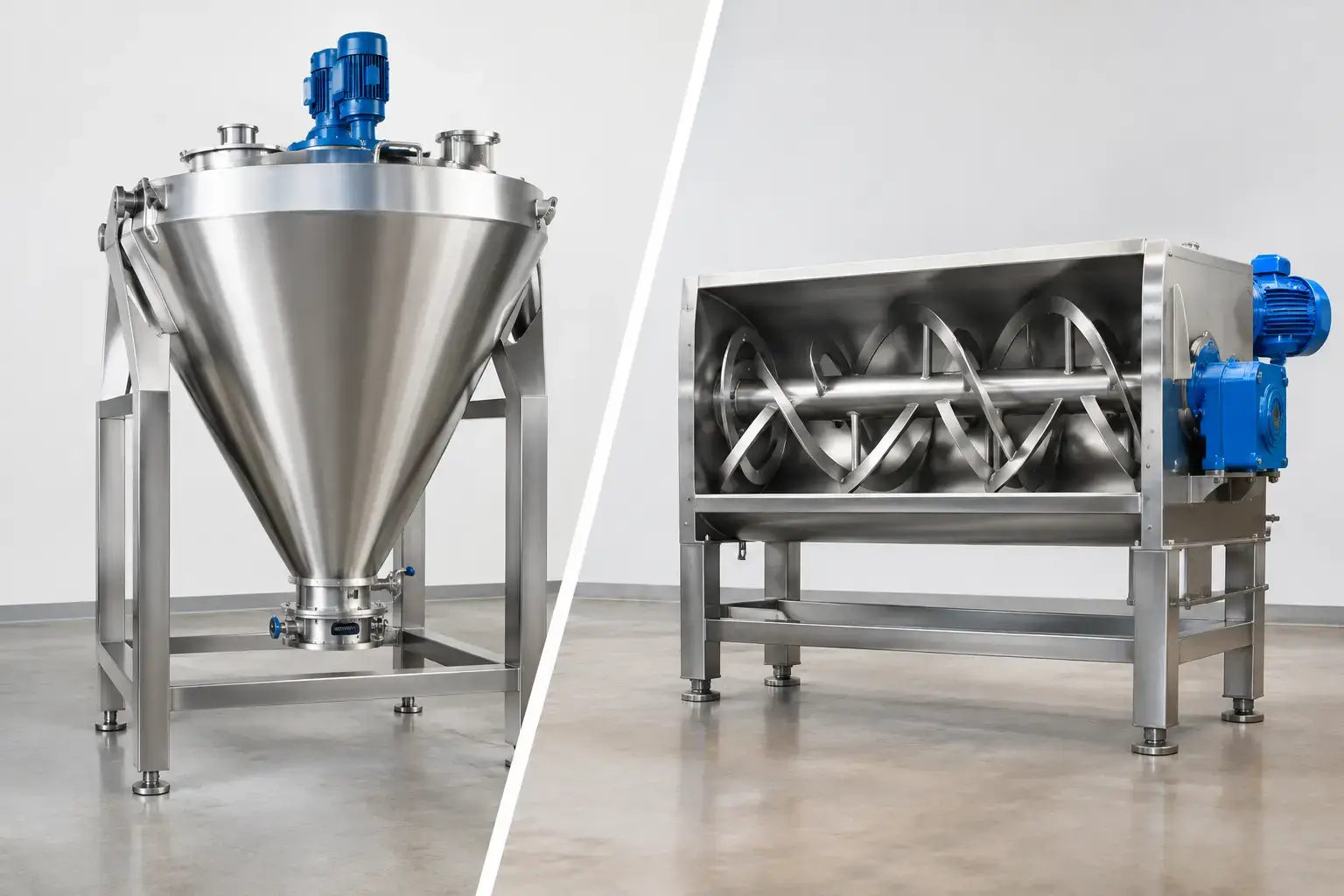
Traditional horizontal mixers remain an excellent choice for many applications, particularly where fast batch processing, wide vessel access, or specific agitation patterns are required. Yet their length and service clearance can be difficult to accommodate in narrow rooms or congested process areas. A vertical configuration concentrates the vessel volume above a smaller base area, allowing manufacturers to use available height more effectively.
This can make a meaningful difference when positioning a mixer near bulk bag unloaders, storage hoppers, mills, screening equipment, or downstream filling systems. Rather than treating the mixer as an isolated purchase, experienced process teams assess how its shape affects the entire material path.
How Space Saving Vertical Mixers Use the Available Envelope
Space saving vertical mixers use a vertically oriented vessel and mixing element to circulate product through the batch. Depending on the mixer configuration and application, the agitator can lift material from lower areas of the vessel and redistribute it through the product mass. Gravity then supports the downward movement of material, creating a controlled circulation pattern within a compact footprint.
The practical advantage is straightforward: more working volume can be installed within less floor area. In facilities with usable overhead clearance, this may allow a larger batch capacity than a similarly placed horizontal unit. A vertical mixer can also simplify certain gravity-fed layouts, particularly when the discharge can feed a hopper, conveying system, or downstream process located below.
The footprint benefit should be measured with realistic clearance requirements, not vessel diameter alone. Engineers should account for loading access, control panels, dust collection connections, inspection points, discharge valve operation, maintenance access, and the path needed to remove components for service. A compact vessel that cannot be safely loaded or maintained is not a space-efficient installation.
The headroom trade-off
Vertical mixing systems need adequate ceiling height, structural support where applicable, and clearance for charging equipment. This may be easy to achieve in a high-bay production area but less practical on a mezzanine level or in a facility with low overhead utilities.
The mixer’s total installed height includes more than the vessel. Drive assemblies, covers, inlet connections, filters, platforms, and lifting allowances all affect the required envelope. For retrofit projects, a site survey should identify obstructions such as sprinkler mains, HVAC ducts, cable trays, and crane rails before the equipment is selected.
Matching Vertical Mixer Design to Material Behavior
A small footprint is valuable only when the mixer can handle the product consistently. Bulk density, particle size, particle shape, moisture content, flowability, fragility, and ingredient ratio all influence equipment selection. The behavior of a free-flowing granular blend is very different from that of a cohesive powder with minor liquid additions.
For dry powders and granules, the objective is often uniform distribution without segregation or excessive particle damage. A vertical ribbon mixing approach may be suitable where controlled circulation and efficient use of the vessel are needed. For products that bridge, form agglomerates, or have poor flow properties, the agitator geometry, vessel profile, and charging sequence must be evaluated carefully.
Paste-like materials and formulations with liquid additions require another level of assessment. Viscosity changes during processing can affect power demand and movement through the batch. In these cases, a mixer may need specialized mixing elements, intensified zones, spray systems, heating or cooling features, or vacuum capability. The best configuration depends on the actual formulation and production target, not simply on the available floor area.
Material testing is particularly valuable when blend uniformity, product appearance, or ingredient distribution is critical. It provides the process data needed to determine mixing time, fill level, speed range, and discharge performance before an investment reaches the plant floor.
Design Details That Protect Production Efficiency
A vertical mixer should support the full operating cycle: charging, mixing, sampling, discharge, cleaning, and restart. The vessel may occupy little floor space, but avoidable delays in any of these stages can reduce its production value.
Discharge design deserves close attention. The outlet must provide reliable emptying for the product being processed, while minimizing retained material and supporting the next batch. A poorly selected valve or outlet geometry can leave residue, slow changeovers, and create avoidable cleaning work. For higher-value ingredients, retained product also has a direct cost.
Sanitary requirements should shape the configuration early in the project. Food, cosmetic, and pharmaceutical producers may require polished contact surfaces, hygienic seals, clean-in-place provisions, validated cleaning access, or material certifications. Chemical and polymer processors may prioritize abrasion resistance, corrosion-resistant alloys, dust-tight containment, or nitrogen blanketing. These are not optional accessories added after the equipment is chosen. They are core design requirements.
Automation can further improve the performance of a compact mixing cell. Recipe controls, variable-speed drives, load cells, controlled liquid dosing, and batch records help operators run repeatable processes with less manual intervention. The right level of automation depends on production volume and compliance needs, but even a straightforward control package can reduce operator variability.
When a Horizontal Mixer May Be the Better Choice
Vertical designs are not the answer to every space challenge. A horizontal ribbon mixer can be preferable when a facility has limited height, when rapid mixing cycles are the overriding priority, or when the formulation benefits from the shear and mixing pattern associated with a horizontal agitator. Certain materials also require the vessel access, discharge arrangement, or process integration that a horizontal design can provide more naturally.
The right comparison is not vertical versus horizontal in isolation. It is the total cost and performance of each option in the intended process. That includes batch capacity, cycle time, energy use, operator time, cleaning duration, maintenance access, installation constraints, and the consequences of off-spec product.
For some operations, a vertical mixer’s reduced footprint makes a constrained expansion possible. For others, a horizontal mixer delivers stronger throughput or a better fit for the material. A supplier that starts with the formulation and production objectives, rather than a fixed equipment preference, can help prevent an expensive mismatch.
A Practical Specification Process for Vertical Mixing Equipment
Successful projects begin with a clear process profile. Production teams should define the materials to be blended, target batch size, expected annual volume, desired mixing time, density range, liquid addition requirements, cleaning standards, and available utility connections. Facility drawings should show usable floor area, ceiling height, access routes, and nearby equipment.
It is also useful to identify what changes in the next three to five years. A mixer sized only for the current product may limit future formulations or anticipated volume growth. Conversely, oversizing equipment can reduce mixing performance at low fill levels and add unnecessary capital and operating cost. The goal is a tailored solution with a workable operating range.
PerMix works with industrial manufacturers to assess these details and configure vertical ribbon mixing systems around the product, process, and installation environment. This application-focused approach helps buyers evaluate footprint savings alongside the performance factors that protect blend quality and production reliability.
The most productive next step is to bring a real plant layout and representative material information into the equipment discussion. With those details in hand, a compact mixer can become more than a way to fit equipment into a tight space – it can become a dependable part of a more efficient processing line.