How to Optimize Discharge Valve Timing
A ribbon mixer can achieve excellent blend uniformity during the mixing phase and still lose production efficiency at discharge. The transition from mixing to emptying is where many batch operations encounter avoidable delays, residual material, segregation, and downstream feeding inconsistencies. To optimize discharge valve timing, plant teams must treat the valve sequence as part of the mixing process, not as a final mechanical step.
For powders, granules, and paste materials, the correct timing depends on material flow behavior, mixer geometry, discharge valve design, agitator speed, and the requirements of the next process. A valve opened too early can compromise a homogeneous blend. A valve opened too late can extend cycle times, increase energy use, and leave valuable capacity idle. The goal is a controlled, repeatable discharge that protects product quality while moving material efficiently to the next stage.
Why discharge valve timing affects batch performance
In a horizontal ribbon mixer, the inner and outer ribbons generate a controlled axial and radial movement of material. This action brings material from the vessel ends toward the center and from the center back toward the ends, creating a consistent blend when the mixer is properly sized and configured. At discharge, that material movement changes.
Opening the valve changes the flow path within the trough. Free-flowing products may move rapidly toward a center-bottom outlet, while cohesive powders may bridge, smear, or release in uneven surges. Dense granules can drain quickly at first and then slow substantially as material near the sidewalls and end zones must be conveyed toward the outlet. The timing of valve actuation and agitator operation determines how effectively the mixer clears these zones.
This has direct commercial consequences. An inconsistent discharge can create variable fill weights downstream, increase product retained in the mixer, and delay cleaning between batches. In regulated food, pharmaceutical, chemical, and cosmetic production, poor emptying can also complicate traceability and changeover validation. A faster batch is only valuable when it remains controlled and repeatable.
How to optimize discharge valve timing
The right discharge sequence begins with a clear definition of what the operation is trying to improve. Some facilities need the shortest possible batch-to-batch turnaround. Others prioritize maximum product recovery, low cross-contamination risk, or steady feeding into packaging, conveying, drying, or extrusion equipment. Those objectives may require different valve timing strategies.
Establish the true end of mixing
A common mistake is using a fixed mixing time as the only trigger for discharge. Fixed times are useful for validated formulations, but they do not account for variation in raw material moisture, particle size, bulk density, fill level, or incoming temperature. These changes can alter both blending behavior and discharge flow.
Use representative sampling, near-process measurements where available, and production data to establish the point at which the batch has reached the required homogeneity. Only then should the discharge sequence begin. For critical products, the acceptable operating window should define both the required blend quality and the allowable discharge conditions.
In many applications, the mixer should remain running at a controlled speed as the discharge valve begins to open. The ribbons continue moving material toward the outlet and reduce the amount left in low-flow areas. However, this is not universal. Fragile granules, highly abrasive materials, or blends prone to segregation may require reduced agitator speed or a carefully staged stop-and-discharge sequence.
Match valve opening speed to material behavior
The discharge valve should not always move from fully closed to fully open at maximum speed. A rapid opening can be appropriate for free-flowing products moving to a large receiving hopper. But when a downstream conveyor, feeder, or packaging line has limited capacity, a sudden release can cause flooding, dust generation, or unstable feed rates.
A staged opening profile often delivers better process control. The valve can initially open to a restricted position, allowing operators or controls to confirm stable flow. Once the receiving equipment is ready and product movement is predictable, the valve can move to the full-open position. This approach is especially valuable for fine powders, low-bulk-density materials, and blends that generate airborne dust.
For cohesive products, the challenge is different. A narrow initial opening may encourage bridging at the outlet rather than controlled flow. These materials may benefit from a larger opening combined with low-speed ribbon movement, a properly designed outlet shape, and, where appropriate, flow-assist features. The correct solution depends on the product, not a generic valve setting.
Coordinate the mixer with downstream equipment
Discharge valve timing cannot be optimized in isolation. The receiving hopper, screw conveyor, pneumatic transfer system, weigh feeder, dryer, or packaging machine must have capacity to accept the material at the rate delivered.
When the downstream system is not ready, operators may hold a completed batch in the mixer. This consumes valuable equipment time and can expose sensitive formulations to unnecessary heat, shear, or humidity. A better control strategy uses permissive signals between the mixer and downstream equipment. The valve opens only after the next process confirms that it can receive product, and the discharge sequence pauses or adjusts if a downstream fault occurs.
For high-value or tightly controlled products, load cells can provide another useful signal. Tracking the mixer weight during discharge shows the actual emptying profile and identifies whether material is leaving in a smooth, repeatable pattern. A declining but uneven weight trend may point to bridging, poor outlet geometry, or an agitator speed that is not supporting flow effectively.
Balance discharge speed against blend integrity
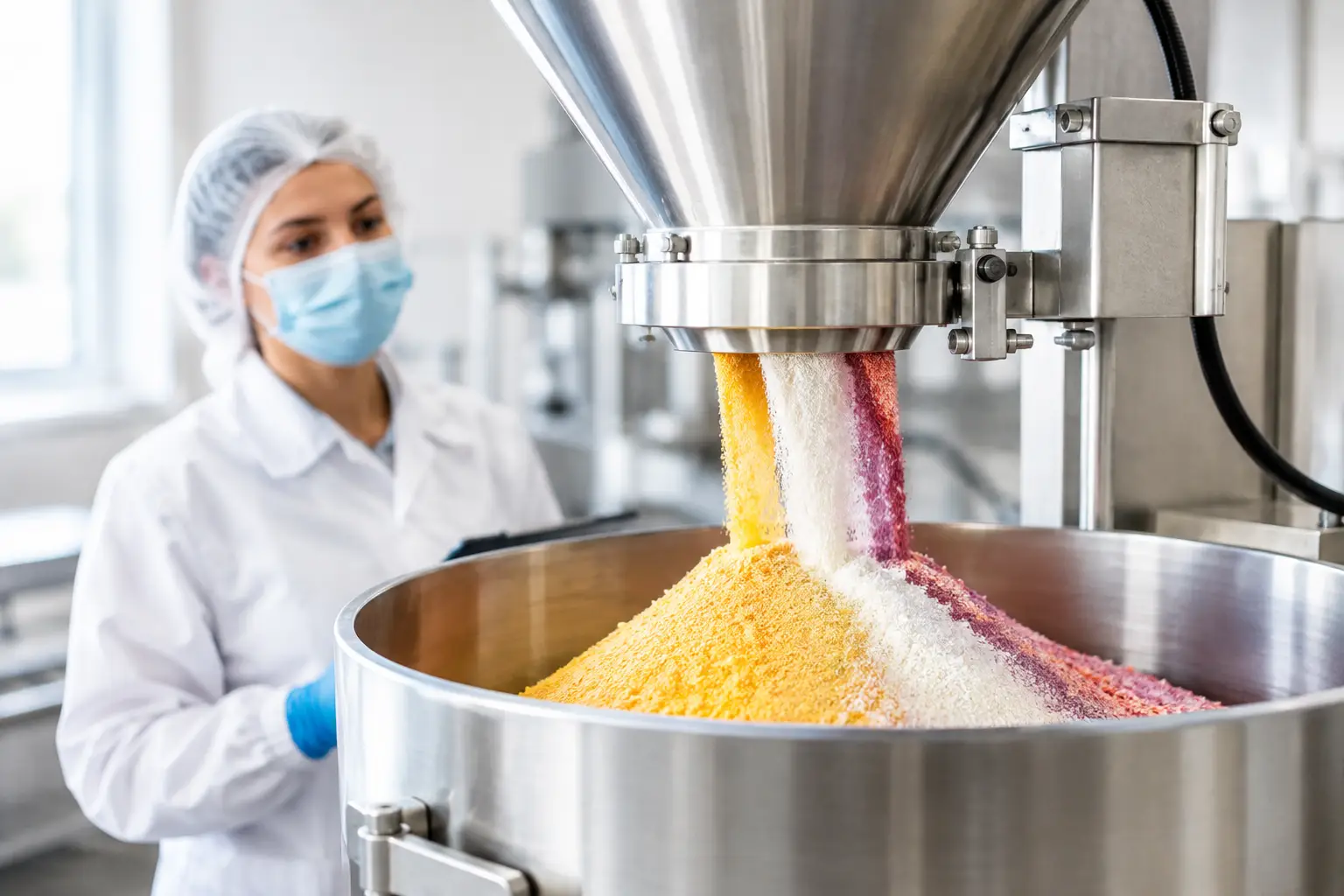
A fast discharge is not automatically a better discharge. Some powder blends can segregate when their components have significant differences in particle size, density, or shape. If the discharge stream is too aggressive, or if product drops a long distance into a receiving vessel, the blend can separate after it has left the mixer.
This risk increases with blends containing fine additives, lightweight ingredients, or coarse particles. In these cases, valve timing should be tested with the full process in mind, including transfer distance and receiving conditions. A controlled discharge rate, minimal drop height, and appropriately designed downstream handling can preserve the uniformity achieved in the mixer.
Paste and high-viscosity applications require a different balance. Longer discharge times may be necessary because product must be swept or conveyed out rather than allowed to flow by gravity. Attempting to force a rapid discharge may increase residual buildup or place unnecessary load on the agitator and valve components. For these processes, consistent emptying and cleanability are usually stronger performance indicators than discharge speed alone.
Measure the discharge, not just the mixing cycle
Optimization becomes more reliable when it is based on measurable operating data. Record the time from valve command to initial product flow, the total discharge duration, the retained product after discharge, and any downstream interruptions. Compare those results by formulation, batch size, moisture range, and valve position.
Four indicators are particularly useful when evaluating discharge performance:
- Total batch cycle time, including the time required for the downstream process to accept material.
- Residual product weight or volume remaining in the mixer after a standard discharge sequence.
- Blend uniformity at the beginning, middle, and end of discharge.
- Valve, actuator, and agitator load trends that may reveal wear, blockage, or abnormal product behavior.
These data points help distinguish a timing issue from a mechanical or formulation issue. For example, a longer discharge time may be caused by an undersized outlet, a worn valve seal, compacted material, insufficient air supply to a pneumatic actuator, or a change in powder moisture. Changing the timing alone will not correct every problem.
Build timing into mixer and valve design
The most effective discharge strategy is often determined before equipment is installed. Outlet size and location, valve style, actuator selection, trough geometry, ribbon clearance, and controls integration all influence how product leaves the mixer.
A full-width bomb-door valve may provide rapid emptying for certain applications, while a center-bottom valve can offer more controlled discharge for others. Sanitary requirements may call for designs that minimize crevices and support efficient cleaning. Vacuum ribbon mixers and dryers introduce additional considerations, including pressure integrity, valve sealing, and safe sequencing before opening the vessel to the next process.
Automation should support the operating reality of the plant. Recipe-driven controls can store proven discharge parameters for each product, including final mixing speed, valve opening position, discharge duration, and agitator shutdown point. Manual override capability remains useful during commissioning and for investigating changes in material behavior, but repeatable production benefits from a documented sequence.
PerMix engineers ribbon mixing systems around the product, process objectives, and required discharge performance. That application-specific approach is particularly valuable when a standard valve arrangement cannot deliver the recovery, sanitary design, or cycle-time target a facility requires.
Keep the valve system mechanically reliable
Timing accuracy depends on valve reliability. A pneumatic actuator with inconsistent air pressure, a sticking butterfly valve, worn seals, or product buildup around the outlet can make a well-designed control sequence unreliable. Preventive maintenance should therefore include valve inspection, actuator response checks, seal condition, and verification that position feedback matches the actual valve position.
Cleaning practices also matter. Residue around the valve seat can interfere with full closure, create leakage, or become a cross-contamination concern. In applications with sticky materials or frequent product changes, the discharge system should be evaluated for cleanability as carefully as the mixing chamber itself.
The best timing profile is the one that delivers a complete, controlled discharge under normal production variation. Start with representative trials, measure both product quality and cycle performance, and refine the sequence as materials and downstream conditions change. A properly coordinated discharge valve turns the final seconds of a batch into a dependable advantage for throughput, product recovery, and process control.