Can Ribbon Mixers Handle Pastes? What It Takes
A ribbon mixer that performs well with a free-flowing powder can stall, smear material along the vessel wall, or leave unmixed zones when a paste enters the process. The question is not simply, “can ribbon mixers handle pastes?” The more useful question is whether the mixer is engineered for the paste’s viscosity, yield behavior, batch volume, and discharge requirements.
For many paste applications, the answer is yes. A properly specified horizontal ribbon mixer can provide efficient, repeatable blending of wet powders, damp granulations, dough-like compounds, filled polymers, cosmetic bases, chemical slurries, and other cohesive materials. But paste mixing places higher demands on the agitator, drive system, vessel geometry, seals, and controls than standard dry blending. Equipment selection must follow the material, not the other way around.
Can Ribbon Mixers Handle Pastes in Production?
Ribbon mixers can handle pastes when the material remains within the machine’s practical torque and flow limits. Their counterflow mixing action moves material in opposing directions: the outer ribbon typically carries product from the ends toward the center, while the inner ribbon moves it from the center toward the ends. This circulation can distribute binders, liquids, colors, actives, and fine solids throughout a cohesive batch without the high speeds associated with some other mixer types.
That action is especially valuable for products that need controlled blending rather than aggressive particle reduction. In food processing, it may support seasoning pastes, fillings, meat analog formulations, and wet mixes. In cosmetics, it can be suitable for powder-to-paste additions and viscous base blends. Chemical and polymer manufacturers may use ribbon mixing for compounds that become progressively denser as liquids, waxes, resins, or plasticizers are incorporated.
The limitation is that not every paste behaves alike. A soft, mobile paste may mix readily in a standard horizontal ribbon configuration. A highly viscous, non-flowing material with a high yield stress may require a heavier-duty agitator, specialized ribbon arrangement, intensifier choppers, a different mixer design, or a combination of these features. The right conclusion comes from material testing and application review, not viscosity alone.
Why Paste Properties Change Mixer Requirements
Viscosity is an important starting point, but it does not tell the full story. Many industrial pastes are non-Newtonian, meaning their resistance to flow changes under shear. Some thin as they are worked. Others build structure, stick to metal surfaces, or form dense agglomerates as ingredients are added.
A process engineer should evaluate how the paste behaves at actual operating temperature, not only under laboratory conditions. A product that appears manageable at room temperature may become substantially thicker after cooling, solvent loss, hydration, or reaction. Likewise, a material with moderate apparent viscosity may still resist movement if it bridges, packs, or adheres to the vessel and agitator.
Several factors influence whether a ribbon mixer is appropriate:
- Yield stress and cohesion: Materials that must receive a minimum force before they flow demand greater mixing torque and may need more intensive agitation.
- Solids loading: As the solids percentage rises, the batch can transition from a wet blend to a dense paste with significantly higher power requirements.
- Particle size and agglomeration: Fine powders can form hard lumps when wetted. Ribbon agitation provides bulk movement, while optional high-speed choppers can help break localized agglomerates.
- Temperature sensitivity: Heating or cooling jackets may be needed to maintain a workable consistency, control reaction conditions, or improve discharge.
- Stickiness and cleanability: Adhesive formulations require attention to surface finish, clearance design, access doors, and discharge valve configuration.
These variables affect both mixing quality and the mechanical load placed on the equipment. A mixer that is undersized for the process may produce inconsistent batches and expose the drive train to repeated overload conditions.
The Equipment Features That Matter Most
Drive Torque and Gearbox Selection
Paste applications require torque margin. The motor and gearbox must be selected for the highest expected resistance, including startup conditions. This is critical because a settled or cooled batch can demand more torque at startup than it did during normal operation.
Variable frequency drives are often useful because they allow operators to begin at a controlled speed, adjust agitation as the material develops, and avoid unnecessary energy use. Lower-speed operation can also reduce heat buildup in shear-sensitive products. The objective is not maximum speed. It is controlled movement through the full batch with dependable mechanical performance.
Ribbon Geometry and Vessel Configuration
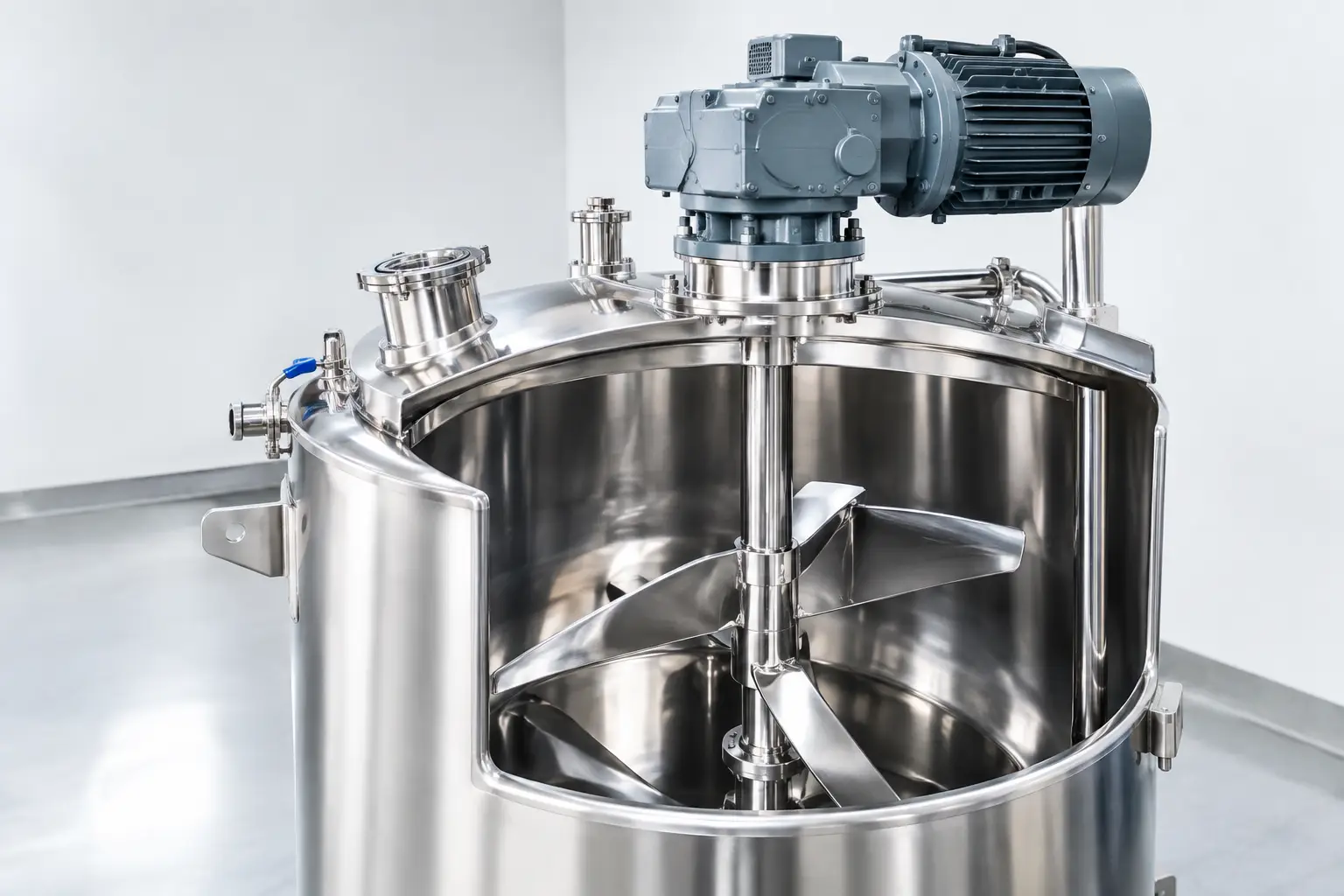
Ribbon design should match material behavior. Pitch, ribbon width, clearance, shaft diameter, and the relationship between inner and outer ribbons influence circulation and wall sweeping. For cohesive pastes, a configuration that minimizes stagnant areas is essential.
A horizontal U-shaped trough is commonly effective because it supports axial and radial movement while keeping the product within the agitator’s working zone. However, vessel dimensions and batch fill level still matter. Overfilling can limit circulation and increase power draw. Underfilling may reduce the product mass available for efficient turnover. In many applications, the optimal working volume is determined through trials rather than assumed from the vessel’s total capacity.
Wet Addition and Intensification Options
Many paste processes begin with dry ingredients and introduce liquid binders, oils, water, solvents, or active components during mixing. Spray bars, injection ports, and controlled liquid addition systems help distribute these ingredients more uniformly than manual pouring. This can reduce localized overwetting and shorten the time needed to reach a homogeneous consistency.
When wetting creates lumps, high-speed side or bottom choppers may be beneficial. They should be selected for a defined purpose, such as deagglomeration or dispersion, rather than added automatically. Choppers increase process intensity and can add heat, maintenance requirements, and energy consumption. For a paste that already moves well under ribbon action, they may not be necessary.
Discharge Design Is Part of the Mixing Decision
A paste that blends well but will not discharge efficiently is not a successful process. Discharge valves must be sized and configured for the material’s actual flow behavior. Flush-mounted bomb-bay doors, slide gates, or other engineered discharge arrangements may be appropriate depending on the batch, downstream equipment, and sanitation needs.
For highly adhesive products, gravity alone may not clear the vessel completely. Agitator-assisted discharge, temperature control, vessel slope, or downstream conveying support may be required. Product retention also matters in regulated industries, where cross-contamination, yield loss, and cleaning validation can have direct operational consequences.
When a Ribbon Mixer May Not Be the Best Choice
Ribbon mixers are versatile, but they are not a universal answer for every high-viscosity product. Extremely stiff, plastic, or putty-like materials may exceed practical ribbon mixer limits, particularly when the process requires heavy kneading, strong wall wiping, or very high shear. Materials with large sticky masses that resist bulk circulation can also call for a different mixing technology.
The same is true when the product’s key quality attribute depends on intensive dispersion rather than bulk blending. A ribbon mixer can distribute components effectively, but it may not replace equipment designed specifically for emulsification, milling, extrusion, or high-shear homogenization.
This does not mean the application is automatically unsuitable. It means the selection process should be honest about the required outcome. Is the goal to blend a cohesive batch? Wet a powder uniformly? Break agglomerates? Heat, dry, react, or vacuum-deaerate a paste? Each requirement changes the recommended machine configuration.
A Practical Evaluation Process for Paste Mixing
Before specifying equipment, gather representative information on the formulation and process. Include the full ingredient sequence, bulk density, particle characteristics, liquid addition rate, viscosity range, operating temperature, batch size, mixing time target, and cleanup method. If the paste changes materially during the batch cycle, document the thickest expected condition.
Pilot testing is particularly valuable for challenging formulations. It verifies torque demand, blend uniformity, liquid incorporation, heat generation, discharge behavior, and cleaning access before a production investment is made. Testing also helps establish a repeatable operating recipe, including fill level, speed, addition sequence, and total cycle time.
For applications requiring moisture removal, vacuum processing, or controlled thermal treatment, a vacuum ribbon mixer and dryer may offer a more efficient path than separate mixing and drying steps. Integrating functions can reduce material transfers, handling exposure, and batch time when the product and process support that approach.
PerMix engineers ribbon mixing systems around the actual material and production objective, with configurable drives, agitators, vessels, jackets, seals, controls, and discharge options. That application-specific approach helps buyers avoid selecting a standard mixer for a nonstandard paste process.
A paste application deserves more than a capacity calculation. Share representative material data and process goals with a mixing specialist early, then validate the configuration under real operating conditions. The result is a system designed not merely to turn the batch, but to deliver the consistency, uptime, and discharge performance the production line depends on.