How Does a Ribbon Mixer Work?
A batch that looks uniform on top can still fail a blend test at discharge. That is usually where the real question starts: how does a ribbon mixer work, and why does it perform well in some applications but struggle in others? For manufacturers handling powders, granules, and pastes, the answer matters because mixer design directly affects product consistency, cycle time, cleaning demands, and operating cost.
How does a ribbon mixer work in practice?
A ribbon mixer is a horizontal mixing machine built around a U-shaped trough and an agitator shaft fitted with helical ribbons. As the shaft rotates, the ribbons move material in opposing directions. The outer ribbon typically pushes product one way along the trough, while the inner ribbon moves it the opposite way. At the same time, the ribbon geometry lifts, folds, and tumbles the batch across the vessel.
That counter-flow pattern is the core of the mixing action. Instead of simply spinning material in place, the agitator creates axial and radial movement together. Product travels from one end of the trough to the other, then back again, while also being pulled from the wall toward the center and redistributed through the mass. The result is a continuous exchange of material layers that promotes a more homogeneous blend.
For many dry bulk solids and powder applications, this design offers a practical balance of mixing intensity and gentle handling. It is effective enough to break up soft agglomerates and distribute minor ingredients, but usually not so aggressive that it damages friable particles. That balance is one reason ribbon mixers remain a common choice across food, chemical, agricultural, cosmetic, and pharmaceutical production.
The core components that drive mixing performance
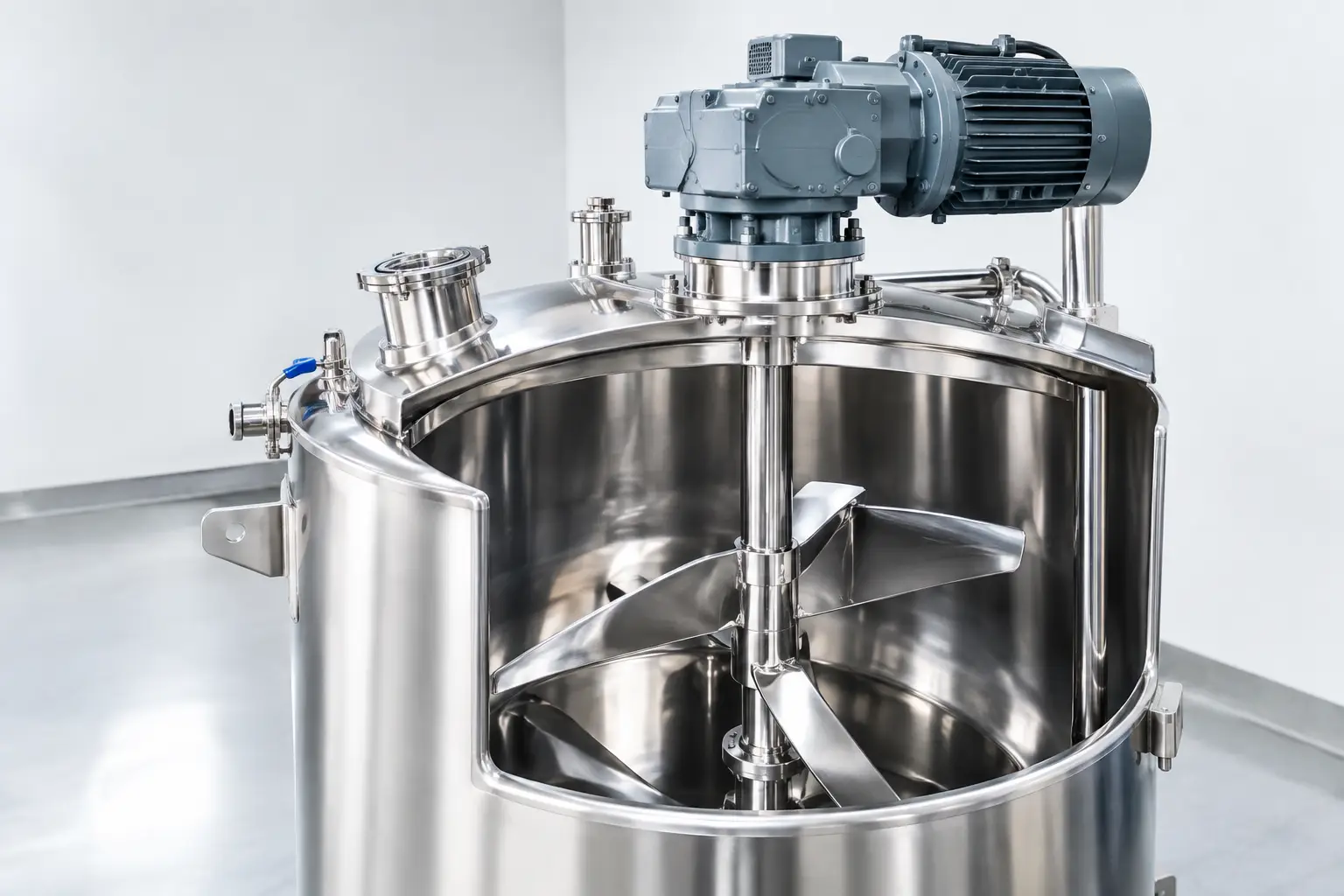
Although the operating principle is straightforward, ribbon mixer performance depends on how the machine is built. The trough holds the batch and contains the material flow pattern. Its shape supports circulation and helps limit dead zones when designed correctly.
The agitator shaft is the machine’s working center. Mounted along the horizontal axis, it carries inner and outer ribbons arranged to move product in opposite axial directions. Ribbon pitch, width, spacing, and clearance all influence how quickly material circulates and how uniformly ingredients are distributed.
Drive systems also matter. Motor size, gearbox selection, and rotational speed need to match bulk density, fill level, and material behavior. A machine that is underpowered may struggle with dense or cohesive products. One that runs too fast can generate excess heat, dusting, particle degradation, or reduced blend control.
Discharge design is equally important. A well-designed outlet allows the mixer to empty efficiently with minimal hold-up. If discharge is slow or incomplete, operators can lose productivity and face cross-contamination risk between batches.
What happens during a typical mixing cycle?
In most operations, the cycle begins with charging raw materials into the trough. Sequence matters more than many buyers expect. If low-dose ingredients, binders, or sensitive actives are added at the wrong stage, distribution may take longer or become less reliable.
Once loaded to the correct working volume, the agitator begins rotating. The ribbons pull product through the batch in overlapping flow paths. Large volumes are displaced longitudinally, while smaller localized movements fold material inward and outward. Over time, concentration differences between ingredients are reduced until the target blend uniformity is reached.
If liquid addition is required, spray nozzles may introduce oils, flavors, or binders during mixing. In that case, the mixer is not only blending solids but also helping coat particle surfaces and distribute moisture evenly. This can work very well, but it depends on spray pattern, droplet size, addition rate, and the powder’s absorption characteristics.
At the end of the cycle, the discharge valve opens and the batch exits for downstream processing. The best systems combine fast mixing with fast, clean discharge, because total batch time includes both. A mixer that blends quickly but empties poorly can still slow the line.
Why ribbon geometry matters
Not all ribbon mixers perform the same way, even when they look similar from the outside. Ribbon design has a direct effect on material flow, shear level, and blend time.
A tighter ribbon pitch may increase material movement and improve turnover in some applications. Greater ribbon-to-trough clearance can help with certain sticky products, but too much clearance may reduce efficiency and leave unmixed zones near the wall. Double-ribbon and customized agitator arrangements can also be selected based on whether the product is free-flowing, cohesive, abrasive, heat-sensitive, or prone to segregation.
This is where application-specific engineering becomes important. Fine powders with poor flow behavior need a different approach than dense mineral blends or fragile food inclusions. The right mixer is not simply the one with the largest motor or fastest shaft speed. It is the one configured for the actual product and process target.
Material characteristics can change the answer
When buyers ask how does a ribbon mixer work, the most accurate response is that it depends partly on what you are mixing. Free-flowing powders usually circulate easily and blend predictably. Cohesive materials may resist movement and require different ribbon clearances, choppers, or longer cycle times.
Bulk density also affects performance. Lightweight products can fluidize or dust if agitation is too aggressive, while heavy products place greater load on the drive system. Particle size distribution matters as well. If the batch contains components with major differences in size, shape, or density, segregation can occur during charging, mixing, or discharge.
Paste and slurry-like applications introduce another layer of complexity. Ribbon mixers can handle certain viscous materials effectively, especially when designed for heavier-duty processing, but viscosity influences power demand and wall build-up. In these cases, a standard configuration may not be enough.
Where ribbon mixers perform best
Ribbon mixers are widely used because they are versatile. They are especially effective for dry powder blending, solid-solid mixing, and applications that require the addition of small percentages of liquid. They also work well for batch processes where repeatability and moderate cycle times are priorities.
In regulated industries, consistent blend quality and cleanability are often just as important as throughput. Stainless steel construction, sanitary finishes, access doors, and appropriate discharge valves all contribute to reliable production. In more demanding process environments, vacuum ribbon mixers and ribbon dryers can combine blending with drying or solvent removal, helping plants reduce handling steps.
That said, ribbon mixers are not the perfect solution for every product. Extremely heat-sensitive materials, highly fragile particles, or applications requiring very high shear may call for a different mixing technology. A dependable equipment partner should say that clearly rather than force a generic recommendation.
Operational advantages for industrial plants
A properly selected ribbon mixer offers more than blend uniformity. It can support shorter batch cycles, lower energy use, reduced operator intervention, and predictable scale-up from pilot to production. Those are not minor benefits. They directly affect line efficiency, labor cost, and product quality risk.
Maintenance is another practical consideration. Durable construction, accessible seals, reliable bearings, and straightforward cleaning access help reduce downtime over the life of the machine. For plants running multiple recipes, changeover time can be as important as mixing time itself.
Customization also has real operational value. Controls, jacketed troughs, vacuum capability, wear-resistant materials, and sanitary design features allow the mixer to match the process instead of forcing the process to adapt to the machine. That is often where long-term return on investment is won.
Choosing the right ribbon mixer for the job
The best buying decisions start with the process, not the catalog. Batch size, fill level, bulk density, ingredient sensitivity, required uniformity, liquid addition, cleanability standards, and discharge expectations all need to be defined early.
Horizontal ribbon mixers are the standard choice for many powder and granule applications because they offer efficient batch blending and reliable discharge. Vertical ribbon mixers may suit operations with different space or handling requirements. Vacuum ribbon mixers and dryers are often selected when blending must be combined with thermal or reduced-pressure processing.
For technical buyers, the main question is not only how the machine mixes. It is how consistently it will mix your material under real production conditions, shift after shift. That is why engineered testing, configuration review, and supplier expertise matter. PerMix approaches ribbon mixing as a process solution, with machine designs tailored to the material behavior, throughput target, and operating environment.
A ribbon mixer works by creating controlled, opposing material flow that continuously folds the batch into itself. The better question for a production team is whether that mixing action has been matched to the product, the plant, and the standard the batch has to meet every time.