Powder Segregation During Mixing Explained
A batch can test perfectly at the mixer discharge and still fail downstream. That is what makes powder segregation during mixing such a persistent production problem. For processors working with fine powders, granules, or blended dry ingredients, segregation is not just a quality issue. It affects yield, rework, compliance, dosing accuracy, and line efficiency.
The challenge is that segregation rarely has a single cause. Material properties, mixer geometry, fill level, cycle time, loading sequence, and discharge behavior all play a role. If the process is not matched to the product, even a well-built system can produce inconsistent results. The right response is not guessing at one variable. It is understanding how and where separation happens, then selecting equipment and operating conditions that keep the blend stable.
What causes powder segregation during mixing?
Powder segregation occurs when particles with different characteristics separate instead of remaining uniformly distributed. In most industrial applications, the main drivers are differences in particle size, density, shape, and flow behavior. A free-flowing coarse material moves differently than a fine, cohesive powder. A dense ingredient may settle while a lighter component remains near the top. Rounded particles can roll to areas that irregular particles do not reach as easily.
Segregation can begin before the mixer starts. Ingredient transfer from bags, bins, or pneumatic systems may already create stratification in the feed. It can continue during blending if the mixer creates movement that encourages separation rather than controlled intermixing. It can also happen after the blend is technically complete, especially during discharge, conveying, or hopper filling.
That is why operators sometimes assume the mixer failed when the real issue occurred upstream or downstream. In practice, powder segregation during mixing is often a full-system problem, not just a vessel problem.
Why blend uniformity breaks down
A common misconception is that more mixing time always improves uniformity. In reality, some formulations reach an optimum mixing point and then begin to separate if agitation continues. This is especially true when ingredients vary significantly in size or density. Once the material is blended, continued movement may allow particles to migrate into preferred zones.
Fluidization is another factor. If powders become overly aerated during loading or blending, fine particles may rise while heavier particles settle. In high-throughput environments, this can happen quickly and repeatedly from batch to batch. Vibration from nearby equipment can make it worse.
Discharge design matters as well. A blend that looks uniform inside the mixer may segregate as it leaves through a small outlet, drops into a tote, or moves across a screw conveyor. Funnel flow in receiving containers often causes coarse or dense particles to concentrate in specific regions. The result is a blend that is only uniform in theory.
Material properties that deserve close attention
When a plant is troubleshooting inconsistent blend quality, the first step should be a close look at the material itself. Particle size distribution is usually the starting point, but it is not the only issue. Bulk density, moisture content, surface texture, electrostatic behavior, and friability all affect how particles move.
Fine powders can fill void spaces between larger particles, which may help stability in some formulations. In other cases, the same fines can separate because they aerate easily or cling to equipment surfaces. Brittle ingredients add another layer of complexity. If particles break during mixing, the blend changes while it is being processed. What started as a manageable size distribution may become far more segregation-prone by the end of the cycle.
This is why a standard mixer selection based only on batch volume is often not enough. The application has to be evaluated based on how the product behaves under motion, not just how much material needs to be processed.
How mixer design influences segregation risk
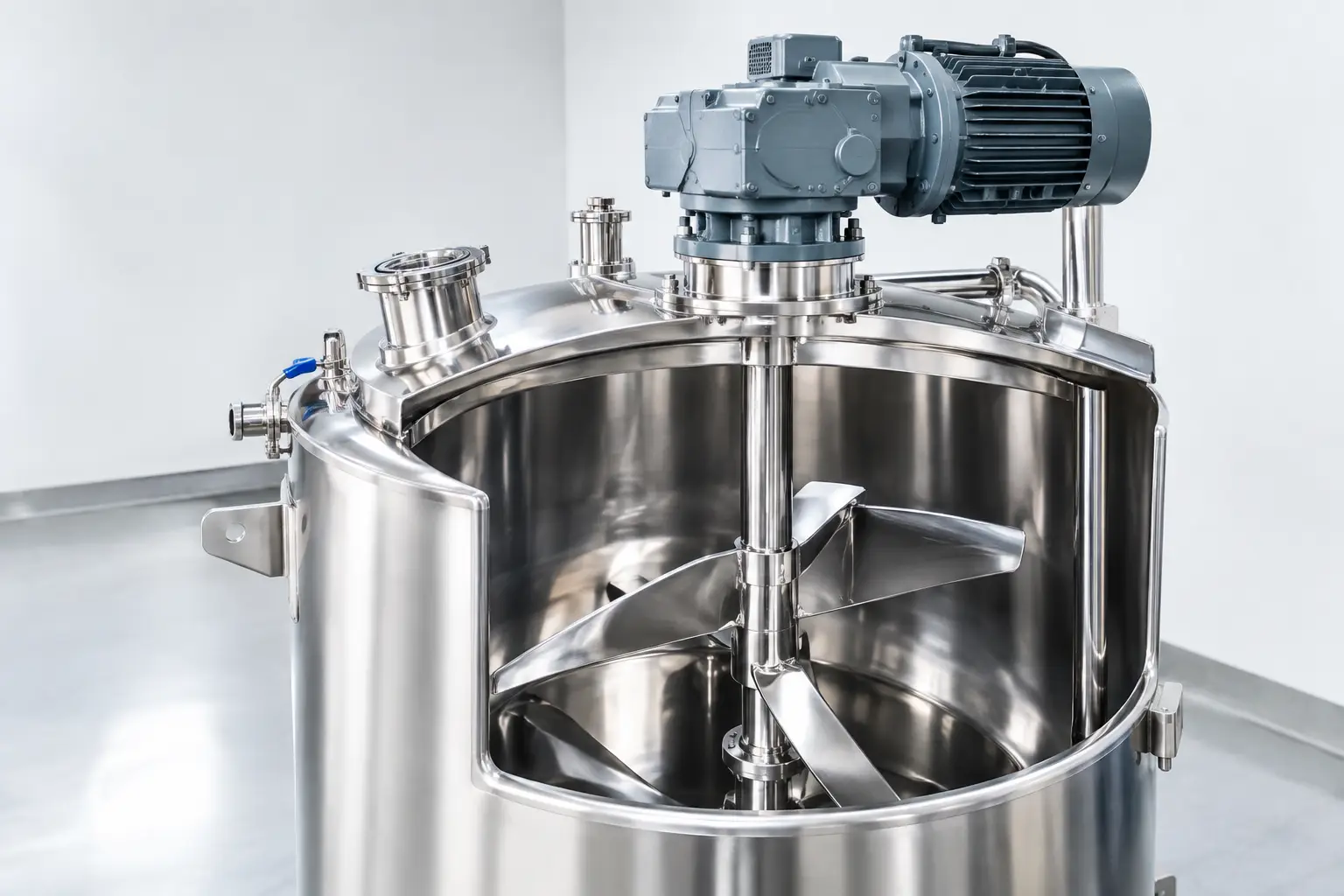
Mixer design has a direct impact on whether powders are gently blended, aggressively circulated, or unintentionally separated. Ribbon mixers are widely used because they create efficient convective movement across the vessel while supporting fast, repeatable batch cycles. When configured correctly, they offer strong performance for many powder and granule applications that require consistent homogenization without excessive shear.
That said, the phrase correctly configured is important. Ribbon geometry, shaft speed, trough design, fill level, and discharge arrangement all affect the flow pattern inside the mixer. If the design generates dead zones, over-fluidizes the product, or applies unnecessary mechanical energy, segregation risk can increase instead of decrease.
For example, a horizontal ribbon mixer can be highly effective for formulations that benefit from controlled, balanced movement across the entire batch. A vertical ribbon design may be better suited for applications with specific space constraints or product handling needs. Vacuum ribbon systems can add process value where drying, solvent removal, or closed processing conditions are required. The right choice depends on the material and the production objective, not on a one-size-fits-all assumption.
Process variables that often make the difference
In many plants, the equipment is capable, but the operating window is too loose. Fill level is a frequent issue. Underfilled mixers may not generate enough particle interaction for reliable blending, while overfilled mixers can restrict movement and create localized separation. The ideal working volume depends on the mixer design and the product characteristics.
Ingredient addition order is another major factor. Adding low-percentage actives, fine ingredients, or density-sensitive components at the wrong stage can make uniform distribution harder to achieve. Premixing a minor ingredient with a compatible carrier often improves dispersion and reduces the chance of localized concentration.
Cycle time should be validated rather than estimated. Too short, and the batch never reaches target uniformity. Too long, and the process may move into re-segregation. Rotor speed also deserves attention. Higher speed is not automatically better. In many powder applications, controlled movement produces a more stable result than aggressive agitation.
How to reduce powder segregation during mixing
The most effective way to reduce segregation is to treat it as a design and process control issue from the start. That means matching the mixer to the formulation, validating the operating range, and looking beyond the blending step alone.
A practical strategy usually includes evaluating particle size and density differences early, then selecting a mixer that promotes full-batch circulation without overworking the product. It also means controlling feed consistency, minimizing unnecessary drop heights, and designing discharge and downstream handling to preserve the blend that the mixer creates.
For difficult formulations, testing is essential. Small changes in ribbon design, internal clearances, liquid addition method, or discharge valve configuration can produce meaningful improvements. Processors that work with regulated ingredients or tight potency tolerances should be especially cautious about assuming that visual uniformity reflects true content uniformity.
PerMix approaches these applications as engineered mixing problems rather than catalog selections. That mindset matters when the cost of segregation includes rejected product, compliance exposure, and lost production time.
When segregation is a material problem, not an equipment problem
Not every formulation can be fully stabilized by mixer design alone. Some products are inherently prone to separation because the ingredient differences are too extreme. Large particle size gaps, very low-dose actives, or combinations of free-flowing and cohesive materials can push even a well-designed process toward inconsistency.
In those cases, the best solution may involve modifying the formulation, tightening raw material specifications, adding a granulation step, or changing the downstream transfer method. This is where technical consultation becomes valuable. A supplier focused on industrial mixing should be able to identify when the mixer can solve the issue and when the process needs broader adjustment.
That kind of honesty saves time. It also helps buyers avoid oversimplified claims that promise uniformity without addressing the actual physics of the product.
What industrial buyers should ask before selecting a mixer
If powder segregation has already created quality problems, the equipment review should go beyond horsepower and capacity. Buyers should ask how the mixer handles differences in density and particle size, what fill range it supports, how discharge is managed, and whether the design has been applied to similar materials.
It is also worth asking how the system will be tested. Blend time, sampling method, cleanout requirements, and scale-up approach all affect real production performance. A mixer that performs well in theory but cannot maintain repeatability under plant conditions will not deliver the business outcome you need.
The best equipment decision is usually the one grounded in application data, realistic operating conditions, and a clear understanding of where segregation actually occurs. That is how manufacturers protect product quality while also reducing downtime, waste, and operator intervention.
Powder blending works best when material behavior, equipment design, and process control are aligned. If your batches are separating, the answer is usually not more mixing. It is a better-matched mixing solution and a process built to keep the blend intact from loading to discharge.