Best Sanitary Mixers for Food Processing
A food mixer can deliver an acceptable blend and still create a sanitation problem. Residue trapped beneath a shaft seal, a rough weld in the product zone, or an inaccessible discharge valve can extend cleaning time, raise cross-contact risk, and reduce available production hours. The best sanitary mixers for food are therefore selected for more than blend uniformity. They must match the product’s behavior while supporting repeatable cleaning, reliable operation, and the facility’s food safety program.
For dry powders, seasoning blends, bakery premixes, nutritional products, pet food ingredients, and wet food pastes, the right mixer design depends on density, particle size, moisture level, fat content, batch volume, and cleaning requirements. A well-specified sanitary system improves product consistency without creating unnecessary complexity or operating cost.
What Makes a Food Mixer Truly Sanitary?
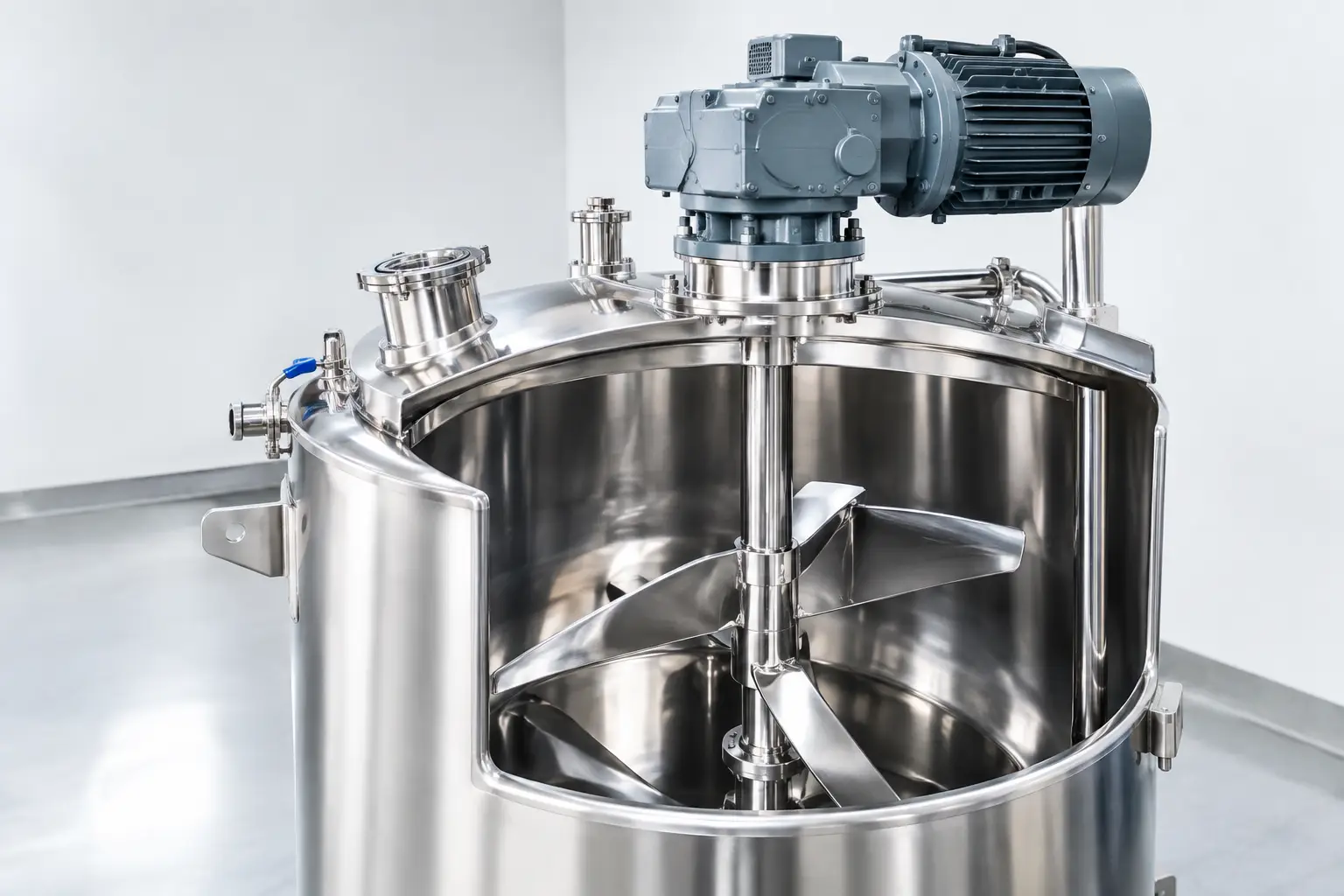
Sanitary construction begins with the product-contact surfaces. Food-grade stainless steel, typically 304 or 316 stainless depending on the product and cleaning chemistry, provides corrosion resistance and a cleanable surface. But material selection alone does not make a mixer sanitary. Surface finish, weld quality, drainability, seal design, access points, and valve geometry determine whether a mixer can be cleaned and inspected effectively.
A sanitary food mixer should be designed to minimize cracks, crevices, ledges, and dead zones where material can accumulate. Continuous welds should be properly finished, and internal surfaces should be smooth enough to prevent stubborn product adhesion. This matters especially in applications using sugar, salt, dairy powders, cocoa, flavors, oil-based ingredients, or allergen-containing materials.
Cleanability must also reflect the plant’s actual operating method. Some food processors require dry cleaning between batches, while others need wet washdown, clean-in-place (CIP) capability, or more demanding hygienic protocols. A mixer intended for frequent wet cleaning needs appropriate seals, electrical protection, drainage, and internal geometry. A dry blending line may benefit more from fast access, quick changeover, and minimal residual material at discharge.
Best Sanitary Mixers for Food: Match the Design to the Product
There is no single mixer that is best for every food application. The best choice is the one that delivers the required blend quality at the lowest practical risk of degradation, segregation, contamination, and downtime.
Horizontal Ribbon Mixers for Free-Flowing Powders and Blends
Horizontal ribbon mixers are a strong choice for many food powder applications. Their inner and outer helical ribbons move material in opposing directions, creating a balanced circulation pattern across the mixing trough. This configuration is widely used for spice blends, flour-based mixes, seasoning systems, dry beverage powders, nutritional formulations, cereal ingredients, and dry pet food additives.
For a properly matched product, a ribbon mixer delivers fast, homogeneous blending with relatively low energy demand. It can also handle moderate additions of liquids, oils, flavors, or colors when the system includes an effective spray bar and distribution arrangement. The horizontal layout provides a practical footprint and allows for large batch capacities.
The trade-off is that ribbons are not automatically the best solution for every material. Highly fragile particles may experience damage if mixing speed or cycle time is excessive. Very cohesive pastes can also demand greater torque and a different agitator geometry. Sanitary ribbon mixer specifications should address the finish of the trough and ribbons, end clearances, shaft seal configuration, full-discharge valve design, and access for inspection and cleaning.
Paddle Mixers for Gentle Blending and Variable Formulations
Where particle integrity is a priority, a paddle mixer may be the better sanitary option. Paddle agitation typically creates a fluidized mixing action that can blend fragile inclusions, coated particles, snack components, and low-density ingredients with less mechanical stress than some ribbon configurations.
Paddle mixers also work well when formulations vary significantly from batch to batch. Their open agitator design can offer good visibility and accessibility, which is valuable when operators must verify cleaning between allergen changeovers. Depending on the product, a paddle mixer may produce faster mixing with less risk of breaking sensitive ingredients.
However, the best result depends on fill level and material flow. Extremely fine powders, sticky ingredients, or formulations requiring intensive shear may not perform as efficiently in a paddle mixer without application-specific testing. Selecting between ribbons and paddles should be based on the actual recipe, not a general preference for one design.
Vertical Mixers for Space-Constrained Food Operations
Vertical mixers are often considered when floor space is limited or when a process benefits from a compact, upward mixing pattern. They can be suitable for certain powder blends, granular foods, and applications requiring vertical conveying within the vessel.
Their main advantage is footprint efficiency. A vertical system may fit more easily into a facility where horizontal floor space is restricted, while still supporting substantial batch volume. Some products also benefit from the lower shear associated with a carefully designed vertical mixing process.
Still, vertical mixers are not always the simplest sanitation choice. Access, cleaning verification, and discharge performance need close review, particularly for cohesive powders or recipes that leave residue on vessel walls. For food processing, the mixer should provide practical access to all product-contact areas and a discharge arrangement that avoids retained material.
Vacuum Ribbon Mixers and Dryers for Moisture-Sensitive Products
Vacuum ribbon mixers and dryers bring mixing, drying, and vacuum processing into one controlled vessel. They are particularly useful for food ingredients that require moisture reduction, low-temperature processing, deaeration, or controlled incorporation of liquids into powders.
This configuration can reduce product transfers and limit exposure to ambient humidity. For high-value nutritional ingredients, specialty powders, flavor systems, and heat-sensitive products, combining processing steps can improve handling efficiency and product control. A vacuum-capable system must be engineered with sanitary seals, cleanable vacuum connections, suitable heating or cooling surfaces when required, and controls that protect the product from overprocessing.
The investment is higher than a standard batch mixer, so the value case is strongest when vacuum functionality eliminates separate process equipment or solves a clear quality issue. It is not the right answer for a basic dry blend that can be produced efficiently in a conventional sanitary ribbon mixer.
Sanitary Features That Affect Daily Plant Performance
The most useful sanitation features are the ones that reduce real labor, reduce inspection uncertainty, and support reliable releases between production runs. When evaluating a mixer, review the entire product path rather than only the vessel body.
Start with the discharge. A poorly designed outlet can retain a meaningful amount of product, causing yield loss and increasing cross-contact concerns. Full-bore, sanitary discharge valves help promote complete emptying and simplify cleaning. The valve must also be easy to inspect and maintain.
Shaft seals deserve equal attention. They operate at a critical boundary between the product zone and the drive system. The correct seal depends on product abrasiveness, operating pressure, cleaning method, and temperature. Food manufacturers should confirm that seals can be serviced without excessive downtime and that their design does not create an area where product can pack and degrade.
Access doors and covers should provide sufficient entry for inspection and manual cleaning, while maintaining safe, repeatable closure. For CIP applications, spray devices and piping should be positioned to clean the vessel, agitator, cover, and discharge area effectively. CIP is not a label to accept without review. Coverage, flow rate, cleaning chemistry, drainability, and validation requirements must be considered for the specific mixer configuration.
Specify the Mixer Around the Process, Not Just the Capacity
Batch capacity is a starting point, but it is not enough to define a food mixing system. A 2,000-pound batch of free-flowing seasoning behaves very differently from a 2,000-pound batch of hygroscopic beverage powder or oil-coated protein ingredients. Bulk density determines usable vessel volume, while ingredient addition sequence can affect both blending time and cleaning requirements.
Plant teams should also consider upstream and downstream equipment. The mixer must accept ingredients efficiently, whether through manual bag dumping, bulk bag unloading, pneumatic conveying, or automated dosing. After blending, it must discharge consistently into packaging equipment, storage hoppers, conveyors, or subsequent processing stages. A high-performing mixer can become a production bottleneck if the surrounding material-handling system is not matched to its cycle time.
Controls should support the operation rather than complicate it. Recipe management, timed mixing cycles, variable speed drives, load monitoring, liquid addition control, and safety interlocks can improve repeatability. The appropriate level of automation depends on batch frequency, formula complexity, traceability expectations, and the skills available on the production floor.
Build Sanitation Into the Equipment Decision
Food manufacturers often evaluate mixers after a problem appears: inconsistent seasoning distribution, residual material after discharge, excessive cleaning labor, or delays during allergen changeover. A better approach is to evaluate blend performance and sanitation together during equipment selection.
PerMix supports this process with configurable ribbon mixing systems designed around material characteristics, processing objectives, and facility requirements. The most productive next step is to define the recipe range, required batch sizes, cleaning method, allowable residuals, and target cycle time before finalizing the agitator, vessel, discharge, and control package. That level of specification turns a mixer purchase into a dependable production asset rather than another variable in the food safety plan.