Horizontal vs Vertical Ribbon Mixer
When comparing a horizontal vs vertical ribbon mixer, the wrong choice usually shows up fast on the plant floor. Blend times stretch, discharge leaves residue behind, fragile ingredients break down, or operators end up working around a machine that does not fit the process as well as it looked on paper. For manufacturers handling powders, granules, or pastes, mixer orientation is not a minor detail. It directly affects throughput, consistency, cleaning time, and operating cost.
Horizontal vs Vertical Ribbon Mixer: What Changes in Practice?
Both designs use ribbon agitation to move material and improve blend uniformity, but they do it in different vessel geometries. That geometry changes how product circulates, how quickly a batch mixes, how the machine loads and unloads, and how much floor or ceiling space the installation requires.
A horizontal ribbon mixer uses a U-shaped trough with a horizontal shaft and double helical ribbons. The inner and outer ribbons move product in opposing directions, creating a balanced convective mixing pattern across the full batch. This configuration is widely used when processors need fast, repeatable blending with efficient discharge and strong performance across a broad range of dry solids and some paste-like materials.
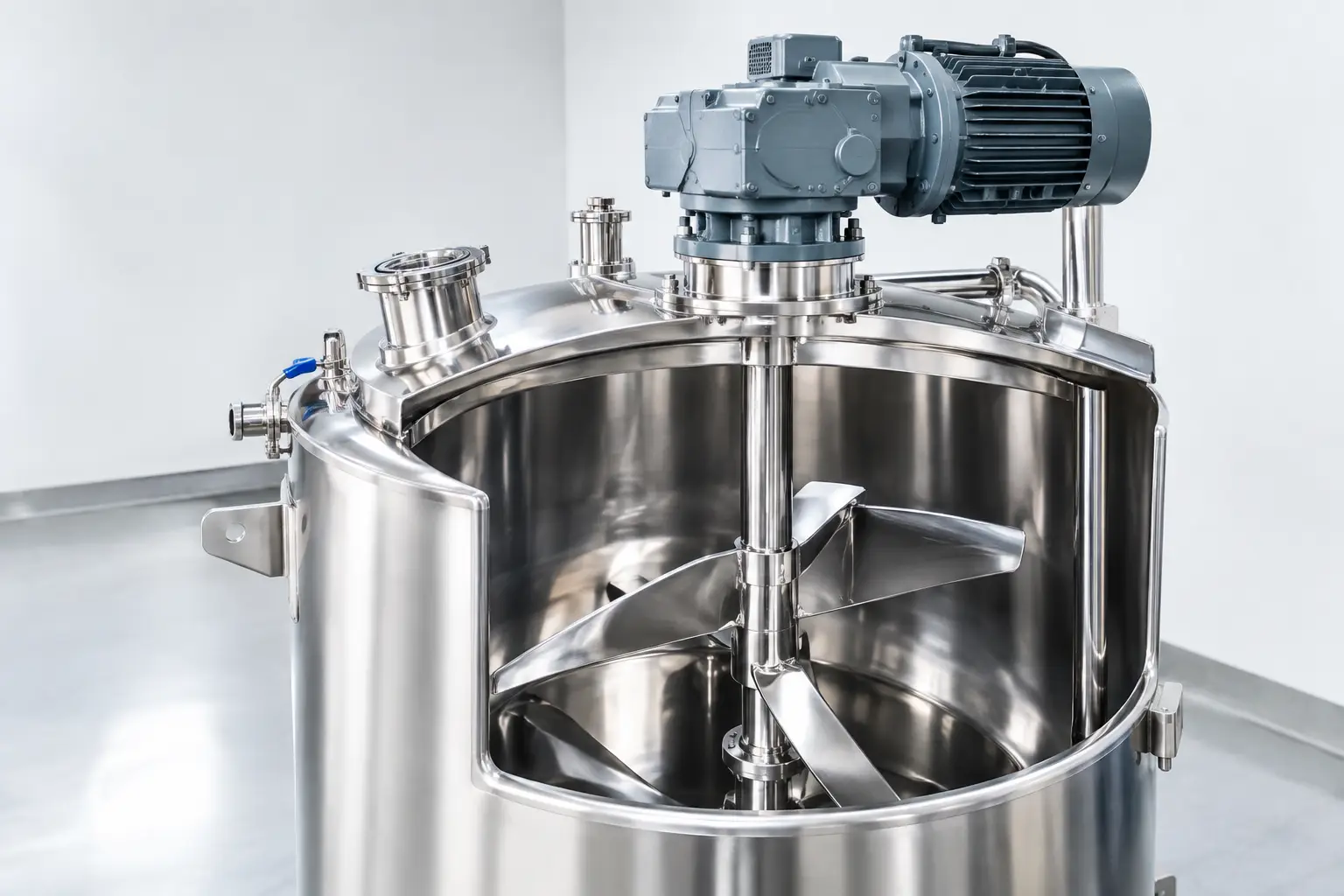
A vertical ribbon mixer uses a vertical vessel with a ribbon agitator that lifts material upward and allows it to recirculate downward by gravity. This layout can be attractive when floor space is limited, when a smaller footprint matters, or when a process benefits from vertical material movement. It can also support certain products that need gentler handling, depending on the formula and operating parameters.
The better option depends less on theory and more on your material behavior, batch target, sanitation needs, and how the mixer fits into the rest of the line.
How Horizontal Ribbon Mixers Perform
Horizontal ribbon mixers are often the first choice in high-throughput manufacturing because they deliver a strong combination of mixing speed, batch consistency, and discharge efficiency. In a well-designed unit, the ribbon assembly continuously moves material both radially and laterally, reducing dead zones and producing a uniform mix in relatively short cycle times.
That matters in sectors such as food, chemicals, plastics, and agriculture, where batch repeatability is tied directly to product quality and production planning. If you are running frequent recipe changes or large volumes, the ability to mix thoroughly and discharge quickly can make a measurable difference in daily output.
Another practical advantage is accessibility. Horizontal machines are generally easier to configure for side discharge, bottom discharge, spray addition, choppers, jackets, vacuum operation, and other process-specific features. For manufacturers that need more than basic dry blending, that flexibility can be decisive.
There are trade-offs. Horizontal ribbon mixers take up more floor space than vertical designs, and for some installations, that footprint can create layout constraints. Depending on the material, they may also require closer attention to seal design, cleanout access, and residual hold-up if sanitation standards are strict and product changeovers are frequent.
How Vertical Ribbon Mixers Perform
Vertical ribbon mixers approach the blending task from a different mechanical angle. Material is lifted through the vessel and allowed to cascade back down, creating circulation with less horizontal spread. The obvious benefit is space efficiency. A vertical mixer occupies a smaller footprint, which can help in facilities where floor area is limited or where equipment must fit into a tighter processing cell.
Vertical designs can also be useful for certain lower-density materials or applications where a gentler recirculating motion is preferred. In some plants, they serve well for specialized formulations, moderate batch volumes, or installations where feeding and storage are already organized around vertical equipment.
The limitations are just as important to evaluate. Vertical ribbon mixers may not match horizontal units on discharge speed or complete evacuation, especially when the product is cohesive, sticky, or difficult flowing. Cleaning access and maintenance can also vary by design and become more complex in taller vessels. If your process depends on rapid turnover between batches, those factors should be weighed carefully.
Mixing Performance Is Only Part of the Decision
A common mistake in the horizontal vs vertical ribbon mixer comparison is focusing only on whether both machines can create a uniform blend. In many cases, both can. The more useful question is how they achieve that result under your actual operating conditions.
If your process runs large batches of free-flowing powders and values short cycle times, a horizontal ribbon mixer often delivers a stronger business case. It supports efficient loading, reliable convective mixing, and faster discharge, which helps reduce idle time between batches.
If your process is constrained by building layout, lower throughput demands, or a need for a compact system, a vertical ribbon mixer may be the better fit. The smaller footprint can offset some of the performance compromises if space is the limiting factor.
This is why application review matters. Ingredient bulk density, particle size distribution, moisture content, fill level, and additive sequence all influence which orientation will perform better. A mixer that looks suitable by volume alone can underperform if the product tends to bridge, smear, segregate, or resist clean discharge.
Key Factors to Compare Before You Buy
Batch size and throughput
Horizontal ribbon mixers are typically better suited for medium to large batch production where time per cycle affects plant capacity. Vertical mixers can serve lower-output applications effectively, but they may become less attractive when every extra minute of mixing or discharge limits throughput.
Material characteristics
Free-flowing powders, granules, and many bulk solids respond well to horizontal ribbon action. Products that are fragile, irregular, or sensitive to compaction may require closer testing in either design. Sticky or cohesive materials often expose differences in cleanout and discharge performance quickly.
Discharge requirements
If near-complete discharge is important for yield, allergen control, or product changeover, horizontal mixers usually offer an operational advantage. Vertical systems can work well, but discharge behavior is more dependent on product flow properties and outlet design.
Footprint and installation
Vertical mixers win on floor space. Horizontal mixers generally need more room across the floor but less height. In retrofit projects, the physical constraints of the building can make this decision for you before process performance is even considered.
Cleaning and maintenance
Neither design should be judged by appearance alone. Access doors, surface finish, weld quality, shaft seals, and internal geometry all affect sanitation and uptime. For regulated industries, these details carry more weight than orientation by itself.
Customization potential
Many industrial applications need more than standard blending. Liquid addition, heating or cooling, vacuum operation, wear-resistant construction, and explosion protection can all shape the final specification. Horizontal designs often provide broader configuration options, especially in demanding process environments.
Which Mixer Fits Which Industry?
In food processing, horizontal ribbon mixers are often preferred for seasonings, dry blends, baking mixes, and other applications where uniformity and fast batch turnover matter. Vertical mixers may still be appropriate in facilities with limited floor space or specific product handling requirements.
In pharmaceuticals and fine chemicals, the decision is more nuanced. Product sensitivity, validation protocols, containment, and cleaning standards may outweigh simple throughput targets. A horizontal ribbon mixer can offer strong performance, but only if the design is aligned with sanitary construction and process control requirements.
In plastics, minerals, and agriculture, where larger batches and dense bulk solids are common, horizontal ribbon mixers frequently deliver better productivity. Their mixing intensity and discharge behavior tend to support continuous production schedules more effectively.
The Best Choice Is Usually the One That Solves the Bottleneck
If your current issue is inconsistent blending, a horizontal unit may improve circulation and reduce batch variation. If the real problem is an overcrowded production area, a vertical mixer could be the more practical investment. If cleaning downtime is the cost driver, the answer may come down to discharge geometry, access design, and finish quality rather than mixer orientation alone.
That is why experienced buyers look beyond brochure categories. They evaluate the full process – how raw materials enter the mixer, how long the batch must run, what level of homogeneity is acceptable, how product exits, and how quickly the machine can be prepared for the next run. The right specification protects not only blend quality but also labor efficiency, maintenance planning, and total operating cost.
At PerMix, that selection process is treated as an engineering decision, not a generic equipment sale. A properly matched ribbon mixer should support superior mixing performance, dependable operation, and a more sustainable cost profile over the long term.
If you are weighing a horizontal vs vertical ribbon mixer, the smartest next step is not to ask which type is better in general. Ask which design best fits your material, your plant constraints, and the production results your operation has to deliver every day.