Conical Blender Versus Ribbon Mixer Compared
A mixer that produces a uniform blend in a pilot batch can become a production bottleneck when batch sizes, ingredient ratios, or discharge requirements change. The conical blender versus ribbon mixer decision is therefore not simply a choice between two vessel shapes. It is a process decision that affects blend consistency, cycle time, sanitation, energy use, and the practical cost of operating the line.
Both mixer types can produce high-quality blends when matched to the material and application. Their working principles, however, are fundamentally different. A conical blender relies primarily on gentle tumbling and gravity-driven movement. A horizontal ribbon mixer uses a dual helical agitator to create controlled axial and radial material movement throughout the batch. The right choice depends on what the material needs, not on a single claim about which design is better.
Conical Blender Versus Ribbon Mixer: The Core Difference
A conical blender, often called a cone blender or double-cone blender, rotates a vessel containing the batch. As the vessel turns, material divides, recombines, and cascades through the blender. This low-shear action can be effective for free-flowing powders and granules that must retain particle shape or minimize attrition.
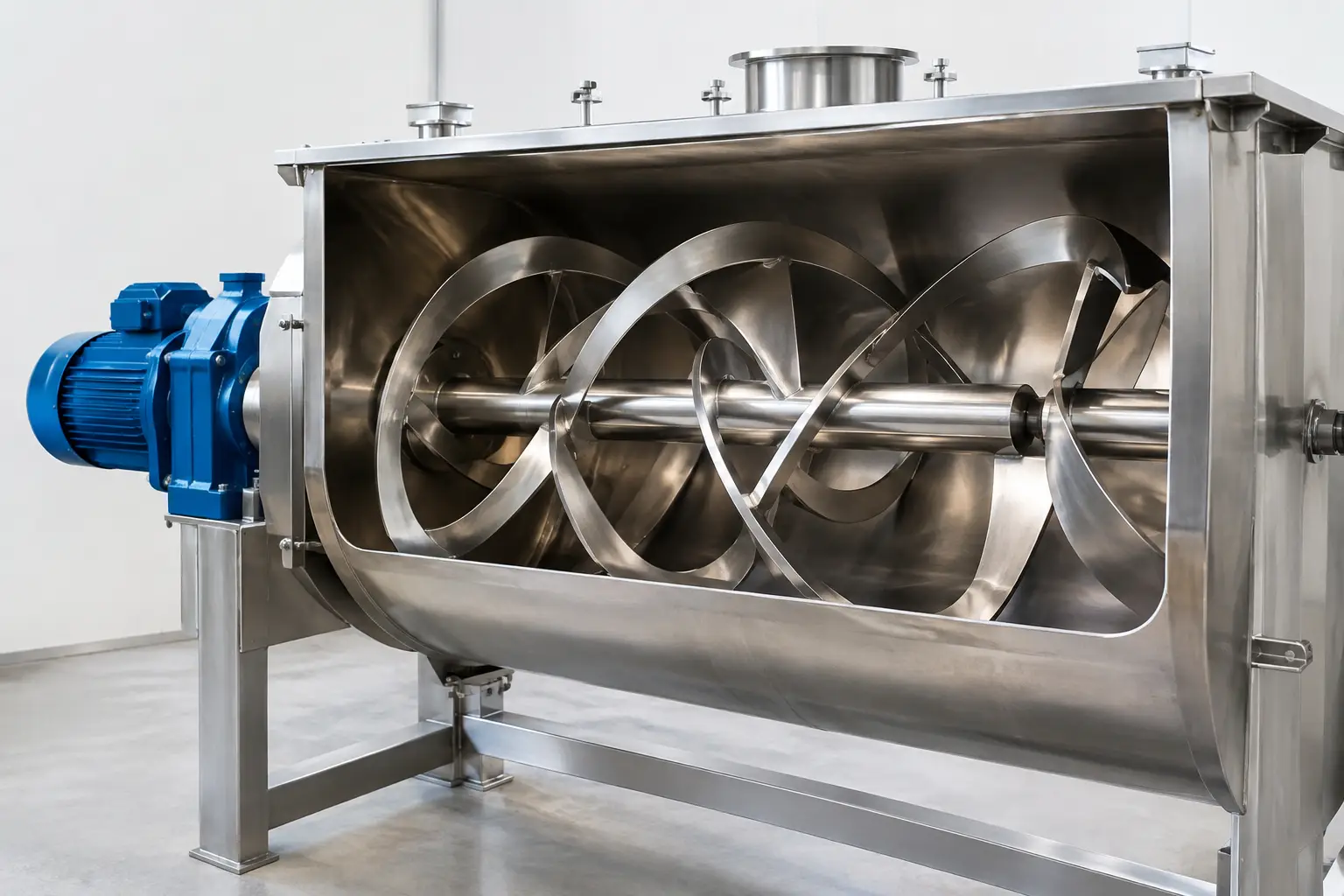
A ribbon mixer operates differently. It uses inner and outer helical ribbons mounted on a horizontal shaft within a U-shaped trough. The outer ribbon typically moves material from the ends toward the center, while the inner ribbon moves it from the center toward the ends. This opposing movement produces a more active mixing pattern that continuously redistributes material across the length and depth of the vessel.
That distinction has operational consequences. Conical blenders are often selected when gentle handling and low power draw are the priority. Ribbon mixers are frequently selected when a plant needs fast, repeatable blending across a wider range of bulk densities, particle sizes, and product consistencies.
Blend Quality Depends on Material Behavior
For a free-flowing dry blend with components of similar particle size and bulk density, either mixer may achieve the required uniformity. In those cases, validation testing, batch size, and cleaning requirements often determine the better investment.
The comparison becomes more decisive when materials differ significantly. Fine powders, ingredients with varying bulk densities, minor additions, and formulations that include oils or liquid binders can challenge a tumble-based blending process. A rotating vessel may not create enough active movement to break up soft agglomerates or distribute a small-volume liquid addition evenly without extending the cycle.
Ribbon mixers provide more mechanical interaction with the product. That added action supports the dispersion of minor ingredients and the incorporation of liquids into dry solids. It can also help process materials that are less free-flowing, slightly cohesive, or prone to bridging. For powders, granules, pastes, and many damp formulations, the ribbon design offers a practical range that is difficult for a conventional conical blender to match.
More agitation is not automatically an advantage. Fragile crystals, coated particles, and highly friable granules may be damaged by unnecessary mechanical action. When product integrity depends on exceptionally gentle handling, a conical blender deserves serious consideration. The decision should be based on measurable product attributes, including particle degradation, segregation tendency, moisture content, and acceptable blend variation.
Batch Time and Production Throughput
A short mixing cycle is valuable only when it produces a verified homogeneous blend. Still, cycle time is one of the clearest differences between these machines in many applications.
Conical blenders generally require enough rotations to create repeated material division and recombination. For readily flowing products, that may be entirely acceptable. For more difficult blends, the required mixing time can increase, especially when the formulation includes a low-dose active ingredient or a liquid addition.
Ribbon mixers are designed for active material circulation. Their mixing action can often achieve uniformity in shorter processing times for demanding powder blends. Faster blend cycles can increase batches per shift, reduce work-in-process inventory, and improve the return on a mixer that is already a critical part of the production schedule.
Throughput should be evaluated as a complete cycle, not only the agitation period. Consider loading time, mixing time, discharge time, cleaning time, and the time required to prepare the machine for the next product. A ribbon mixer with a properly designed discharge valve can empty efficiently, helping reduce retained product and shortening changeovers. For high-volume production, these details often have more financial impact than a small difference in motor horsepower.
Handling Liquids, Pastes, and Difficult Powders
The formulation itself should lead the equipment discussion. Conical blenders are best suited to materials that flow and redistribute naturally during vessel rotation. They can be a sound solution for dry, low-shear blending, but their capabilities are more limited as product cohesiveness rises.
Ribbon mixers are commonly used for dry powders, granules, moist solids, and paste-like products. Liquid spray bars, choppers, heating or cooling jackets, vacuum capability, and specialized agitator configurations can expand their range further. A properly engineered ribbon mixer can support applications such as seasoning blends, chemical premixes, polymer compounds, agricultural formulations, cosmetic powders, and pharmaceutical intermediates.
For liquid addition, distribution matters as much as volume. Adding a small amount of oil, flavoring, binder, or active solution to a large powder batch requires enough material movement to prevent localized wet spots. A ribbon mixer can be configured with liquid injection points positioned to support even dispersion while the ribbons circulate the batch.
When processing paste, sludge, or highly viscous material, the equipment selection may move beyond a standard ribbon configuration. A heavy-duty mixer, paddle design, or custom agitator may be more appropriate. An experienced manufacturer should assess viscosity, fill level, particle characteristics, temperature requirements, and discharge behavior before recommending a final design.
Cleanability, Containment, and Maintenance
Sanitary and regulated facilities must evaluate more than mixing performance. The mixer must also support practical cleaning, inspection, containment, and validation.
A conical blender has a relatively simple internal vessel, which can be an advantage for some cleaning procedures. However, the rotating vessel and its support structure can require substantial floor space and careful attention to access, charging, and discharge arrangements. Depending on the installation, the blender may also need to be integrated with lifting or material transfer equipment.
A horizontal ribbon mixer provides direct access through top-mounted covers and can be specified with polished product-contact surfaces, sanitary seals, clean-in-place features, and dust-tight covers. Its stationary vessel can simplify integration with upstream feeders, vacuum conveying systems, and downstream packaging equipment. The shaft seals and discharge valve remain critical maintenance points, so component quality and service accessibility should be part of the specification.
For facilities handling allergens, potent ingredients, or volatile powders, containment requirements may outweigh general mixing preferences. Dust control, sealed charging ports, vacuum operation, and safe access for cleaning should be designed into the system from the start rather than added after installation.
How to Select the Right Mixer for Your Process
The strongest equipment decision begins with product trials and a clear process specification. Procurement teams should avoid selecting solely on vessel capacity or purchase price. Two mixers with the same nominal volume can perform very differently at the required fill level and with the actual formulation.
Before comparing quotes, define these operating requirements:
- Product bulk density, particle size, moisture level, flowability, and sensitivity to shear
- Required batch size, production rate, acceptable blend uniformity, and allowable cycle time
- Whether liquids, heat, cooling, vacuum, or vacuum drying are part of the process
- Cleaning standard, material of construction, sanitary finish, containment, and regulatory requirements
- Discharge method, downstream equipment, available floor space, and utility limitations
A conical blender is often the appropriate solution when a product is free-flowing, fragile, dry, and processed at a moderate production rate. Its gentle tumble action and simple internal geometry can be a strong fit for applications where preserving particle structure is the primary objective.
A ribbon mixer is often the stronger choice when production demands faster cycles, more active ingredient distribution, liquid incorporation, or the ability to process a broader range of material behaviors. Its configurable design also makes it well suited to manufacturers that expect formulations or capacity needs to evolve over time.
Specify for the Real Production Environment
The best mixer is the one that consistently meets product specifications under real operating conditions, not ideal lab conditions. That means testing representative materials, including the difficult ingredients, at realistic fill levels. It also means considering operator workflow, cleaning labor, parts availability, and the cost of lost production during maintenance.
PerMix helps manufacturers evaluate these variables and configure ribbon mixing systems around the demands of the application. When blend uniformity, throughput, and dependable operation are central to profitability, an application-specific mixer evaluation provides a far better basis for selection than a general equipment comparison.