How to Improve Batch Homogeneity in Mixing
A blend can look uniform at the mixer discharge and still fail where it matters: at the packaging line, in a tablet press, during a downstream reaction, or in a customer’s finished product. To improve batch homogeneity, manufacturers need to control more than mixer run time. Material behavior, fill level, ingredient addition, ribbon geometry, and validation methods all affect whether each sample represents the intended formula.
For operations handling powders, granules, fibers, flakes, pastes, or materials with widely different bulk densities, homogeneity is a process outcome, not a setting on a control panel. The right approach produces repeatable quality without adding unnecessary cycle time, energy use, or operator intervention.
What Causes Poor Batch Homogeneity?
Poor blending is rarely caused by one factor alone. In many plants, a mixer was selected for nominal capacity rather than actual material characteristics. The result may be dead zones, incomplete particle movement, excessive shear, or a mixing pattern that promotes segregation after discharge.
Particle size distribution is a common source of variation. Fine powders can coat larger particles, while coarse or dense ingredients can migrate away from lighter components. Differences in particle shape, moisture content, flowability, and electrostatic charge can further change how materials move through the batch. A formula that blends well in a pilot trial may behave differently at production scale if its fill volume, ingredient sequence, or mixing intensity changes.
The addition of minor ingredients deserves equal attention. When a low-dose active, colorant, flavor, lubricant, or additive enters the mixer without proper preblending or dispersion, the main batch may never correct that initial concentration error. Longer mixing times do not always solve the problem. In some formulations, extended mixing can create segregation, particle attrition, or heat buildup that reduces product quality.
Improve Batch Homogeneity With the Right Mixing Action
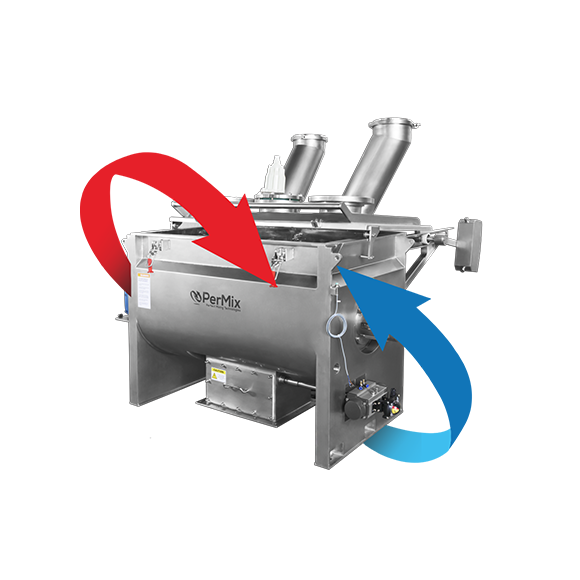
Horizontal ribbon mixers are widely used because they create a controlled, three-dimensional movement of material. The outer ribbon typically moves material in one direction while the inner ribbon moves it in the opposite direction. This counterflow circulation continually exchanges material between the ends, center, top, and bottom of the trough.
That mixing pattern is especially effective for free-flowing powders, dry blends, granules, and many paste applications. However, ribbon geometry, shaft speed, trough configuration, and discharge design must match the product. A highly aerated powder requires different handling than a dense mineral blend or a cohesive food ingredient.
A properly configured mixer should generate broad material turnover without relying on excessive speed. Higher rotational speed can shorten the apparent blending time for some products, but it may also increase particle degradation, heat generation, and energy consumption. The target is not maximum agitation. It is consistent distribution at the lowest practical intensity and cycle time.
Vertical ribbon mixers can be a strong option when floor space is limited or when a process benefits from vertical lifting and folding action. For materials that require vacuum drying, solvent recovery, or controlled processing under reduced pressure, vacuum ribbon mixer-dryers combine mixing and thermal processing in one enclosed system. Consolidating these steps can reduce material transfers and limit opportunities for contamination or post-mix segregation.
Select Capacity Based on Working Volume
Mixer capacity is not the same as batch working volume. Underfilling reduces the amount of material available for effective ribbon engagement, while overfilling limits circulation and can leave stagnant areas near the ends or top of the vessel. Both conditions can extend cycle times and produce inconsistent sample results.
The appropriate fill level depends on product density, flow behavior, mixer design, and required process steps. A low-density powder may occupy far more volume than its weight suggests. A wet or cohesive blend may need more open space for turnover than a free-flowing granular product. Equipment selection should begin with bulk volume and material behavior, not only pounds per batch.
Control Ingredient Addition Before the Mixer Starts
A homogeneous batch begins with disciplined charging practices. Adding all ingredients at once may be acceptable for similar bulk materials, but it can be ineffective when a formulation includes low-percentage components or ingredients with major density differences.
For difficult blends, a preblend can distribute minor ingredients into a compatible carrier before they enter the main mixer. This increases the effective concentration of the low-dose component and gives the ribbon system a better starting condition. Liquid additions also require planning. Spray placement, droplet size, addition rate, and mixer movement determine whether the liquid disperses evenly or forms localized wet lumps.
Operators should follow a defined charging sequence rather than relying on individual judgment. The sequence should specify which materials are charged first, when the mixer begins rotating, whether intermediate mixing is required, and when liquids or sensitive ingredients are added. This level of control supports traceability and makes deviations easier to investigate.
Validate Time, Speed, and Sampling Locations
A mixer’s optimal cycle cannot be confirmed by visual inspection alone. Validation should use representative samples taken from multiple locations and, when practical, from the beginning, middle, and end of discharge. This identifies whether variation exists within the vessel or develops as the product leaves the mixer.
A useful validation study evaluates samples at several time points rather than testing only one long cycle. The objective is to identify the shortest mixing time that consistently meets the product specification. Operating beyond that point may waste capacity and can create new risks for blends prone to demixing.
Sampling must be designed carefully. A poorly placed sample port or inconsistent sampling technique can create misleading data. For regulated applications, documented procedures should define sample quantity, location, analytical method, acceptance criteria, and the number of samples required. For food, chemical, plastics, and agricultural operations, the same discipline provides valuable process control even when formal validation requirements differ.
Prevent Segregation After Mixing
Achieving a uniform blend inside the mixer is only part of the job. A batch can segregate during discharge, conveying, storage, or packaging. Free-falling material is particularly vulnerable when fine and coarse particles have different aerodynamic behavior. Long transfer distances, high-speed pneumatic conveying, and multiple drops can separate components that were properly blended minutes earlier.
Discharge design should promote mass flow and minimize material retention. A full-width or properly sized discharge valve can reduce the time a completed blend remains in the mixer and help maintain a consistent discharge profile. Downstream equipment should be evaluated as part of the complete process, especially for formulations with broad particle-size distributions or large density differences.
Where segregation is likely, reduce unnecessary handling steps and avoid uncontrolled drops. The best solution may be a different transfer method, a shorter conveying path, revised packaging conditions, or a formula adjustment. It depends on the material, but the root cause should be addressed downstream as well as in the mixer.
Build Repeatability Into Daily Operations
Even well-designed equipment cannot compensate for uncontrolled operating practices. Establish acceptable ranges for ingredient condition, batch weight, fill level, mixer speed, mixing time, and liquid addition rate. Track these values in production records so quality teams can connect a failed result to a specific process deviation.
Preventive maintenance also protects blend consistency. Worn ribbons, damaged seals, shaft misalignment, buildup on internal surfaces, and malfunctioning discharge valves can alter material movement. Cleaning procedures should remove carryover without damaging the finish or leaving cleaning residues that affect the next product. In applications requiring frequent changeovers, sanitary construction and access features can reduce downtime while supporting reliable cleaning verification.
For new products or recurring consistency problems, pilot-scale testing and application review provide a practical path forward. PerMix evaluates material characteristics, required batch size, processing conditions, and downstream handling to configure ribbon mixing solutions around the actual production requirement rather than a generic equipment specification.
A consistent blend is not simply evidence that the mixer is running. It is evidence that equipment design, material handling, operating controls, and validation are working together. When those elements are aligned, each batch is easier to release, easier to reproduce, and better prepared for the next stage of production.