How to Properly Size Mixer Motors for Production
A ribbon mixer can have the correct working volume, agitator design, and discharge configuration yet still underperform if its drive is undersized. The ability to size mixer motors correctly determines whether the mixer starts reliably under load, maintains the intended ribbon speed, handles material variability, and delivers repeatable batch performance without wasting energy.
Motor sizing is not a matter of selecting the highest available horsepower. An oversized motor can increase capital cost, complicate low-speed control, and mask mechanical or process issues. An undersized motor can cause stalled starts, overload trips, excess heat, premature gearbox wear, and inconsistent mixing. The right selection starts with the material and ends with a complete drive-system evaluation.
Why Motor Sizing Is a Process Decision
For industrial mixing operations, motor horsepower is often treated as a mechanical specification. In practice, it is a process specification. The required power changes according to bulk density, particle shape, moisture, fill level, cohesiveness, liquid addition, temperature, and the desired mixing cycle.
A free-flowing dry powder may need relatively modest power once the ribbons are moving. The same mixer may require substantially higher starting torque when processing a dense mineral blend, a sticky food premix, or a paste-like chemical formulation. Materials that compact during storage or form agglomerates can place a high momentary load on the drive at startup.
This is why a motor should be selected for the actual duty, not for an idealized material specification. A process engineer should consider normal operating conditions, expected seasonal changes, allowable product variations, and the most demanding foreseeable batch. This approach protects production capacity while avoiding unnecessary overdesign.
The Inputs Needed to Size Mixer Motors
Accurate motor sizing depends on reliable application data. The more clearly the process is defined, the more precisely the mixer, gearbox, and motor can be matched to the required duty.
Material Characteristics and Bulk Density
Bulk density is a primary factor because it affects the total mass carried and displaced by the agitator. A large-volume mixer filled with a low-density powder may require less torque than a smaller mixer processing dense granules. However, density alone does not tell the full story.
Internal friction, flowability, particle size distribution, moisture content, and cohesion all influence the resistance encountered by the ribbons. Fine powders may aerate and flow easily, while a slightly damp version of the same material may bridge, compact, and demand much more torque. Fibrous ingredients, flakes, and irregular particles can also increase mixing resistance.
For this reason, material samples and test data are highly valuable. When the material is difficult, variable, or newly formulated, pilot testing can reveal power demands that specification sheets do not show.
Batch Volume and Fill Level
Ribbon mixers are generally most effective within a defined fill range. Motor selection must reflect the intended working capacity rather than only the total vessel volume. Running a mixer at a higher fill level increases the material mass and can raise torque demand, particularly during startup.
Plants should also identify whether occasional overload batches are part of normal production. If an operation regularly exceeds the recommended working volume to meet demand, a larger motor alone is not always the answer. The mixer geometry, ribbon design, and gearbox rating must also support that duty. Otherwise, the drive may become the weak point in the system.
Agitator Speed and Tip Speed
The motor does not directly determine the final ribbon speed. In most horizontal ribbon mixers, a gear reducer converts motor speed into the low-speed, high-torque output needed by the agitator. The required output RPM depends on the product and mixing objective.
Higher ribbon speeds can reduce blend time for some free-flowing materials, but they may also increase power demand, particle degradation, heat generation, and dusting. Lower speeds can protect fragile ingredients or support controlled liquid addition, but may lengthen the batch cycle. The correct speed is therefore a balance between mixing efficiency and product protection.
Variable frequency drives can provide useful flexibility when formulations or batch conditions change. They allow operators to adjust speed during loading, mixing, liquid addition, and discharge preparation. Still, a VFD does not eliminate the need for proper motor sizing. The motor and gearbox must safely handle the full torque requirement across the intended operating range.
Starting Torque and Load Conditions
Starting a loaded mixer is frequently more demanding than maintaining speed once the batch is in motion. A motor may appear adequate during normal mixing but struggle to accelerate a dense, compacted, or highly filled batch from a standstill.
This concern is especially relevant for cohesive powders, wet granulations, heavy mineral products, high-viscosity pastes, and formulations that may sit in the mixer before restart. The drive system should provide sufficient breakaway torque without repeated overload trips or excessive mechanical stress.
Starting method matters as well. Across-the-line starting, soft starting, and VFD control each produce different acceleration and torque characteristics. The appropriate choice depends on the plant electrical system, material behavior, operating procedure, and the mechanical limits of the mixer.
Horsepower Is Only One Part of the Drive System
A properly selected motor must work as part of a coordinated drive package. The gearbox, couplings, bearings, shafts, ribbons, and electrical controls all need ratings appropriate for the application. Specifying a larger motor without reviewing these components can create a mismatch that shortens equipment life.
Gear reduction is particularly important because ribbon mixing requires high torque at relatively low rotational speed. The reducer must accommodate the continuous operating load, startup demand, shock loading, and required service factor. A unit that is acceptable for intermittent blending may not be suitable for extended production shifts or frequent start-stop cycles.
Motor efficiency class should also be considered. Premium-efficiency motors can reduce energy consumption in facilities operating multiple shifts, especially where mixers run frequently. The savings must be evaluated alongside the actual load profile. A motor operating far below its intended load range may not provide the efficiency benefits expected on paper.
Account for Process Changes Before They Become Problems
Many motor-sizing failures occur because the original process changes after installation. A mixer initially used for a light powder blend may later be assigned to denser products, larger batches, or formulations with more liquid. Production teams may also shorten cycle targets, increase daily batch counts, or operate equipment in hotter conditions.
These changes should trigger a review of motor and gearbox capacity. Warning signs include frequent overload alarms, slow starts, unusually high motor temperature, repeated belt or coupling issues, rising maintenance requirements, and batch-to-batch variation. Treating these symptoms as electrical nuisances can allow a mechanical or process problem to worsen.
A well-designed mixing system should leave an appropriate engineering margin for realistic operating variation. The margin should be intentional, not arbitrary. Too little margin restricts production flexibility. Excessive margin can increase cost and reduce the precision of control.
When Testing Is the Best Sizing Tool
Calculated estimates are useful, but difficult materials often require testing. This is particularly true for powders with changing moisture, abrasive solids, sticky ingredients, high liquid addition rates, or blends that transition from dry to paste-like during the cycle.
Testing can establish actual power draw, mixing time, blend uniformity, temperature rise, and discharge behavior. It can also show whether the challenge is truly motor capacity or a different issue, such as ribbon geometry, insufficient clearance, poor loading sequence, or an unsuitable mixer type.
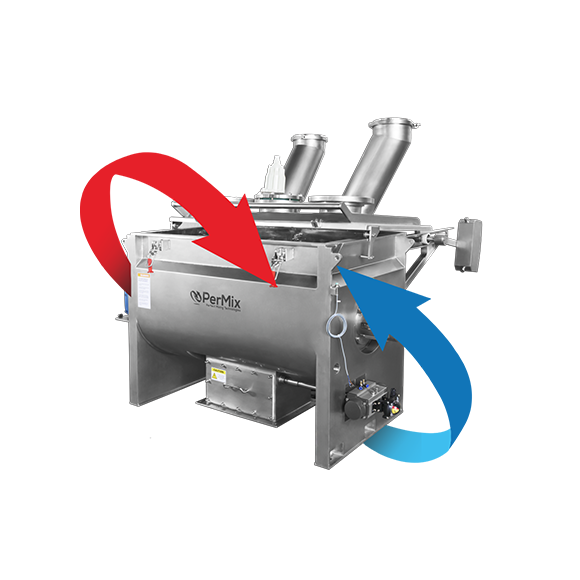
For demanding applications, PerMix evaluates the full process rather than treating motor horsepower as an isolated purchase decision. That engineering approach helps match the ribbon mixer configuration, drive arrangement, and controls to the material behavior and production objective.
Selecting the Right Motor for Long-Term Performance
The most effective motor selection supports consistent product quality and dependable operation over the life of the equipment. It considers the heaviest expected batch, the required ribbon speed, startup torque, service factor, operating hours, control method, and future formulation changes. It also recognizes that the lowest initial horsepower cost may become expensive if it causes downtime, lost batches, or frequent maintenance.
Before finalizing a mixer specification, provide complete material and operating data to the equipment supplier, including bulk density range, moisture range, batch size, target cycle time, liquid additions, temperature, and cleaning requirements. A properly sized drive gives the mixer the torque and control needed to perform under real plant conditions, not just under ideal ones.