How to Manage Sticky Materials in Mixing
A batch can look uniform through the inspection port while a costly amount of product remains on the shaft, ribbons, end walls, and discharge valve. Knowing how to manage sticky materials is therefore not just a mixing question. It is a process-design question that affects yield, cycle time, sanitation, operator safety, and the repeatability of every batch that follows.
Sticky behavior is rarely caused by one factor alone. Moisture, fat content, particle size, temperature, pressure, formulation sequence, and mixer geometry can all change how a material moves. The right solution begins with defining the material behavior under actual production conditions rather than selecting equipment based only on a product’s dry-bulk description.
Why Sticky Materials Create Production Problems
Materials become difficult to handle when cohesive forces are stronger than the forces that keep them flowing. A powder may absorb humidity and form agglomerates. A paste may soften as friction raises its temperature. A polymer compound may cling to metal surfaces because of its tack point, while a food blend may smear because oils are released during mixing.
The result is often uneven circulation in the vessel. Material can ride with the agitator instead of being folded and redistributed. It can accumulate in low-velocity zones, bridge above the discharge, or form a coating that reduces usable working volume. If operators must stop the process to scrape surfaces manually, a mixer that appears productive on paper can become a bottleneck on the plant floor.
For regulated applications, retained material carries an additional risk. Residue from one batch can complicate cleaning validation, allergen control, traceability, and changeover procedures. In high-value chemical, cosmetic, pharmaceutical, or specialty food production, even a small loss at discharge may have a meaningful cost.
Start With the Material, Not the Mixer
Before specifying a mixer or modifying an existing process, evaluate the product as it behaves in the plant. A lab sample at room temperature may not reflect material that has been conveyed, preheated, sheared, or exposed to humid air for several hours.
Useful information includes moisture range, bulk density, particle-size distribution, fat or binder content, temperature sensitivity, viscosity at operating temperature, and the tendency to compact under pressure. Also document how the formula changes during the batch. A free-flowing blend may become sticky only after liquid addition, melting, hydration, or particle breakdown.
The process sequence matters just as much. Adding a small amount of liquid too quickly can create localized wet lumps that never fully disperse. Adding it at the wrong stage can cause fine powders to coat the vessel before larger particles have been incorporated. In some applications, a controlled spray pattern, staged addition, or pre-blending step is more effective than increasing mixing speed.
Test Under Representative Conditions
A practical trial should reproduce the intended batch size, fill level, temperature, ingredient order, and mixing time. It should also assess discharge, not simply blend uniformity. A material that mixes well but will not discharge cleanly is not a successful process.
During testing, examine retained material on contact surfaces, torque trends, product temperature, discharge time, and the consistency of samples taken across the batch. These observations help distinguish a formulation issue from a mixer-design issue.
Choose Mixing Action That Prevents Build-Up
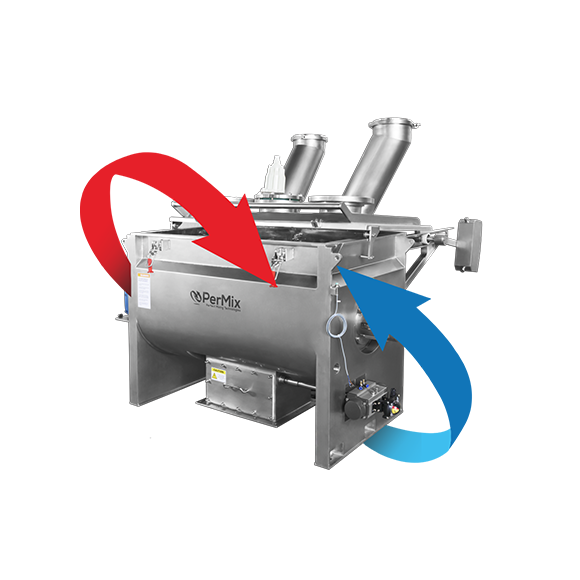
Sticky products need reliable bulk movement. In a horizontal ribbon mixer, the inner and outer ribbons are designed to move material in opposing directions, creating a continuous folding and convective mixing pattern. For cohesive powders, damp blends, and pastes, this action can provide strong distribution while maintaining a controlled process environment.
However, ribbon design should be matched to the product. Ribbon pitch, width, clearance, shaft configuration, agitator speed, and vessel geometry all influence whether material moves through the batch or collects on surfaces. Very tight clearances may improve surface sweeping but can raise friction, heat generation, and sensitivity to dimensional variation. Larger clearances may reduce drag but leave more material behind. The correct balance depends on the product and cleaning requirements.
For highly cohesive or dense materials, additional mixing elements may be needed to break agglomerates and eliminate dead zones. A vertical configuration can be advantageous where a material’s flow pattern, batch size, or footprint favors vertical movement. Vacuum ribbon mixers and dryers can support processes that require moisture removal or controlled conditions, but vacuum alone will not solve poor agitator geometry or improper thermal control.
PerMix evaluates these variables as a system, helping manufacturers configure ribbon mixing equipment around the actual product, process, and production target rather than relying on a one-size-fits-all arrangement.
Control Temperature Before Stickiness Escalates
Temperature is one of the most overlooked causes of material adhesion. Friction from the agitator, warm incoming ingredients, jacket temperature, ambient conditions, and extended batch times can move a product into a tacky range. That change may be gradual enough to go unnoticed until discharge performance declines.
Where a product softens with heat, use temperature monitoring and establish an operating limit based on product behavior, not only equipment capability. A jacketed vessel may be used for cooling or controlled heating, depending on the formula. The objective is to maintain a stable viscosity or particle condition throughout the cycle.
Speed is also a trade-off. Higher agitator speed can reduce batch time and improve dispersion, but it may increase frictional heat and smear-sensitive ingredients. Lower speed can limit heat but may not provide enough circulation to distribute liquids or break lumps. The best operating window is usually established through trials that measure both blend quality and material retention.
Design the Discharge for Complete Emptying
Discharge is where sticky-material processes either protect yield or lose it. The outlet should be sized and located to support the product’s natural movement, with minimal ledges, restrictions, or areas where material can bridge. Valve selection is especially important because a poorly suited valve can become a collection point for cohesive material.
A large, properly designed bottom discharge can reduce emptying time and residual hold-up. Surface finish and weld quality also matter. Smooth, sanitary contact surfaces reduce mechanical anchoring points and make cleaning more predictable, particularly in food, pharmaceutical, and cosmetic operations.
Do not assume that gravity will do all the work. Some products require continued slow agitation during discharge to keep material moving toward the outlet. Others benefit from a defined discharge sequence that prevents compaction. The right approach depends on whether the material is a damp powder, a viscous paste, a fat-containing blend, or a temperature-sensitive compound.
Build Cleaning Into the Process Design
Cleaning difficulty is often a sign that the process is operating outside its ideal window. If residue becomes baked onto surfaces or trapped behind components, operators face longer changeovers and greater exposure to manual cleaning tasks.
For products requiring frequent changeovers, specify accessible internals, cleanable discharge components, and a vessel design that supports the site’s sanitation method. Dry cleaning may be suitable for some powder applications, while wet washdown or clean-in-place methods may be required for others. The cleaning method should be considered before finalizing seals, finishes, access covers, and instrumentation.
A repeatable cleaning procedure should verify that the mixer is empty before cleaning starts. This is a yield issue as well as a sanitation issue. Recovering usable product at discharge is generally more efficient than washing it away later.
Operating Practices That Reduce Sticking
Equipment configuration is critical, but day-to-day discipline keeps the process stable. Operators should follow a documented sequence for ingredient addition, mixing speed, temperature control, and discharge. When the material changes, the process should change with it.
Watch for four early warning signs:
- Rising motor load or torque at a consistent batch size
- Longer discharge times or increased residual material
- Product temperature drift during the mixing cycle
- More frequent scraping, cleaning, or unplanned stoppages
These indicators can point to excess moisture, a changed raw material, worn agitator components, altered clearances, or an operating speed that no longer fits the formula. Tracking them by batch creates a useful baseline and helps maintenance teams intervene before production losses become routine.
Specify a Solution Around the Full Process
Managing sticky materials is not about forcing a difficult product through a standard mixer. It requires aligning material properties, mixing action, thermal conditions, discharge design, and cleaning expectations. When these elements are considered together, manufacturers can improve homogeneity while reducing waste, downtime, and labor-intensive intervention.
The most productive next step is to review a representative sample, the full batch sequence, and the conditions that cause sticking to begin. That level of process detail turns a persistent handling problem into an engineering decision with measurable results.