Vacuum Drying vs Tray Drying for Production
A wet powder that appears straightforward in a pilot batch can become a costly production bottleneck once moisture limits, solvent recovery, cleaning requirements, and batch consistency enter the equation. In the vacuum drying vs tray drying decision, the right choice depends less on a single drying-rate claim and more on how the material behaves under heat, vacuum, agitation, and handling.
Tray dryers remain a practical option for certain low-volume and heat-tolerant products. Vacuum dryers, particularly agitated vacuum ribbon dryers, provide a more controlled route for sensitive, sticky, solvent-bearing, or high-value materials. Understanding the operating differences helps process teams select equipment that supports product quality without creating unnecessary labor, energy, or downtime burdens.
Vacuum Drying vs Tray Drying: The Operating Difference
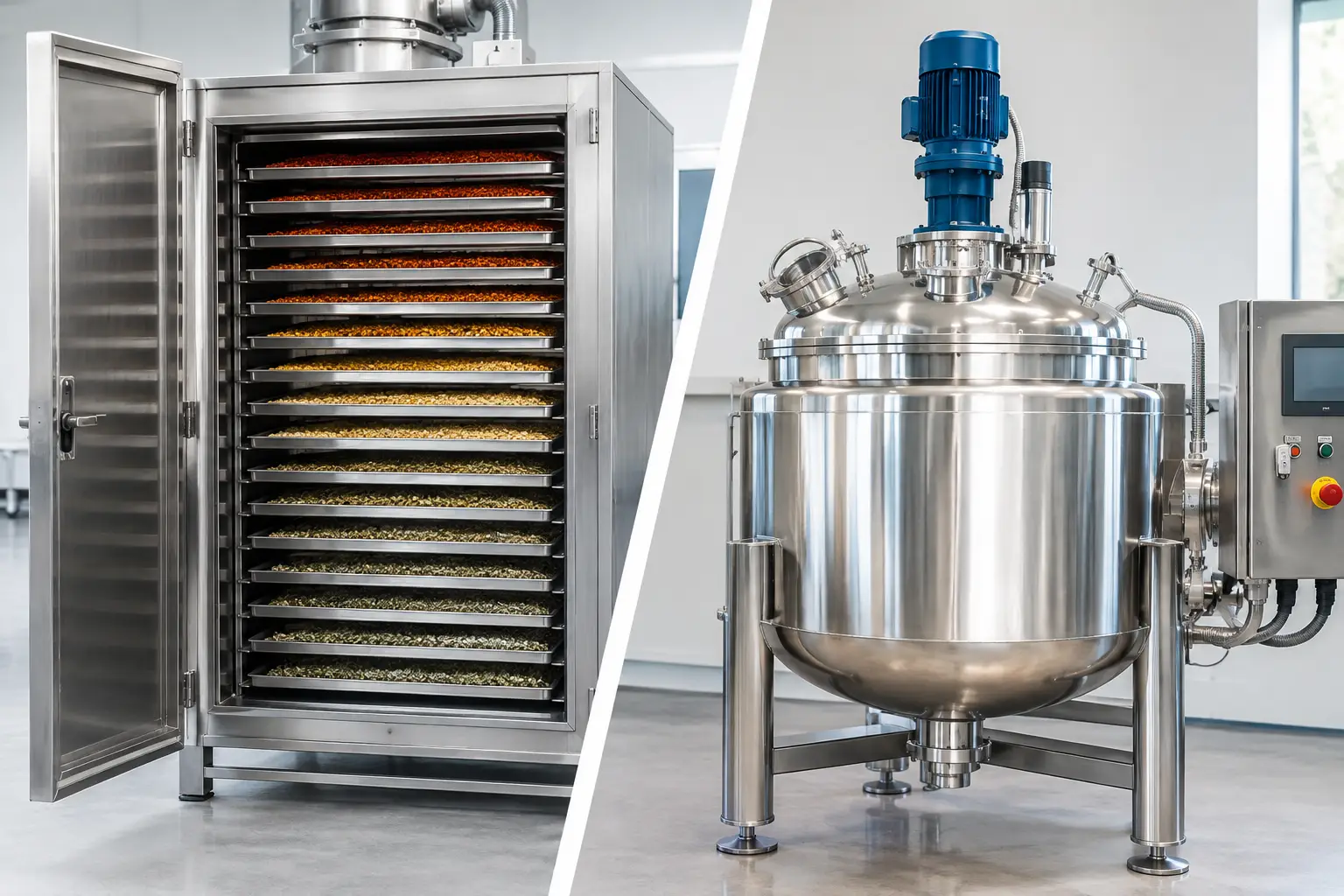
Tray drying is a static batch process. Operators spread wet material across shallow trays, load those trays into a heated chamber, and circulate hot air around the product. Heat moves from the air and tray surfaces into the material, while moisture evaporates and is carried away by the airflow. Once the cycle is complete, each tray must be removed and unloaded.
Vacuum drying reduces the pressure inside a sealed vessel. Because water and many solvents evaporate at lower temperatures under vacuum, the product can dry with less thermal exposure. In an agitated vacuum ribbon dryer, a horizontal ribbon agitator continually moves the material, exposing fresh wet surfaces and distributing heat more evenly across the batch. Vapors are pulled from the vessel and can be condensed for recovery or controlled disposal.
The practical distinction is significant. Tray drying relies on manual product presentation across many individual surfaces. Vacuum drying creates an enclosed, controlled environment where mixing and drying occur in the same vessel.
Heat Sensitivity and Product Protection
Heat-sensitive materials are often the strongest case for vacuum drying. Pharmaceutical intermediates, nutraceutical powders, flavor compounds, specialty chemicals, pigments, and certain cosmetic ingredients can degrade, discolor, oxidize, or lose functionality when exposed to elevated temperatures for extended periods.
Lower-pressure operation allows evaporation at a lower product temperature. This can protect active ingredients, preserve volatile components, and reduce the risk of heat-related quality variation. The ability to control jacket temperature, vessel pressure, agitator speed, and drying time gives operators more process flexibility when moisture specifications are tight.
Tray dryers can still perform well when the product is stable at the required air temperature and does not require intensive mixing. They are commonly used for products where a longer thermal cycle is acceptable and where simple static drying is sufficient. However, material at the center of a thick tray bed may dry more slowly than material near the surface. If loading depth, particle size, or initial moisture varies, final moisture uniformity can become harder to manage.
For materials that form crusts, clumps, or hard surface layers during drying, static trays create an additional challenge. A ribbon agitator breaks apart soft agglomerates and renews the exposed surface area throughout the process. That action can improve heat transfer and support a more uniform final product.
Throughput, Labor, and Batch Consistency
A tray dryer may have a lower initial equipment cost, but the total production cost deserves closer review. Each batch requires tray filling, rack loading, chamber loading, unloading, tray cleaning, and product discharge. These steps consume operator time and introduce opportunities for cross-contamination, product loss, and inconsistent fill depth.
In facilities with frequent product changeovers or strict hygiene requirements, manual tray handling can become a major limitation. The labor requirement also rises quickly as production scale increases. What works for a small development batch may not be an efficient method for commercial manufacturing.
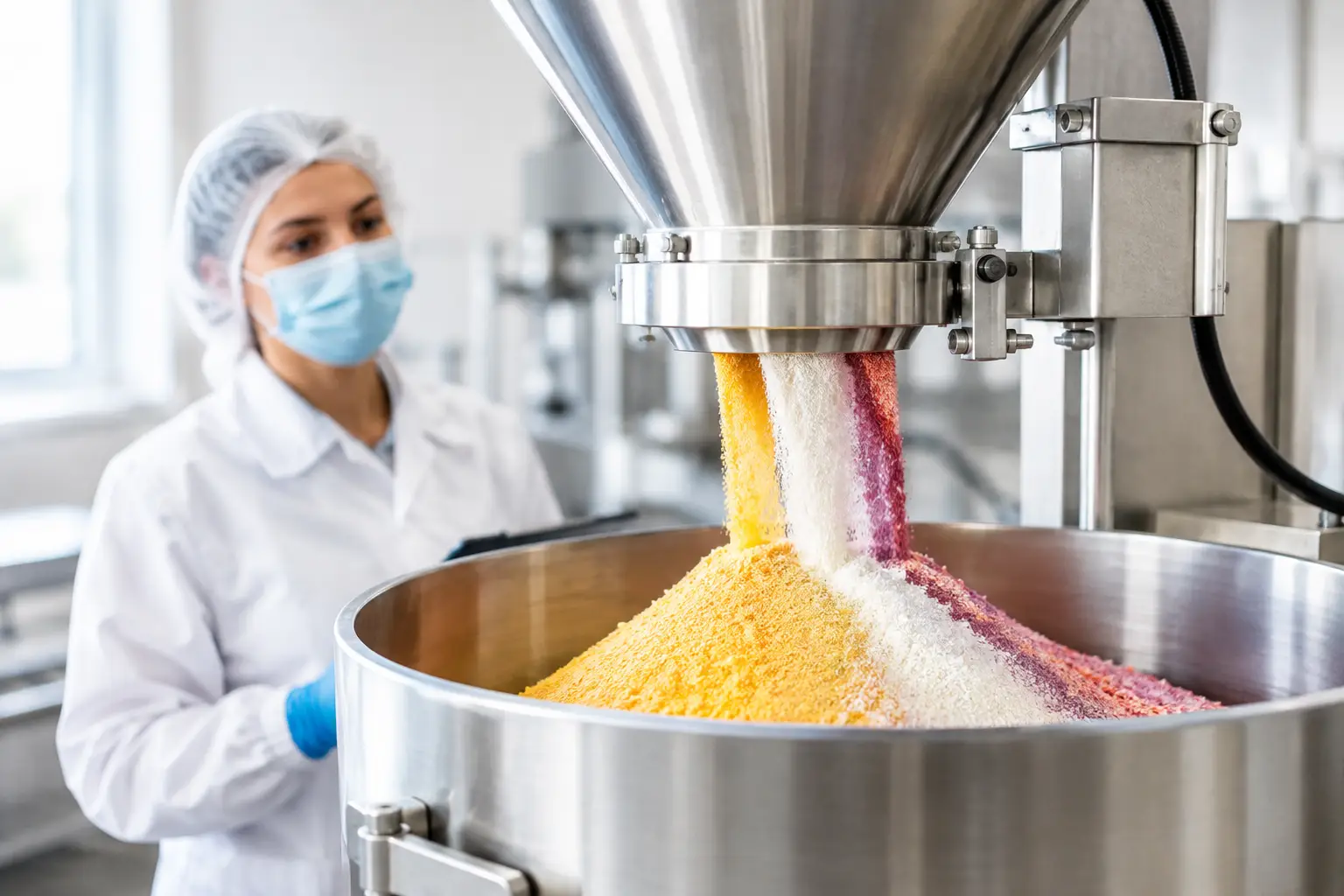
Vacuum ribbon dryers reduce handling by consolidating drying and agitation in one enclosed system. Material can be charged through a sealed inlet, processed under controlled conditions, and discharged through a bottom valve or dedicated discharge arrangement. This approach improves containment and can simplify integration with upstream mixing, wet granulation, filtration, or downstream milling and packaging.
Batch consistency is another operational advantage. In tray drying, each tray may experience slightly different airflow and loading conditions. In a vacuum ribbon dryer, agitation continuously redistributes material through the vessel. The result is typically more consistent moisture removal across the batch, provided the equipment is properly sized and the operating recipe is validated for the product.
Energy Use and Cycle Time
Neither technology is automatically the lowest-energy choice in every application. Energy performance depends on batch size, initial moisture, target moisture, solvent type, insulation, heat source, vacuum level, airflow requirements, and the number of operator interventions required per cycle.
Tray dryers require heated air circulation and typically exhaust moisture-laden air from the chamber. This can be effective for simple water-based products, but it may be less efficient when drying requires long dwell times or when the product must be dried gently at reduced temperatures. For solvent-bearing material, exhaust treatment and safety controls can add further complexity.
Vacuum drying requires energy for the heating jacket, agitation, vacuum pump, and vapor condensation system. Yet lower evaporation temperatures and improved product movement can shorten cycles for many difficult materials. When solvents have value or require controlled handling, an enclosed vacuum system can also support condensation and recovery rather than releasing vapors into a large air-exhaust stream.
The most accurate comparison is based on a real material balance, not a nameplate assumption. Process teams should calculate moisture removal per batch, expected cycle time, utility demand, labor hours, yield loss, and cleaning time. A faster dryer does not always produce the best business case if it creates excess maintenance or fails to meet product-quality requirements. Likewise, a low-cost tray dryer may become expensive when operator handling and long cycles limit available capacity.
Containment, Sanitation, and Safety
For regulated and technical industries, drying equipment must do more than remove moisture. It must protect operators, prevent contamination, and support repeatable cleaning procedures.
Tray dryers are relatively open during loading and unloading. This can be acceptable for benign products in lower-risk environments, but it is less desirable for potent powders, dusty materials, allergen-sensitive food ingredients, or products with strict exposure limits. The trays, racks, and chamber interior also create many surfaces that must be cleaned and inspected between campaigns.
An enclosed vacuum ribbon dryer supports a more contained process path. This is particularly valuable for fine powders, materials that generate dust during discharge, and products where atmospheric moisture pickup must be minimized. Depending on the application, the system can be configured with sanitary finishes, clean-in-place features, dust collection connections, inert gas capability, condensers, and vacuum-rated seals.
Solvent processing requires a separate level of engineering review. The dryer, vacuum system, condenser, controls, electrical classification, grounding, and inerting strategy must align with the solvent properties and facility safety requirements. Tray drying may be unsuitable for volatile solvents when open airflow and vapor management create an elevated risk. A properly designed vacuum system provides more control, but it must be specified as a complete process system rather than treated as a standard vessel.
When Tray Drying Still Makes Sense
Tray dryers remain a sound choice for select applications. They are often appropriate when production volumes are modest, the product is heat-stable, the material spreads easily, and manual handling does not affect safety, sanitation, or throughput targets. They can also be useful for facilities processing a variety of small batches where equipment simplicity is more valuable than automation.
The limitations become more visible when material is sticky, paste-like, low-density, highly variable in moisture, or prone to agglomeration. The same is true when the business needs reduced labor, better containment, solvent recovery, shorter campaign turnaround, or tighter batch-to-batch consistency.
Selecting the Right Dryer for Your Material
The best equipment decision starts with the material, not the dryer category. Evaluate initial and final moisture content, particle size distribution, bulk density, rheology, heat sensitivity, solvent composition, desired batch size, allowable cycle time, cleaning expectations, and discharge behavior. A material that flows freely when dry may behave very differently during the critical intermediate stage, when it is partially wet and adhesive.
Pilot testing is especially valuable for products with narrow moisture specifications or unusual rheology. It reveals whether agitation improves drying performance, whether the product coats heated surfaces, how quickly vapors evolve, and whether the material can discharge cleanly at the end of the cycle. These findings should guide vessel geometry, ribbon design, heating area, vacuum capacity, and control strategy.
PerMix applies this application-specific approach to vacuum ribbon dryers and mixing systems, helping manufacturers match equipment configuration to real production conditions rather than relying on generic drying assumptions. The goal is a durable, efficient system that supports product quality while reducing avoidable handling and downtime.
A dryer should fit the full process around it, from material charging to cleaning and final discharge. When those details are addressed early, the selected system becomes a dependable production asset rather than the next constraint on capacity.