Industrial Mixer Maintenance Guide
A mixer rarely fails at a convenient time. More often, it starts with a bearing running hotter than usual, a seal showing early wear, or a batch taking longer to hit spec. That is why an industrial mixer maintenance guide matters in real production environments. It helps plant teams protect blend consistency, avoid unplanned shutdowns, and extend the service life of equipment that sits at the center of the process.
For operations handling powders, granules, pastes, or sensitive formulations, maintenance is not just a mechanical task. It is a production control issue. When a ribbon mixer drifts out of condition, the impact reaches throughput, sanitation, energy use, and final product quality. A disciplined maintenance approach reduces those risks and supports more predictable output.
Why an industrial mixer maintenance guide affects plant performance
Industrial buyers usually evaluate mixers on capacity, mixing quality, discharge efficiency, and material compatibility. Those factors are critical, but maintenance deserves the same level of attention because it directly affects total operating cost. A well-maintained mixer delivers more stable performance over time, while a neglected one gradually creates hidden losses through longer cycle times, inconsistent batches, and avoidable repairs.
This is especially true in ribbon mixing applications. Horizontal ribbon mixers and vertical ribbon mixers rely on precise clearances, dependable drive components, and proper sealing to maintain uniform movement of material. If internal wear changes how product flows through the trough, the machine may still run, but it may no longer run at the level your process requires.
Maintenance strategy also depends on the application. A food processor focused on sanitation will not prioritize the same details as a chemical manufacturer handling abrasive powders. A vacuum ribbon mixer or dryer adds another layer, since vacuum integrity and thermal performance become part of the maintenance equation. The right plan is always specific to the product, duty cycle, cleanout requirements, and production environment.
Core areas every maintenance plan should cover
The most effective maintenance programs are built around the components most likely to affect uptime and mixing accuracy. In most industrial mixers, that means the drive system, bearings, seals, shafts, ribbon assembly, discharge mechanism, and control elements.
The drive system should be inspected routinely for alignment, unusual vibration, overheating, and changes in load behavior. Motors and gear reducers often show early warning signs before a major failure, and those signs are easier to catch during planned inspection than during an emergency stop. If your mixer begins drawing more power for the same batch profile, the cause may be material buildup, internal drag, worn components, or developing mechanical resistance.
Bearings require close attention because they operate under continuous load and can degrade gradually. Lubrication intervals must match the actual operating conditions, not just the equipment manual. High-duty cycles, washdown exposure, or elevated ambient temperatures may require a more frequent schedule. Over-lubrication can be just as harmful as under-lubrication, so maintenance teams should follow a controlled approach rather than treating grease volume as a safety margin.
Seals are another critical point. In powder processing, poor seal condition can lead to contamination, product leakage, and premature wear around the shaft area. In sanitary or regulated environments, failed seals can quickly become a compliance concern. For vacuum ribbon systems, seal condition also affects process performance. A small leak may not stop production immediately, but it can reduce efficiency and compromise repeatability.
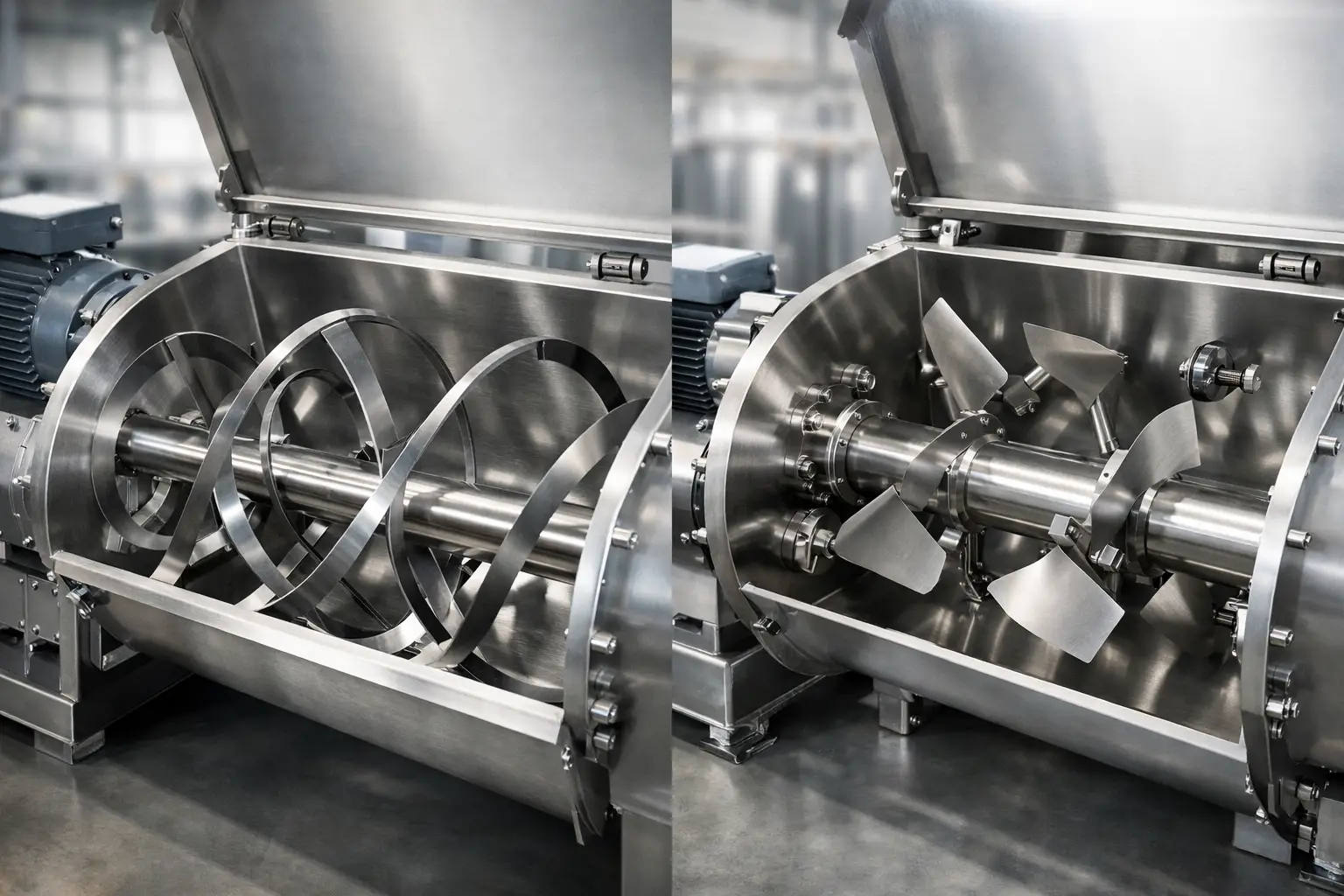
Inside the mixer, the ribbon assembly and shaft should be checked for wear, deformation, and residue accumulation. Even minor buildup can affect material movement, especially in applications that depend on tight batch uniformity. Abrasive materials can gradually reduce ribbon thickness or alter edge profiles, which changes mixing action over time. That kind of wear does not always look dramatic, but it can still influence blend quality.
Daily, weekly, and scheduled maintenance practices
An industrial mixer maintenance guide is most useful when it turns maintenance into a repeatable operating habit. Daily checks should be simple enough for operators to complete without disrupting production. That usually includes a visual inspection for leaks, unusual noise, vibration, loose hardware, and product accumulation around seals, discharge points, and external surfaces. Operators should also confirm that safety devices, guards, and interlocks are in place and functioning correctly.
Weekly checks can go further. This is the right interval to verify lubrication points, inspect drive components more closely, and review any trend data from the control system. If cycle time, motor load, or temperature readings have shifted, maintenance should investigate the cause rather than waiting for failure. Many preventable mixer problems announce themselves through small changes in operating behavior.
Scheduled maintenance should include deeper inspection during planned downtime. This is when teams should assess ribbon condition, internal clearances, fastener integrity, shaft alignment, bearing condition, and discharge function. For mixers used in demanding applications, planned inspection of wear surfaces can prevent costly secondary damage. Replacing a worn seal or bearing on schedule is usually far less expensive than repairing a shaft, gearbox, or housing after the component fails in service.
Documentation matters here. Plants that keep clear records on lubrication, inspections, part replacement, and abnormal findings make better maintenance decisions. They can see whether a mixer is developing a recurring issue, whether a certain product causes above-average wear, or whether maintenance intervals should be shortened or extended. Without records, maintenance stays reactive.
Cleaning and sanitation are part of maintenance
In many facilities, cleaning is treated as separate from maintenance. In practice, the two are closely connected. Incomplete cleaning leads to buildup, and buildup leads to drag, contamination risk, and accelerated wear. A mixer that is difficult to clean may also be difficult to maintain efficiently, especially if residues hide wear points or interfere with inspection.
For food, pharmaceutical, and cosmetic applications, sanitation procedures must protect both product integrity and equipment condition. Aggressive cleaning chemicals, excessive water exposure, or improper disassembly can create new maintenance problems if the mixer was not designed for that cleaning method. The best results come from matching the equipment configuration to the sanitation requirement from the start.
This is one area where application-specific engineering makes a measurable difference. Mixer design choices such as surface finish, seal arrangement, access doors, discharge configuration, and cleanout features affect not only hygiene but also maintenance time and downtime exposure.
Common warning signs you should not ignore
Most mixer failures are preceded by symptoms. The challenge is that busy plants often normalize them. A slight increase in noise, a hotter bearing housing, a slower discharge, or a batch that needs extra mixing time may seem manageable for a while. In reality, those are often early indicators of mechanical wear or process instability.
Watch for recurring vibration, product leakage, inconsistent batch uniformity, rising power consumption, unusual odor from drive components, and repeated seal replacement. None of these automatically means major failure is imminent, but all of them justify inspection. The longer the issue is allowed to continue, the more likely it is to affect other components.
It also pays to look at maintenance through the lens of process performance. If operators are compensating for equipment condition by extending mix times, reducing batch size, or increasing rework, the mixer is already costing more than it should. The maintenance team may be keeping it running, but the operation is no longer running efficiently.
When preventive maintenance is not enough
Preventive maintenance is the baseline, not the ceiling. For critical mixers, condition-based maintenance can provide better control. Monitoring vibration, temperature, amperage, and seal condition helps plants identify problems earlier and plan service around production schedules. This approach is especially valuable where downtime is expensive or where the mixer supports a high-value formulation.
There is also a point where repeated maintenance is no longer the best answer. If a mixer requires frequent repairs, struggles with current materials, or creates too much downtime for cleaning and service, the issue may be equipment fit rather than maintenance discipline. In those cases, the right solution could be a more suitable mixer configuration, upgraded materials of construction, or a design tailored to the product and operating environment.
For buyers evaluating long-term performance, this is where a specialized manufacturing partner adds value. A well-built mixer should support superior mixing performance with durable construction, low-energy operation, and maintenance requirements aligned with the process, not working against it.
Building a maintenance plan that supports ROI
The best maintenance plans are realistic. They reflect actual usage, product characteristics, and staffing conditions rather than a generic checklist pulled from a manual. A plant running abrasive minerals across multiple shifts needs a different schedule than a facility blending nutritional powders in shorter campaigns. The maintenance plan should match that reality.
It should also define ownership clearly. Operators handle frontline observation. Maintenance technicians manage inspection, lubrication, and repair. Engineering and operations leaders review trends and decide when process changes or equipment upgrades are justified. When those responsibilities are unclear, small issues tend to stay small only until they become expensive.
For companies investing in ribbon mixing systems, maintenance should be considered part of asset strategy from day one. That means selecting equipment with serviceability in mind, planning parts support, training operators to recognize early warning signs, and aligning maintenance intervals with production goals. PerMix Ribbon Mixers approaches this as a practical business issue as much as a mechanical one, because reliable mixing performance depends on both equipment design and disciplined upkeep.
A good mixer earns its value batch after batch, but only if its condition is protected with the same precision expected from the process itself.