How to Improve Batch Consistency
A batch that tests within spec on Monday but drifts on Wednesday usually is not a mystery. It is a process signal. If you are evaluating how to improve batch consistency, the answer rarely comes from a single adjustment. Most consistency problems trace back to the interaction between material behavior, mixer design, loading method, cycle time, and operator control.
In production environments where uniformity affects yield, compliance, and customer acceptance, inconsistent batches create more than rework. They increase downtime, consume labor, complicate quality investigations, and reduce confidence in the process itself. The practical path forward is to identify where variation enters the system and remove it through better equipment fit, tighter process definition, and repeatable operating conditions.
How to improve batch consistency at the process level
The first step is separating true mixing problems from upstream and downstream variation. Many plants assume the mixer is underperforming when the real issue starts earlier, such as fluctuating particle size, inconsistent bulk density, poor ingredient dosing, or uncontrolled feed sequence. A ribbon mixer can only perform as well as the process around it allows.
Start by reviewing batch records against product test results. Look for patterns in fill level, ingredient order, operator shifts, raw material lots, and mix time. If the same formula performs differently under slightly different conditions, you are likely dealing with a process window that is too wide. Narrowing that window often improves consistency faster than increasing cycle time.
Sampling method also matters. In some facilities, inconsistent results are partly a testing problem. If samples are pulled from only one discharge point or from material that has already begun to segregate during transfer, the data may not reflect actual mixer performance. A sound sampling plan should evaluate the blend at multiple locations and at the right point in the process.
Material behavior often sets the limit
Powders and bulk solids do not behave the same way, even when formulas look similar on paper. Fine cohesive ingredients may form agglomerates. Free-flowing granules may segregate during loading or discharge. Ingredients with large differences in particle size, density, or shape can resist uniform distribution unless the mixer and process are designed specifically for that challenge.
This is where many consistency issues become application-specific. A food blend with minor ingredients added at low inclusion rates does not require the same approach as a chemical formulation with fragile particles or a pharmaceutical powder that must meet tight content uniformity targets. The right answer depends on whether the process needs aggressive convective mixing, gentle blending, vacuum capability, heating or drying, or tighter control over residence time.
When evaluating how to improve batch consistency, do not overlook moisture. Small changes in moisture content can alter flow properties, adhesion, and blend uniformity. A formula that mixed well in dry winter conditions may behave differently in a humid environment. In those cases, controlling storage conditions and material preparation can have the same impact as changing the mixer itself.
Mixer design has a direct effect on repeatability
Batch consistency depends on achieving the same motion pattern every cycle. That starts with matching the mixer geometry and agitator design to the application. In ribbon mixing, the relationship between inner and outer ribbons, trough shape, tip clearance, and rotational speed determines how effectively materials are moved axially and radially through the batch.
An undersized mixer can force overfilling, reducing active movement and creating dead zones. An oversized mixer may run partially filled, which changes flow patterns and lowers repeatability. Neither condition supports consistent blending. The goal is not simply to have enough capacity. It is to operate within a designed working range where the mixer produces stable, repeatable motion.
Clearance and fabrication quality also matter more than many buyers expect. Poorly controlled tolerances can leave stagnant areas near the trough wall or discharge zone. Over time, wear can increase those gaps and gradually change performance. For operations with demanding applications, a durable, application-specific mixer design is often the difference between short-term improvement and long-term consistency.
Ribbon configuration should be selected based on the material and objective. Some products require faster turnover and dispersion. Others benefit from gentler movement to avoid particle degradation or heat buildup. A configurable solution is valuable because the best design for one formulation may not be ideal for another, even within the same plant.
Feeding sequence and load method are common failure points
Plants often focus on mixing time while overlooking how ingredients enter the mixer. Yet feed sequence can strongly influence uniformity, especially when dealing with low-dose actives, liquids, or ingredients that tend to clump. If a fine minor ingredient is added late into a dense bulk bed, it may not disperse fully within the available mix cycle. If liquids are introduced too quickly or in the wrong zone, localized wetting can create persistent lumps.
A more controlled loading strategy can improve consistency without extending production time. That may mean adding key components in stages, premixing certain minors, changing the liquid spray pattern, or standardizing the fill rate. The objective is to give the mixer the best possible starting condition rather than asking it to correct preventable variation.
Operator dependence should also be reduced wherever possible. If one shift consistently produces tighter results than another, that usually signals that critical steps are not fully standardized. Automated ingredient charging, timed liquid addition, speed control, and recipe-based sequencing reduce variation that manual work instructions alone cannot eliminate.
Process control should be validated, not assumed
Consistent batches come from defined operating parameters, not broad estimates. Mix time is a clear example. Many operations set time based on habit, then add extra minutes when results drift. That approach increases energy use and can make some products worse by causing particle attrition, heat generation, or segregation after overmixing.
A better approach is to establish the validated mix time for each product at a defined fill level, agitator speed, and ingredient sequence. Then hold those conditions steady. If production demand forces a change in batch size or raw material source, the process should be re-evaluated rather than assumed to perform the same way.
Discharge consistency deserves the same attention. Some blends leave the mixer uniformly but segregate during transfer into bins, packaging lines, or downstream feeders. If results change after discharge, the issue may be material handling rather than blending. Equipment layout, drop height, conveyor type, and hopper design all influence whether a homogeneous batch stays homogeneous.
For higher-value or regulated products, in-process verification can provide added protection. That does not always mean complex instrumentation. Sometimes it means more disciplined sampling, trend tracking, and preventive maintenance tied to measurable performance shifts.
Sanitation, maintenance, and wear affect consistency over time
A mixer that delivered strong results during startup can drift after months of production if sanitation and maintenance are not managed closely. Residual buildup changes internal flow surfaces. Worn seals may allow contamination or material loss. Ribbon wear can alter mixing action gradually enough that the change is not obvious until quality problems appear.
This is especially relevant in industries that switch products frequently or process sticky, fine, or abrasive materials. Easy-clean construction, reliable access, and durable components support consistency because they make it more practical to maintain the same internal condition from batch to batch.
Preventive maintenance should focus on performance-critical points, including agitator alignment, bearing condition, seal integrity, drive performance, and discharge operation. When maintenance is reactive, consistency usually suffers before failure becomes visible.
Equipment selection should support the real application
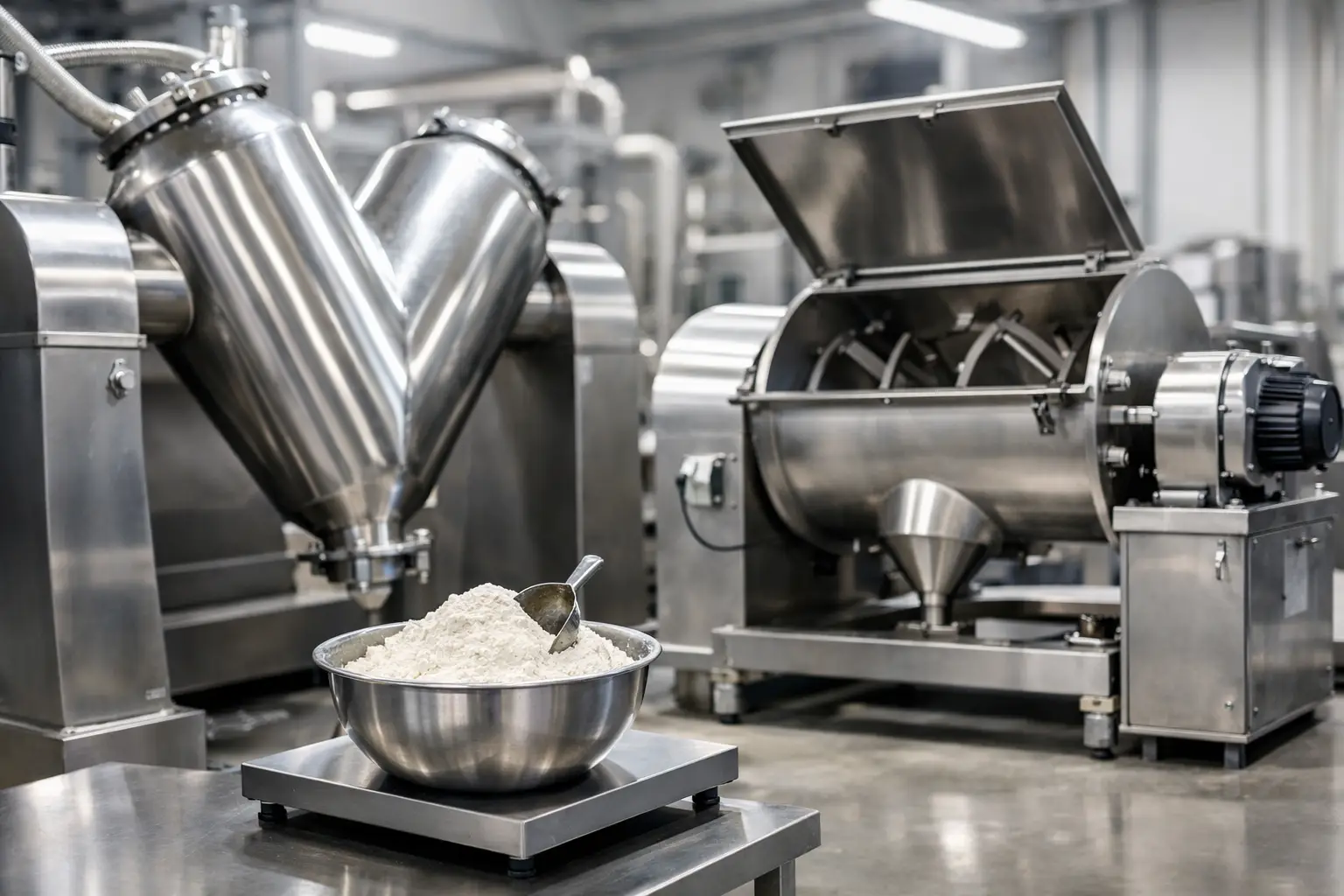
If the current process is fundamentally mismatched to the product, procedural fixes will only go so far. A standard horizontal ribbon mixer is highly effective for many powder and granule applications, but some processes need a vertical configuration for footprint or gentle handling, while others benefit from vacuum ribbon mixing and drying to combine blending with moisture removal or solvent handling.
That is why equipment selection should be based on the actual material set, desired homogeneity, batch size, cleanability requirements, and production target. A tailored solution often improves consistency because it removes the need for workarounds. In practice, that means fewer operator adjustments, shorter validation cycles, and more predictable throughput.
At PerMix, this is where application-specific engineering provides real value. The mixer is only part of the answer. The stronger result comes from aligning machine design, process conditions, and material behavior into one repeatable system.
If you are working on how to improve batch consistency, the most productive mindset is not to chase isolated symptoms. Build a process that gives the same materials the same motion under the same conditions every time. When the equipment is properly matched and the operating window is controlled, consistency stops being a recurring issue and becomes part of normal production.