Powder Blending Equipment Selection Guide
A powder blending line rarely fails because of one dramatic mistake. More often, performance problems show up as small, expensive symptoms – long cycle times, inconsistent homogeneity, dusting, segregation after discharge, or a mixer that works well for one product and struggles with the next. A practical powder blending equipment selection guide starts with that reality: the right machine is the one that fits your material behavior, process targets, sanitation requirements, and production economics at the same time.
For plant managers, process engineers, and procurement teams, equipment selection is not simply about choosing a mixer type from a catalog. It is about controlling risk. The wrong choice can create recurring quality issues, unnecessary energy use, operator frustration, and maintenance demands that stay with the line for years. The right choice supports repeatable blends, predictable throughput, lower downtime, and a better return on capital.
What this powder blending equipment selection guide should answer
Before comparing machine designs, define what success looks like in your operation. In some plants, the main issue is blend uniformity with minor ingredients at very low inclusion rates. In others, the challenge is gentle handling of friable particles, quick cleanout between recipes, or keeping moisture-sensitive powders under controlled conditions. Those are very different jobs, and they do not always point to the same equipment.
The most useful starting questions are straightforward. What materials are being blended? How much batch-to-batch variation is acceptable? Is the process purely dry blending, or does it include liquid addition, heating, vacuum drying, or deagglomeration? What level of throughput is required per shift? The answers shape the mixer design far more than nameplate capacity alone.
Start with the material, not the machine
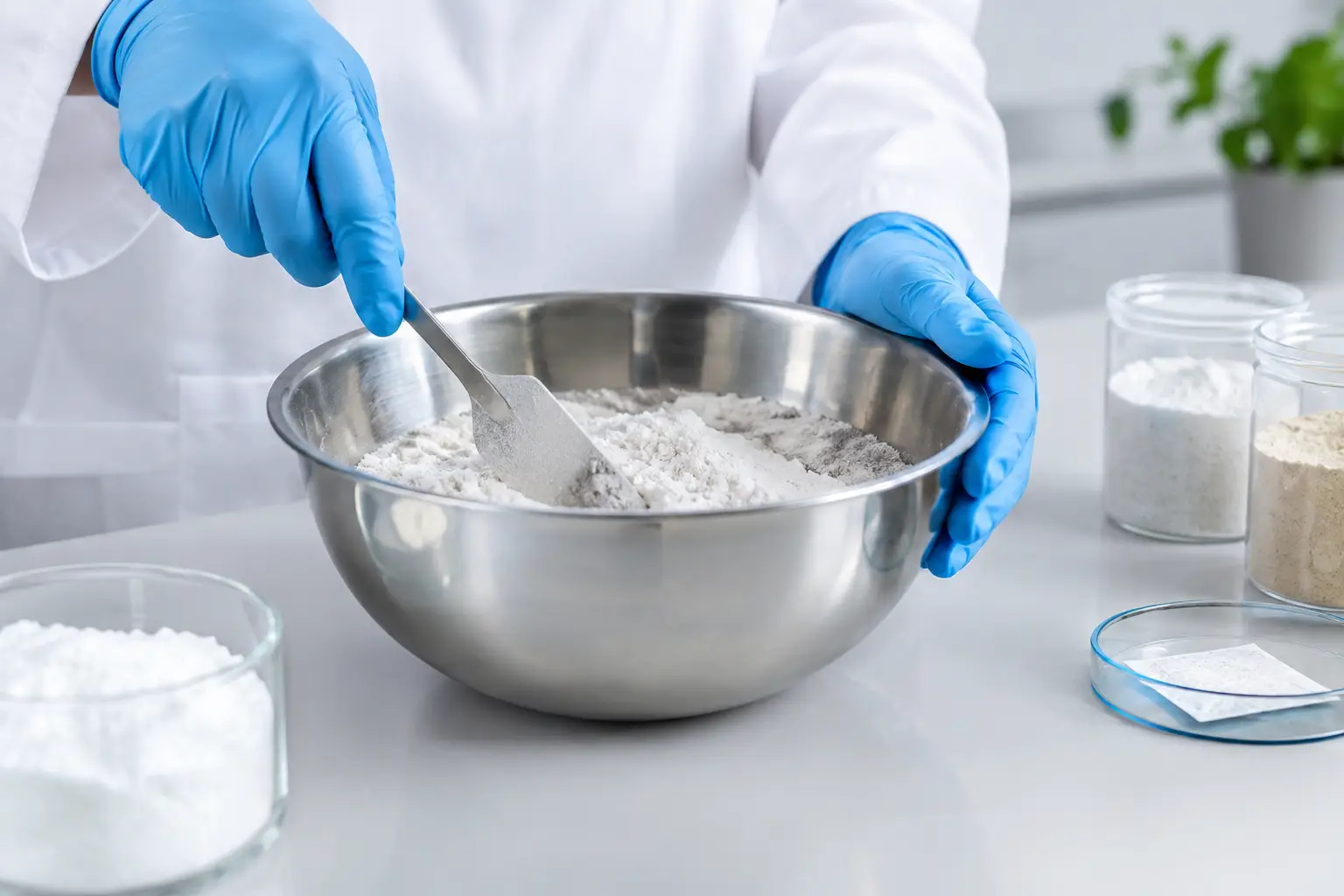
Powders can behave in ways that look similar in storage but become very different inside a mixer. Bulk density, particle size distribution, flowability, abrasiveness, cohesiveness, moisture sensitivity, and tendency to segregate all influence equipment performance. A free-flowing granular product may blend quickly in one geometry, while a cohesive fine powder may need a more deliberate mechanical action to achieve a uniform result.
Formulation structure matters just as much. If you are blending a base powder with trace additives, your mixer must distribute very small ingredient percentages consistently across the full batch. If you are working with fragile particles, aggressive shear may damage product integrity. If liquid is added during blending, the mixer must promote fast dispersion without creating wet lumps or product buildup on internal surfaces.
This is where many selection decisions improve. Buyers often focus first on horsepower, vessel size, or footprint. Those factors matter, but they come later. Material behavior determines whether a mixer will actually deliver superior mixing performance in production conditions.
Ribbon mixers and where they fit best
For many industrial dry blending applications, horizontal ribbon mixers remain a strong choice because they combine efficient convective mixing with broad application versatility. A properly configured ribbon agitator moves material in counter-current patterns, creating a reliable blend across powders, granules, and many bulk solids. For manufacturers that need consistent batch performance, short blend cycles, and dependable discharge, this design often provides an effective balance of speed, uniformity, and cost.
That does not mean ribbon mixers are the answer for every powder. Extremely fragile particles, highly adhesive products, or processes that require a very specialized shear profile may call for a different configuration. But in food, chemical, agricultural, plastics, and many technical powder applications, ribbon systems are often selected because they can handle varied product characteristics with predictable, repeatable results.
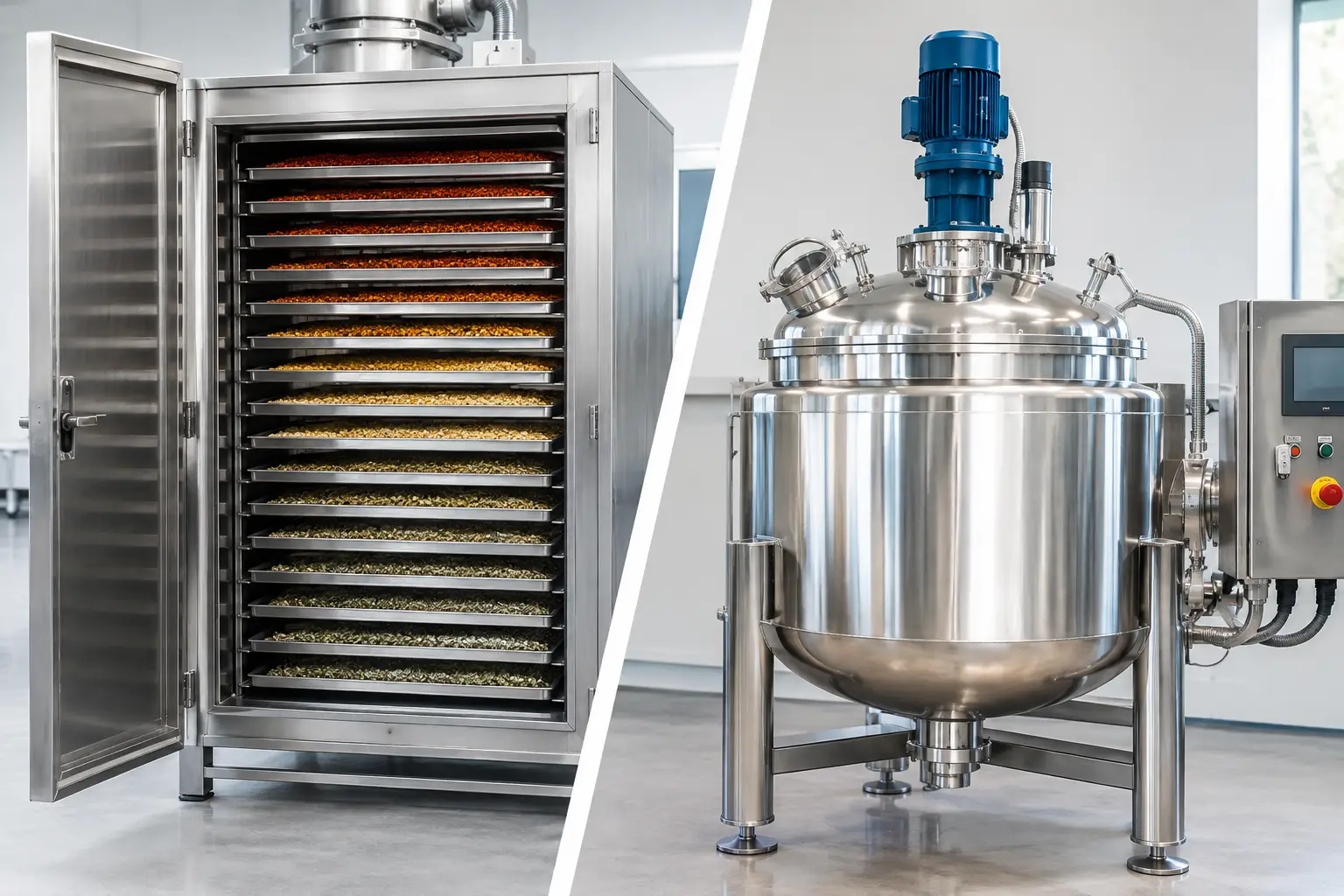
Vertical ribbon mixers can be a practical option when floor space, batch geometry, or specific handling needs favor a vertical design. Vacuum ribbon mixers and dryers become more relevant when the process extends beyond blending and requires moisture removal, controlled atmosphere operation, or thermal functionality in one system. Combining process steps can reduce handling time and improve production efficiency, but only when the application truly benefits from that integration.
Capacity is more than vessel volume
One of the most common purchasing errors is sizing equipment strictly by total vessel volume. Usable working capacity is what matters in real operation. A mixer must have enough fill level to generate proper material movement, but it also needs enough headspace and internal geometry to avoid dead zones, poor turnover, or inconsistent ingredient distribution.
Production targets should be calculated around actual batch weight, bulk density range, blend time, loading time, discharge time, and cleaning intervals. A mixer that appears large enough on paper may still underperform if changeovers are frequent or if discharge leaves excessive residual product behind. On the other hand, oversizing can reduce mixing efficiency at lower fill levels and increase both capital cost and operating cost.
For operations planning, it helps to evaluate not just maximum batch size but the realistic range of products the mixer will run. If your facility processes multiple formulations with different densities and flow characteristics, flexibility may be worth more than selecting a machine optimized for a single ideal batch.
Match the mixer to the process, not just the product
A strong powder blending equipment selection guide always looks beyond the blend chamber. Upstream and downstream conditions affect mixer performance in ways that are easy to underestimate. Ingredient feeding accuracy, sack dumping or bulk handling method, dust control, liquid spray systems, discharge valves, and transfer equipment all influence the final result.
For example, a well-designed mixer can still produce inconsistent batches if minor ingredients are introduced unevenly or if discharge equipment causes segregation after blending. Likewise, a mixer selected for dry blending alone may become a bottleneck if future production plans include liquid addition or vacuum drying. Good equipment selection considers the entire process path, including where the system may need to expand later.
This is also where configurable solutions become valuable. Shaft seals, internal finishes, access doors, spray nozzles, choppers, heating jackets, vacuum capability, and discharge arrangements should support the actual process, not simply add complexity. More features are not automatically better. The right features are the ones that improve reliability, cleanability, and batch consistency for your application.
Sanitation, compliance, and maintenance requirements
In regulated and hygiene-sensitive industries, mixer design has to support more than blend quality. Cleanability, surface finish, inspection access, and validation requirements may heavily influence equipment choice. Pharmaceutical, food, and cosmetic manufacturers often need designs that minimize residue retention and simplify cleaning between batches. In those environments, labor time spent on washdown or dry cleanout has a direct cost impact.
Maintenance should be reviewed with the same discipline. Bearings, seals, drives, and internal components must be accessible and durable enough for the production schedule. A lower purchase price does not help if service intervals are frequent or replacement parts create long stoppages. Downtime is one of the most expensive hidden costs in powder processing, especially when mixer failure disrupts multiple packaging or finishing lines downstream.
For many buyers, the best long-term value comes from equipment built for durability, low-energy operation, and reduced maintenance burden rather than a machine that only appears competitive at initial quote stage.
Testing and application expertise reduce selection risk
No catalog description can fully predict how a powder blend will behave in production. Material testing remains one of the most reliable ways to confirm mixer suitability, blend time expectations, and any need for customization. This is particularly important when formulations contain trace ingredients, difficult flow properties, abrasive solids, or a combination of dry and wet processing steps.
Application support also matters. An equipment supplier should be able to discuss your blend objective, material characteristics, discharge needs, cleanability targets, and future expansion plans with technical depth. That level of consultation helps prevent a mismatch between standard equipment and real operating conditions. PerMix approaches mixer selection in that practical way, with an emphasis on tailored solutions that align machine design with process demands.
How to make the final decision
At the final stage, compare options against business outcomes, not only equipment specifications. Ask which design is most likely to deliver consistent homogeneity, acceptable cycle time, manageable cleaning, low unplanned maintenance, and room for product variation. If two mixers can both blend the product, the better investment is usually the one that protects uptime and product quality more reliably over time.
It also helps to think in terms of operational fit. The best machine for your plant is not necessarily the most complex or the most specialized. It is the one that solves the actual production problem with the least friction. That may be a horizontal ribbon mixer for efficient batch blending across multiple formulas, a vertical design for a space-driven layout, or a vacuum-capable system where blending and drying must happen in one controlled environment.
A good selection process is disciplined but not complicated. Start with the material. Define the process. Evaluate capacity realistically. Review sanitation and maintenance expectations. Then choose the equipment configuration that gives your operation stable, repeatable performance instead of forcing your team to work around avoidable limitations.
The right mixer should not just blend powder. It should make the rest of the plant run better.