Horizontal Ribbon Mixer Review for Buyers
When a batch comes out uneven, the problem rarely starts in the recipe. It usually starts in the mixer. This horizontal ribbon mixer review is written for buyers and process teams who need more than a spec sheet – they need to know how a machine will perform under real production conditions, how it will hold up over time, and where the design trade-offs actually matter.
For many powder, granule, and light paste applications, the horizontal ribbon mixer remains one of the most practical and cost-effective mixing technologies available. It is widely used because it can deliver fast, repeatable blending across a broad range of materials while keeping energy use and maintenance demands within reason. That said, not every ribbon mixer is built for the same duty, and not every process should be matched to the same configuration.
Horizontal ribbon mixer review: what the machine does well
A horizontal ribbon mixer uses inner and outer helical ribbons mounted on a horizontal shaft to move material in opposing axial directions while also creating radial mixing. In practical terms, this means it can circulate product through the trough efficiently and produce a consistent blend in relatively short cycle times.
Its biggest strength is versatility. A well-designed unit can handle dry powders, granules, fibers, and certain wet or paste-like formulations. That makes it a strong fit for manufacturers running multiple SKUs or changing formulations over time. Food processors, chemical plants, agricultural producers, cosmetic manufacturers, and pharmaceutical operations often favor this design because it can support different product families without forcing a complete process redesign.
Another advantage is throughput. Horizontal ribbon mixers are suited to batch production environments where operators need reliable blending at scale. Compared with slower or less aggressive mixer types, ribbon systems often reduce batch time while maintaining acceptable uniformity. For plants looking to increase output without adding excessive complexity, that matters.
Where performance depends on the application
This is where any honest horizontal ribbon mixer review needs to slow down. Ribbon mixers are not universal answers. They perform best when the machine geometry, fill level, material characteristics, and discharge design are aligned with the product.
Free-flowing powders usually mix very well in this format. Materials with similar bulk density and particle size are typically straightforward. The challenge increases when the formula includes trace ingredients, fragile particles, sticky additives, or a wide variation in density. A ribbon mixer can still be the right choice, but only if the design accounts for those conditions.
For example, a processor blending minor active ingredients into a bulk carrier may need tighter mixing validation, more controlled cycle times, and attention to dead zones. A food manufacturer introducing liquid flavoring into dry ingredients may need choppers, spray systems, or a specific ribbon profile to prevent localized buildup. A plant handling abrasive materials may prioritize wear resistance over lower initial cost.
That is why buyers should be cautious of simple claims about “uniform mixing” without process context. A mixer that performs well in one plant may underperform in another if the material behavior changes.
Design quality separates average machines from dependable ones
At a distance, many ribbon mixers look similar. In operation, the details are not minor.
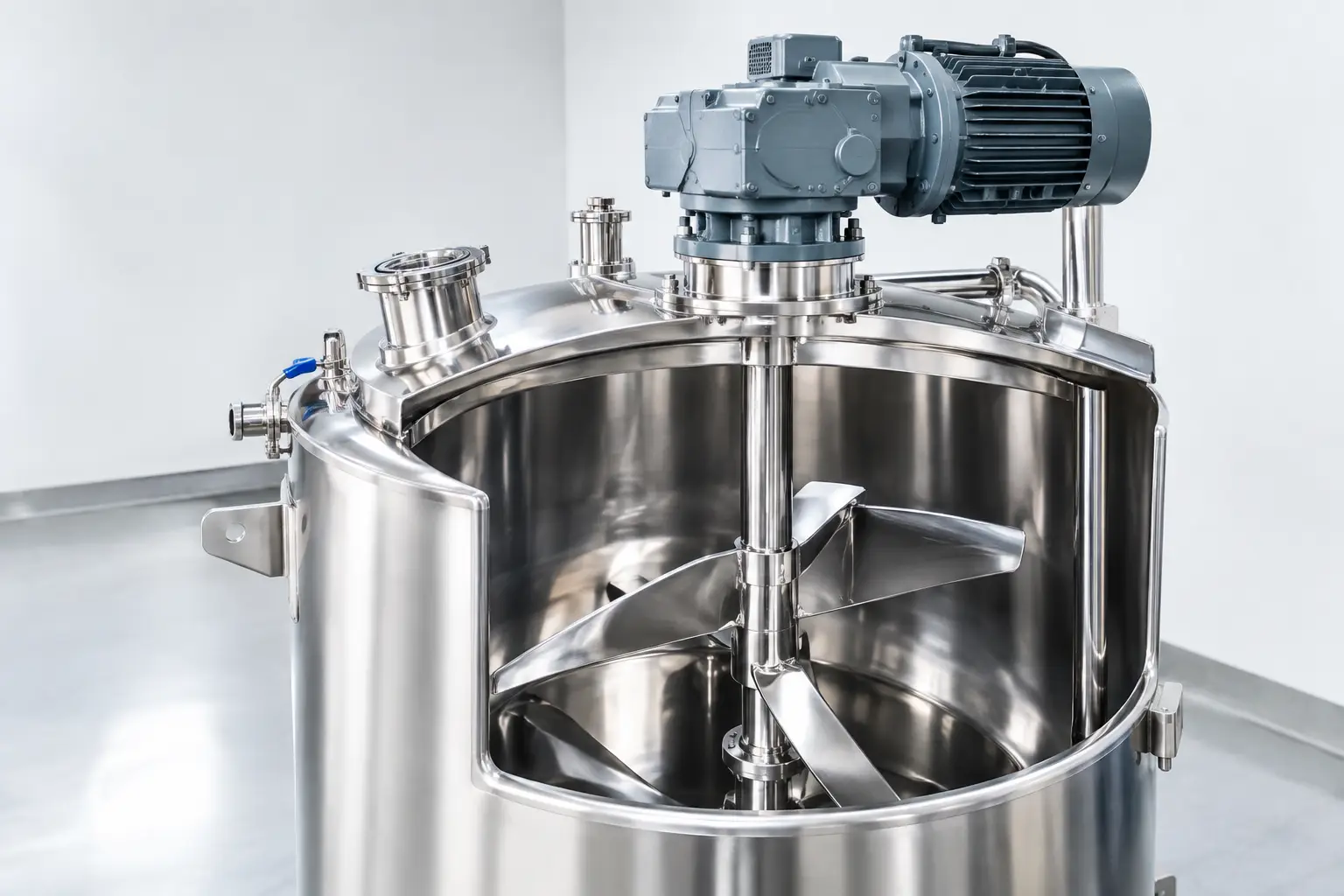
Trough geometry, ribbon clearance, shaft strength, weld quality, drive sizing, bearing protection, and discharge valve design all affect long-term performance. If the ribbon-to-trough clearance is not controlled properly, you can see reduced mixing efficiency or excess residue. If the discharge system is poorly designed, material retention increases and cleaning takes longer. If the drive is undersized for bulk density or starting load, reliability suffers.
Construction quality also affects process consistency. Industrial buyers are not just purchasing a vessel with an agitator. They are buying uptime, repeatability, and the ability to hold performance over years of production. In regulated or high-value applications, those factors carry more weight than a lower purchase price.
A strong design should also reflect the application environment. Sanitary builds, polished contact surfaces, special seals, heating or cooling jackets, vacuum capability, and heavy-duty wear options are not extras for the sake of marketing. In the right process, they are essential.
Horizontal ribbon mixer review: maintenance and sanitation reality
One reason ribbon mixers remain attractive is that they are mechanically straightforward compared with some more specialized blending systems. That can translate into easier maintenance and lower operating cost. But maintenance simplicity depends on access and component quality.
A buyer should look closely at shaft seals, bearing arrangement, gearbox selection, cleanout access, and discharge valve serviceability. These are the areas that tend to determine whether a mixer becomes a dependable production asset or a recurring maintenance project. If operators cannot inspect or clean key areas easily, downtime rises and product changeovers become harder to manage.
Sanitation is another point where the right machine can outperform expectations – or create frustration. For food, pharma, and cosmetics, cleanability is not optional. Smooth internal finishes, minimized crevices, proper welds, and easy-access covers directly affect turnaround time and compliance confidence. If you run frequent recipe changes, cleaning labor may matter as much as mixing speed.
There is also a practical trade-off here. Higher sanitary standards and more accessible designs usually increase capital cost. For some operations, that investment pays back quickly through faster changeovers and less product loss. For others, a simpler industrial finish may be enough.
Energy use and operating efficiency
Horizontal ribbon mixers are often chosen because they offer a favorable balance between mixing intensity and power consumption. They do not require the extreme energy input of some high-shear systems, and for many dry blending duties they deliver strong efficiency per batch.
Still, energy performance should be evaluated in context. A machine that mixes quickly but leaves residue, causes rework, or requires extended cleaning is not truly efficient. Likewise, a lower-horsepower mixer is not automatically the better value if it struggles with full loads or variable-density materials.
The better question is whether the mixer supports stable, repeatable production with minimal waste. That includes batch time, discharge completeness, maintenance intervals, and product loss during cleaning. Sustainable and cost-effective operation comes from the full process result, not one power number.
What industrial buyers should evaluate before requesting a quote
A serious review should move beyond brochure language and into selection criteria. Buyers should start with the material itself. Bulk density, particle size distribution, moisture level, flow behavior, abrasiveness, and required batch size all influence the right mixer configuration.
Next comes the process target. Are you blending for visual consistency, analytical uniformity, coating, minor ingredient dispersion, or liquid addition? Each goal shifts what matters most. Some applications need short cycles and fast discharge. Others need more controlled mixing action to protect particle integrity.
Then consider plant realities. Ceiling height, upstream and downstream equipment, cleaning procedures, operator access, and utility availability all shape the final specification. A technically sound mixer that is difficult to integrate into the production line can still become an expensive mistake.
This is where an application-focused manufacturer adds value. PerMix, for example, approaches ribbon mixer selection as an engineering decision tied to product behavior and production goals, not just vessel volume. That matters because the best mixer purchase is rarely the cheapest unit on paper. It is the one that solves the blending problem with the least operational friction.
The verdict for most production environments
For many industrial mixing duties, the horizontal ribbon mixer remains a strong investment. It offers superior mixing performance across a broad range of powders and granules, supports efficient batch processing, and can be configured for demanding production requirements. When properly specified, it is a dependable, sustainable, and cost-effective solution.
Its limitations are not deal breakers, but they are real. Very delicate materials, highly cohesive products, and processes with extreme sanitary demands may require added design features or a different mixer type altogether. That is not a weakness of the technology. It is simply a reminder that good equipment selection is application specific.
If you are evaluating a ribbon mixer, look past general claims and focus on fit. Ask how the machine handles your material, how it discharges, how it cleans, and how it will perform after years of use. The right answer is the one that supports consistent quality on the plant floor, not just in the quotation package.
A mixer should reduce risk, not add uncertainty. When the design is matched to the process, a horizontal ribbon mixer can do exactly that.