How to Reduce Mixing Energy Without Sacrificing Quality
A mixer that delivers a uniform blend but draws unnecessary power is quietly raising the cost of every batch. For processors handling powders, granules, pastes, and other bulk solids, the goal is not simply to make the agitator turn more slowly. To reduce mixing energy effectively, the mixing system must achieve the required homogeneity, discharge performance, and cycle time with the least practical mechanical input.
That requires a process view. Energy use is shaped by material behavior, batch fill level, mixer geometry, operating speed, sequencing, and the condition of the equipment. Reducing one variable without understanding the others can create a false economy, especially in applications where blend consistency, sanitation, and traceability are non-negotiable.
How to Reduce Mixing Energy at the Process Level
The largest energy savings usually come from selecting and operating a mixer for the actual material, not for a generic product category. A free-flowing dry premix behaves very differently from a cohesive powder, a high-fat food blend, a fragile granule, or a damp chemical paste. Each requires a different balance of convective movement, shear, and residence time.
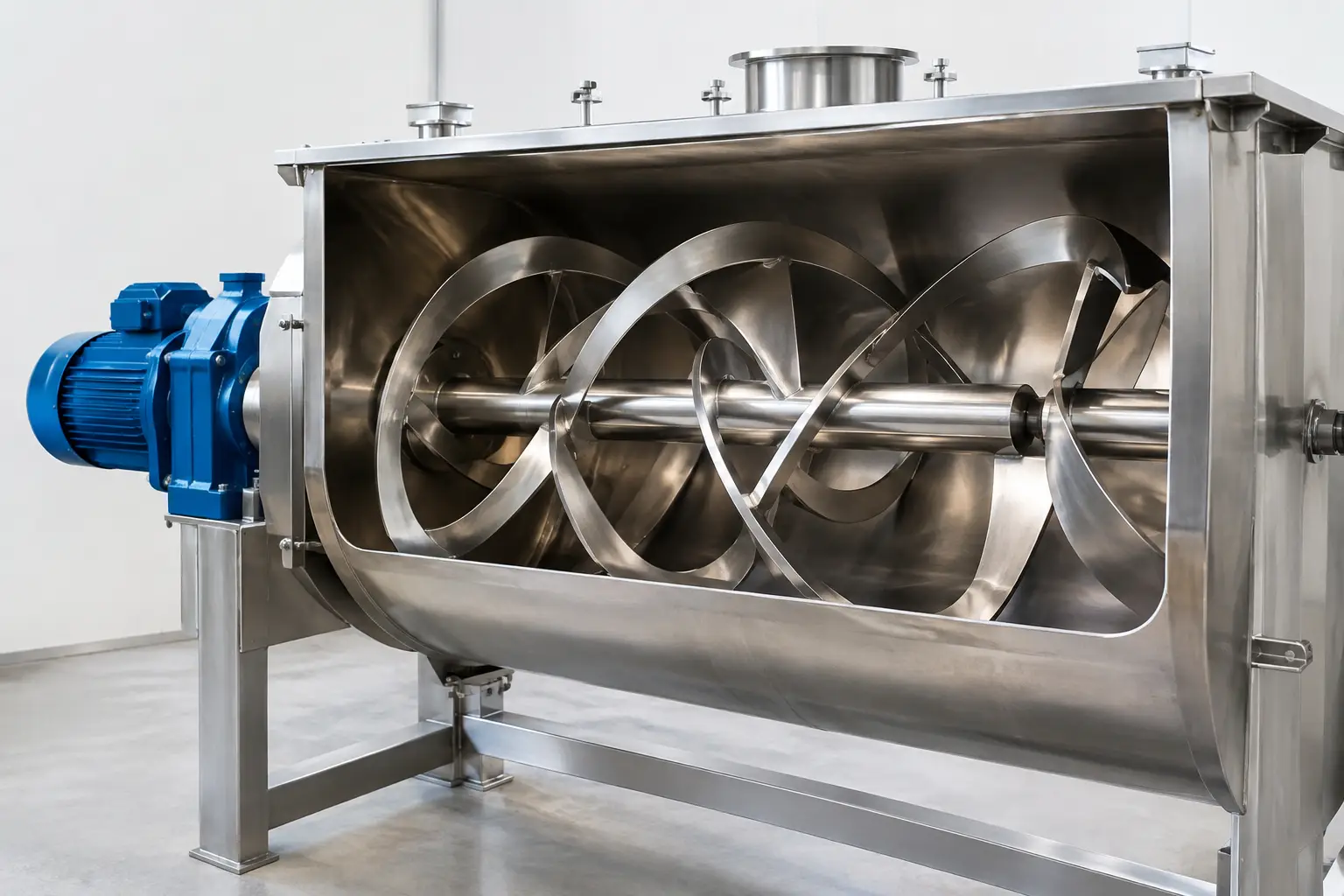
Ribbon mixers are highly effective when a process needs broad material circulation and reliable blending across a horizontal batch. Their inner and outer ribbons move material in opposing directions, creating a continuous folding and redistribution pattern. When the ribbon configuration, trough geometry, and drive are correctly matched to the product, the mixer can reach specification without excessive speed or prolonged run time.
The practical question is not, “What is the lowest motor horsepower available?” It is, “What operating point produces the required blend at the lowest total energy per accepted batch?” An undersized mixer may run at high load for too long. An oversized or poorly configured unit may consume power without improving the result. Both conditions add cost.
Start with Material Characterization
Before changing speed settings or replacing equipment, define what the material is doing inside the mixer. Bulk density, particle size distribution, moisture level, flowability, friability, and cohesion all influence torque demand and mixing time. Small changes in formulation can also alter the process substantially. A powder blend that flows well at room temperature may become difficult to move after the addition of oil, heat-sensitive ingredients, or a minor liquid component.
For challenging applications, testing should include the intended ingredient addition sequence. Adding a binder, colorant, or active ingredient at the wrong point can form agglomerates that demand more mixing time and higher power to break apart. In some cases, changing the liquid injection method or the order of addition delivers more savings than changing the mixer itself.
Product behavior also determines whether low-shear ribbon mixing is the right solution. Some formulations require intensifiers or choppers for dispersion, while others benefit from avoiding unnecessary high-shear action. The correct design is application-specific.
Match Batch Size to Usable Mixer Capacity
Batch loading has a direct effect on mixing efficiency. A ribbon mixer needs enough material in the trough for the ribbons to engage and circulate the batch properly. At very low fill levels, material may travel unevenly and require longer run times. At excessive fill levels, movement becomes restricted, torque rises, and dead zones can develop.
The optimum working capacity depends on product properties and mixer design, but it should be established during process development rather than estimated from total vessel volume alone. A batch size that appears efficient on paper can increase energy use if it lengthens the mixing cycle, causes repeated blending, or slows discharge.
Consistent batch loading matters as much as nominal capacity. When one shift runs at 45 percent fill and another runs at 70 percent, the same timer setting is unlikely to produce the same result. Standardized load targets, ingredient weights, and charging procedures give operators a stable foundation for energy control.
Avoid Mixing Beyond the Required Endpoint
Many operations use fixed mixing times with a large safety margin. That practice may protect quality when the process is poorly understood, but it often consumes power after the blend has already reached uniformity. It can also damage fragile particles, create unwanted heat, or increase segregation risk during extended handling.
Blend validation should establish the minimum time required to meet the defined acceptance criteria at the chosen fill level and speed. Sampling plans should reflect the real discharge path and account for low-dose ingredients, not just the average composition of the batch. Once validated, the process can use a controlled time window instead of relying on habit.
A reduction of even two or three minutes per batch can be meaningful in a high-volume plant. The gain includes motor energy, reduced wear on bearings and seals, and more available production capacity.
Use Speed Control with a Clear Purpose
Variable frequency drives can be valuable tools for reducing mixing energy, but they are not automatic efficiency devices. Lowering speed generally lowers instantaneous power draw, yet it may extend the batch long enough to increase total kilowatt-hours. Conversely, a brief higher-speed phase may disperse an ingredient quickly and allow the rest of the cycle to run at a lower setting.
The best speed profile depends on the formulation. A typical approach may use moderate speed during dry blending, a controlled speed during liquid addition, and a short finishing phase only if testing shows it is needed. For heat-sensitive, fragile, or segregation-prone materials, the profile should minimize unnecessary agitation after the target is achieved.
Motor current, torque, batch time, and product temperature are useful operating indicators. Tracking them by recipe helps process teams recognize when a formulation change, incoming raw material variation, or mechanical issue is increasing the energy required to mix.
Reduce Friction, Drag, and Mechanical Losses
Not all mixing energy goes into moving product. Worn bearings, misalignment, inadequate lubrication, damaged ribbon elements, and failing seals can increase resistance at the drive. These issues may appear first as rising amp draw, abnormal noise, vibration, or a gradual increase in cycle time.
A disciplined maintenance program protects both reliability and energy performance. Inspect drive components, gearbox condition, bearing temperatures, shaft alignment, and ribbon clearances on a schedule based on duty cycle and material abrasiveness. For sanitary applications, inspection routines should also verify that cleaning procedures do not compromise seals or leave buildup that changes the mixer’s effective geometry.
Material accumulation is especially costly. A sticky coating on ribbons or the trough wall reduces free movement and can force operators to extend the cycle. In some applications, surface finish, jacket temperature control, anti-stick features, or a revised cleaning schedule can prevent buildup before it becomes a production problem.
Consider Discharge and Material Handling Energy
The motor on the mixer is only one part of the energy picture. A process that mixes efficiently but discharges slowly, retains product, or requires repeated manual intervention wastes labor and often adds energy downstream. Poor discharge can also force a longer blend time because operators are trying to compensate for inconsistent material movement.
A properly designed discharge valve, trough configuration, and downstream transfer arrangement help protect the value created during mixing. For products that bridge, smear, or retain in corners, the discharge system should be engineered as part of the complete process. The right solution may involve valve selection, outlet size, internal geometry, or controlled post-mix handling rather than more agitation.
Vacuum ribbon mixers and dryers deserve particular attention where drying and blending occur in the same vessel. Combining operations can reduce material transfers, cleaning demands, and handling losses. However, vacuum level, heating method, product temperature limits, and evaporation rate must be balanced carefully. The lowest energy approach is not always the highest heat input. Efficient heat transfer and stable vacuum performance can often shorten the cycle without stressing the product.
Build Energy Measurement into Production Decisions
Plants cannot improve what they do not measure. Recording total batch energy, not just instantaneous motor load, creates a more useful baseline. Pair the energy data with recipe, batch weight, fill percentage, mixing time, speed profile, material lot, and quality results. Over time, this information shows which products are operating efficiently and which require engineering attention.
Useful metrics include kilowatt-hours per batch, kilowatt-hours per ton, average mixing time, peak amp draw, and rejected or reworked batches. No single number tells the full story. A slightly higher energy use may be justified if it prevents costly quality failures, while a lower-energy cycle is not a win if it increases blend variability.
For new equipment or process upgrades, request a discussion centered on the material and production objective. PerMix Ribbon Mixers can evaluate ribbon configuration, drive sizing, fill level, discharge needs, and optional features to develop a solution tailored to the application rather than applying a standard mixer design.
Energy Savings Should Protect Product Value
The strongest mixing programs treat energy reduction as a result of better process control, not as an isolated cost-cutting exercise. Start with a validated blend endpoint, operate within the mixer’s effective working range, and monitor mechanical condition before inefficiency becomes downtime. Then test speed, sequencing, and batch parameters against real product quality data.
When every kilowatt-hour is tied to a controlled, repeatable batch outcome, lower energy use becomes a sustainable operating advantage rather than a short-term adjustment.