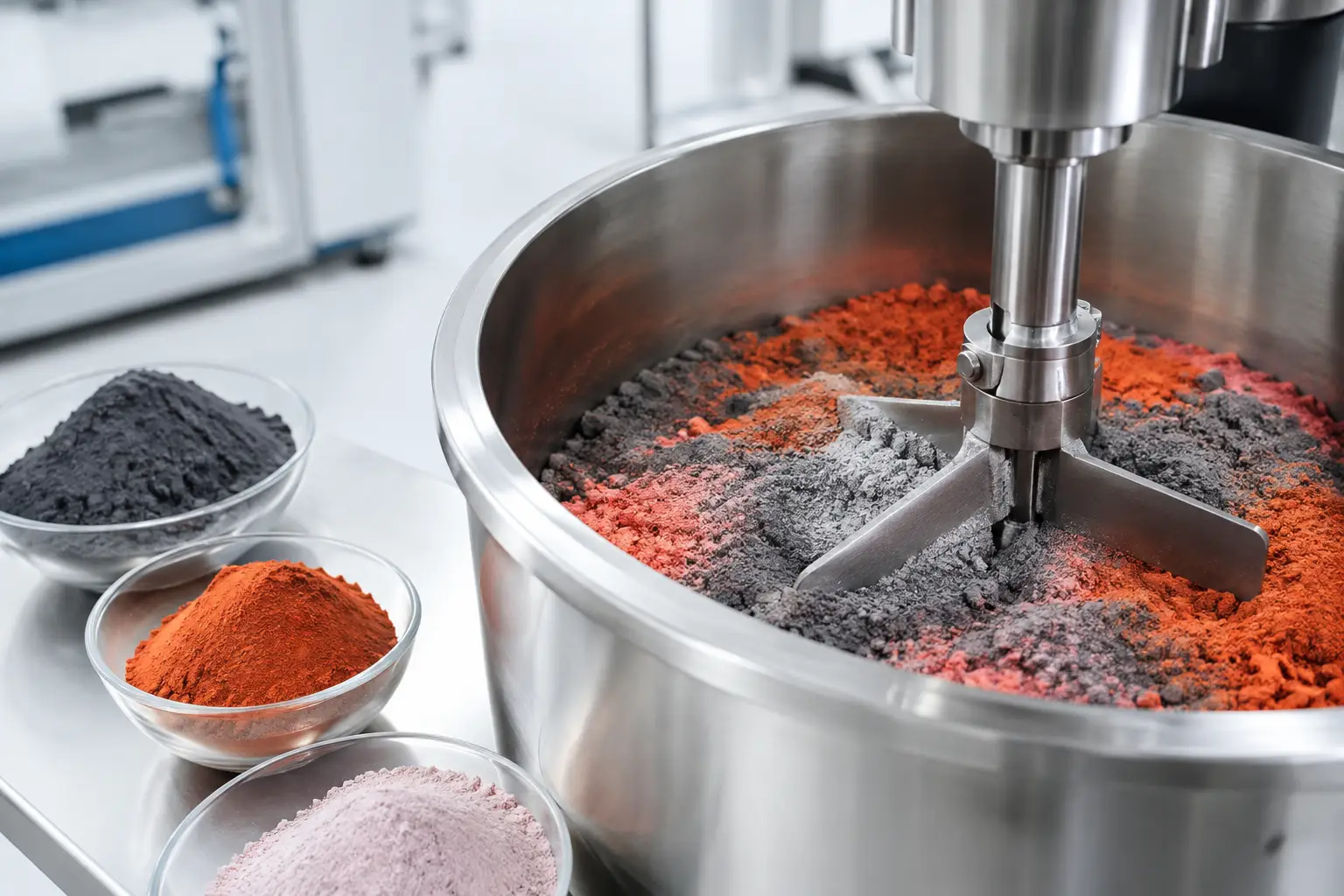
A Polymer Compounding Example That Gets Mixing Right
A useful polymer compounding example starts before the extruder. When resin, fillers, pigments, stabilizers, and performance additives enter the process with poor distribution, downstream melting cannot always correct the problem. The result may be color variation, unstable mechanical properties, visible specks, inconsistent pellet quality, and avoidable scrap.
For plastics processors, the practical objective is not simply to combine ingredients. It is to create a repeatable preblend that feeds consistently, protects fragile materials, and supports the target output without adding unnecessary cycle time or operating cost. That calls for a mixer selected around the formulation, batch size, material behavior, and cleaning requirements.
A polymer compounding example: glass-filled polypropylene
Consider a manufacturer producing a 30% glass-filled polypropylene compound for injection-molded automotive components. The finished compound needs predictable stiffness, impact performance, color, and flow properties across production lots. Even a small shift in filler loading or additive distribution can create quality problems at the molding press.
A representative batch may include polypropylene resin pellets, chopped glass fiber, a mineral filler, carbon black masterbatch, antioxidant, lubricant, and a coupling agent. Some components arrive as free-flowing pellets or granules, while others are fine powders. The glass fiber must retain its usable length. The powder additives must not form concentrated pockets. Carbon black must distribute evenly enough to prevent streaking or shade variation.
This is where dry preblending has a direct effect on both product quality and production economics. A homogeneous batch allows the extruder feeder to receive a more uniform material stream. That reduces formulation swings and gives the process team a more stable foundation for temperature, pressure, torque, and throughput control.
The batch sequence matters
The order of addition is often as important as the mixer itself. In this example, the process may begin by charging polypropylene pellets and selected powder additives into a horizontal ribbon mixer. The mixer distributes the powders over the resin surfaces before introducing the more damage-sensitive chopped glass fiber. Liquid coupling agents or lubricants, if used, can be sprayed in a controlled manner to avoid localized wet spots and powder agglomeration.
Once the initial ingredients are dispersed, glass fiber is added later in the cycle and mixed only as long as required to achieve uniform distribution. Excessive mixing can contribute to fiber breakage, especially when the material sees high shear or aggressive mechanical handling. Too little mixing, however, may leave fiber-rich and fiber-poor zones that affect part performance.
The correct sequence depends on the formulation. A high-loading mineral-filled compound may require more attention to powder wetting and dispersion. A color-sensitive product may require a longer validation process to confirm pigment distribution. Materials with very different bulk densities may need controlled charging rates and mixer fill levels to prevent stratification.
Why a ribbon mixer fits many polymer preblends
Horizontal ribbon mixers are widely used for polymer compounding preblends because they create a controlled convective mixing pattern. Inner and outer ribbons move material in opposing directions, continuously transferring material across the length and cross-section of the trough. This action helps distribute powders, pellets, flakes, granules, and selected fibrous materials without relying on extreme shear.
For the glass-filled polypropylene example, a properly configured ribbon mixer can deliver several production advantages. It can process a wide range of batch sizes, accommodate materials with different particle sizes and bulk densities, and discharge efficiently to downstream conveying or extrusion equipment. The horizontal design also provides good access for inspection, cleaning, and maintenance.
Mixer geometry should be matched to the product. Ribbon pitch, ribbon clearance, shaft speed, drive size, and discharge configuration all influence performance. A formulation containing cohesive powders may need more mixing energy than a simple pellet-and-additive blend. A batch with fragile fibers may benefit from a gentler operating profile. The goal is not maximum agitation. It is sufficient, repeatable mixing with minimal material damage.
PerMix Ribbon Mixers can be configured around those operating realities, including material-contact finishes, spray bars for liquid addition, dust-control features, and discharge options that support the plant’s preferred transfer method.
Process conditions that determine blend quality
A mixer cannot compensate for uncontrolled incoming materials. Successful polymer compounding begins with defined material specifications and disciplined batch handling. Moisture content, particle size, density, temperature, and flow behavior can all change how ingredients distribute during blending.
In practice, process engineers should validate the following conditions during development and scale-up:
- Ingredient addition order and charge rate
- Batch fill level and usable working volume
- Mixing speed and total blend time
- Powder dispersion and fiber integrity
- Liquid-addition location and spray rate
- Discharge behavior and segregation risk
A ribbon mixer is generally most effective within its intended fill range. An underfilled mixer may not generate the desired material movement, while an overfilled unit can limit circulation and extend mixing time. The ideal operating level depends on the material’s bulk density, flow characteristics, and required batch output.
Mixing time should be established through testing rather than assumed from a previous formulation. A 10-minute cycle may be sufficient for one pellet-and-powder blend but inadequate for another with a low-dose pigment, a sticky liquid, or a high concentration of fine filler. Conversely, running longer than necessary consumes energy, limits throughput, and can increase the chance of particle attrition or fiber damage.
Preventing segregation after the blend is complete
A good blend can lose uniformity between the mixer discharge and the extruder hopper. This risk is particularly relevant when pellets, powders, and fibers differ sharply in size, density, or shape. Fine materials may settle, while larger particles or lightweight fibers can migrate during conveying, storage, or vibration.
The discharge path should therefore be considered part of the mixing system. Short, controlled transfers are preferable to long drops and unnecessary material handling. Hopper design, conveying velocity, transfer bends, and intermediate storage time should all be reviewed during process design. In some operations, direct discharge from the mixer to a day bin or feeder system provides better consistency than repeated transfers through multiple conveyors.
Plants should also assess discharge completeness. Material retained in corners, near seals, or around the outlet can contaminate the next batch or alter the actual formulation of the current batch. A full-width or appropriately sized discharge valve helps support efficient emptying, especially with blends containing powders that may bridge or cling to surfaces.
Verifying the compound before production losses occur
Blend validation should connect directly to the performance requirements of the final polymer compound. Visual inspection is useful for detecting obvious color streaks or unmixed powder, but it is not enough for technical formulations. Sampling plans should collect material from multiple locations, including early, middle, and late discharge points.
For the glass-filled polypropylene example, quality checks may include ash content to verify glass loading, melt flow testing, color measurement, moisture analysis, and molded-part mechanical testing. If a low-dose additive is critical to weatherability, flame resistance, or process stability, analytical testing should confirm its distribution rather than relying only on nominal batch calculations.
The strongest approach is to establish acceptable variation limits during trials, then use those limits to guide operating procedures. When the process changes – such as a new resin grade, filler source, batch size, or mixer speed – the blend should be revalidated. Small raw-material changes can alter flow behavior enough to affect mixing performance.
Selecting equipment around the actual formulation
There is no single mixer configuration that suits every polymer compounding operation. A free-flowing pellet blend may prioritize high throughput and rapid discharge. A formulation with powders and liquid additives may need intensified dispersion features, dust-tight construction, and carefully placed injection points. Products that require oxygen-sensitive handling or vacuum drying call for a different processing approach than standard dry blending.
The best equipment decision comes from defining the material and the production target in practical terms: batch weight, bulk density, component ratios, allowable cycle time, cleaning frequency, downstream feed method, and the consequences of an off-spec batch. Those details allow the mixer to be sized and configured for the work it must perform rather than selected by volume alone.
A productive next step is to run a representative blend trial with actual materials and evaluate uniformity at discharge, not just inside the mixer. That is where a polymer compounding process proves whether it can deliver reliable pellets, stable production, and lower-cost quality control over the long term.