Applications of Ribbon Mixers in Industry
Applications of Ribbon Mixers in Industry
When a batch leaves the mixer with uneven distribution, the problem rarely stays in the mixing room. It shows up as rejected product, inconsistent dosing, longer cycle times, and avoidable downtime downstream. That is why the applications of ribbon mixers matter so much in industrial processing. For manufacturers handling powders, granules, fibers, and pastes, ribbon mixers remain one of the most practical ways to achieve repeatable, high-capacity blending without adding unnecessary complexity.
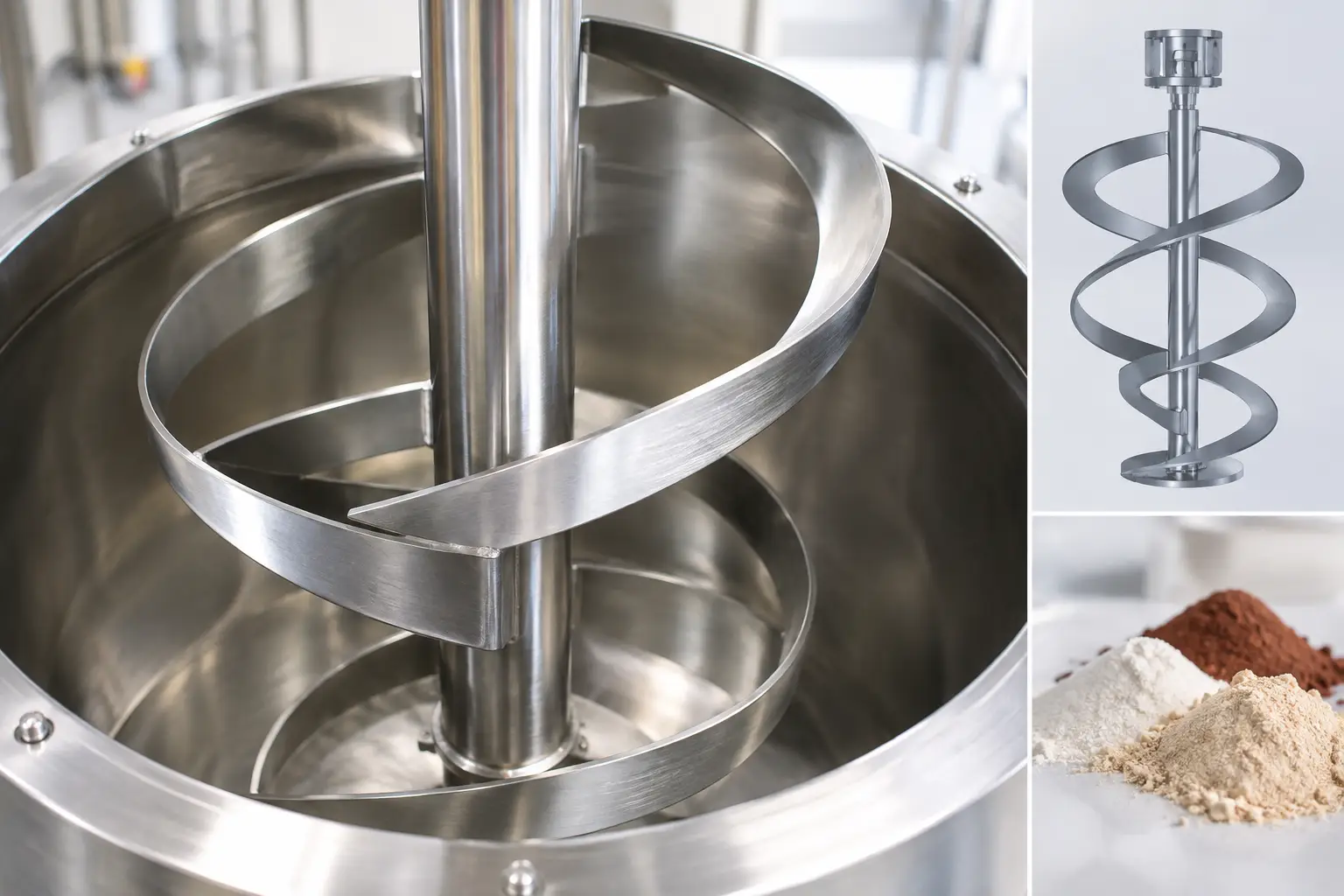
Ribbon mixers are widely used because they can handle a broad range of materials while maintaining strong mixing performance and manageable operating costs. Their basic working principle is straightforward. Inner and outer ribbons move material in opposing directions inside a horizontal or vertical vessel, creating a balanced flow pattern that promotes fast and uniform blending. What makes them valuable is not just that they mix, but that they can be configured for specific products, batch sizes, discharge requirements, sanitation standards, and process constraints.
Why the applications of ribbon mixers are so broad
Few industrial mixers are as adaptable across sectors as the ribbon mixer. In one facility, it may be blending dry food ingredients with tight recipe tolerances. In another, it may be preparing chemical compounds with fillers, pigments, or additives that behave very differently in the vessel. The same core technology can also be used for paste-like materials, moisture-conditioned products, and vacuum drying duties when the process calls for more than simple dry blending.
That range comes from a few practical strengths. Ribbon mixers offer good batch homogeneity, short blending times for many formulations, and a vessel design that can be built around discharge efficiency and cleanability. They also scale well for industrial production. For operations teams, that means one machine concept can often support multiple SKUs or production campaigns with fewer process compromises.
Still, application fit depends on the material. Ribbon mixers are excellent for many free-flowing and semi-cohesive products, but they are not the best answer for every shear-sensitive or highly adhesive formulation. Material density, particle size variation, moisture level, and fill rate all affect performance. That is why equipment selection should be tied to the product and process, not just the category name.
Food processing applications
In food manufacturing, consistency is non-negotiable. Whether the batch includes flour, starches, protein powders, seasonings, sugar, cocoa, spice blends, or functional additives, poor distribution can affect taste, appearance, nutrition, and label accuracy. Ribbon mixers are commonly used for dry blending because they deliver gentle but effective movement across large batch volumes.
For powdered drink mixes, baking premixes, soup bases, seasoning blends, and snack coatings, the goal is usually the same: even distribution without damaging ingredients or creating excessive fines. A well-designed ribbon mixer can also support liquid addition, which is useful when oils, flavors, or colorants need to be sprayed into a dry mix. The exact configuration matters here. If the liquid addition rate is too high for the formulation, clumping can become an issue, so spray system design and mixing intensity need to be matched carefully.
Sanitation is another major factor in food applications. Buyers often need polished contact surfaces, easy-access cleaning, and discharge designs that reduce material hold-up. In facilities running allergen control programs or frequent changeovers, cleanability may matter just as much as blend time.
Pharmaceutical and nutraceutical blending
Pharmaceutical and nutraceutical producers use ribbon mixers for dry powder blending, excipient mixing, supplement premixes, and intermediate batch preparation where homogeneity and repeatability are critical. In these environments, the mixer is not just a production asset. It is part of a validated process.
The advantage of ribbon mixing in these applications is controlled, repeatable blending for powders and granules that need consistent ingredient distribution. This is especially important when active components or micro-ingredients must be dispersed uniformly through a larger bulk base. Depending on the formulation, a ribbon mixer may be used upstream of granulation, tableting, encapsulation, or sachet filling.
The trade-off is that highly potent products, strict containment requirements, or very delicate particles may call for more specialized equipment or additional safeguards. Pharmaceutical buyers typically look beyond nominal mixing capacity and focus on surface finish, dead-spot reduction, sampling access, validation support, and batch-to-batch reproducibility. For those reasons, configurable engineering is often more valuable than a standard off-the-shelf design.
Chemical processing and specialty materials
Chemical plants rely on ribbon mixers for products that range from powdered detergents and dry additives to construction chemicals, pigments, catalysts, and specialty compounds. These materials often present more variation than food products, both in bulk density and in flow behavior. Some are free-flowing, others are abrasive, dusty, or prone to segregation.
This is where ribbon mixers deliver strong practical value. They can blend different particle sizes and densities efficiently when the process is designed correctly, and they can be built with wear-resistant materials, specialty coatings, or sealing options to suit the application. For many chemical processors, the ability to integrate charging, venting, dust control, and reliable discharge is as important as the actual mixing action.
Certain chemical formulations also benefit from vacuum ribbon mixers and dryers, particularly when the process requires solvent removal, low-temperature drying, or blending under reduced pressure. In those cases, the mixer becomes a more integrated processing system rather than a standalone batch blender.
Plastics, polymers, and masterbatch preparation
The applications of ribbon mixers also extend into plastics and polymer processing, where uniform distribution of additives can have a direct effect on product quality and downstream conversion performance. Compounders and processors often use ribbon mixers for blending polymer powders, pellets, pigments, stabilizers, fillers, and regrind before extrusion or further processing.
A key benefit here is batch consistency. If additives are not dispersed evenly before the next process step, the result can be visible defects, off-spec properties, or unstable processing behavior. Ribbon mixers help create a more uniform feed material, which supports more predictable throughput and quality in extrusion or molding operations.
For abrasive fillers or high-volume production, durability becomes a deciding factor. Mixer design should account for wear, discharge reliability, and the possibility of material build-up. A machine that mixes well on paper but creates cleanup delays between batches may not improve the overall process.
Agriculture and animal feed production
In agriculture, ribbon mixers are commonly used for fertilizer blends, feed premixes, mineral mixes, and seed treatment formulations. These applications often involve large volumes, practical production schedules, and materials with very different flow properties.
Feed and premix producers in particular need dependable ingredient distribution, especially when vitamins, minerals, medications, or trace additives are included at low percentages. Uneven mixing can create compliance issues and product performance problems. Ribbon mixers are well suited for these dry blending duties because they provide efficient circulation across the vessel and can be sized for routine batch production.
Some agricultural products also involve moisture or liquid addition. That can work well in a ribbon mixer if the formulation remains within the machine’s effective handling range. Once stickiness increases beyond a certain point, a different mixer type may become the better choice.
Paste, slurry, and vacuum process applications
While ribbon mixers are often associated with dry solids, they are also used for thicker materials such as pastes, putties, slurries, and moist compounds. In these cases, ribbon design, drive sizing, and vessel geometry need to match the product’s resistance and flow behavior.
This matters in sectors such as cosmetics, specialty chemicals, and certain food processes where products are not fully dry but still benefit from strong convective mixing. Vacuum ribbon mixers and dryers add another layer of process capability by combining mixing with heating and moisture removal. That can reduce handling steps and improve process efficiency for temperature-sensitive or solvent-bearing materials.
Not every semi-solid belongs in a ribbon mixer, and that is where experienced application review becomes essential. Viscosity, heat transfer requirements, and discharge behavior all affect whether the technology is the right fit.
Choosing the right ribbon mixer for the job
The best results come from matching mixer design to the application, not forcing the application into a standard machine. Horizontal ribbon mixers are often preferred for high-efficiency batch blending of powders and granules. Vertical ribbon mixers can be useful where floor space, product flow, or specific handling needs point in that direction. Vacuum ribbon mixers and dryers are suited to more advanced processing duties that combine blending with thermal or vacuum requirements.
Industrial buyers should evaluate the material first, then the process. Questions around batch size, target homogeneity, bulk density, abrasiveness, liquid addition, sanitation, containment, and discharge speed all shape the right specification. A mixer that is technically capable but difficult to clean, slow to discharge, or oversized for the actual batch profile can become an expensive compromise.
For manufacturers looking at the full range of applications of ribbon mixers, the real value is operational fit. The right machine supports product quality, consistent throughput, lower maintenance burden, and a more efficient production line. That is why many processors work with an application-focused supplier such as PerMix Ribbon Mixers through https://permixribbonmixers.com/ to align equipment selection with actual production demands.
A ribbon mixer earns its place when it solves a process problem cleanly and repeatably. If your operation depends on consistent blending across powders, granules, or paste-like materials, the smartest next step is to assess the product behavior, not just the machine category, and choose a configuration built for the way your plant actually runs.