Vacuum Mixers for Demanding Batch Processes
A batch can look uniform at discharge and still fail downstream. Entrained air can create voids in a paste, compromise tablet density, interfere with coating, or shorten the usable life of a sensitive formulation. Excess moisture can cause caking, poor flow, and inconsistent packaging weights. For these applications, vacuum mixers do more than blend ingredients. They combine controlled mixing with reduced-pressure processing to improve product quality and reduce handling steps.
For plant managers and process engineers, the value is practical: better batch consistency, fewer rejected lots, and a process that can blend, deaerate, and, when heat is applied, dry within one enclosed vessel. The correct system depends on the material, required vacuum level, thermal duty, and the way the product must move through the plant.
What Vacuum Mixers Do Differently
A conventional mixer distributes ingredients through mechanical agitation. A vacuum mixer performs that same fundamental task while operating in a sealed vessel connected to a vacuum system. As pressure falls, trapped air and volatile moisture are more readily removed from the product mass. This is especially useful for cohesive powders, wet granulations, high-viscosity pastes, and formulations that cannot tolerate air pockets.
The lower-pressure environment also changes drying behavior. Water and other volatiles evaporate at lower temperatures under vacuum, allowing processors to remove moisture without exposing heat-sensitive materials to unnecessarily high temperatures. When a mixer includes a jacketed trough or vessel, the combination of controlled heat, agitation, and vacuum can provide efficient contact drying.
This does not mean vacuum is automatically the right answer for every blend. Free-flowing dry powders with no moisture-removal or deaeration requirement may be processed more economically in a standard ribbon mixer. The strongest case for vacuum processing arises when air, moisture, solvents, oxidation risk, or multiple handling stages create a measurable quality or productivity problem.
Where Vacuum Mixing Creates Process Value
Vacuum mixing is widely used where formulation quality depends on more than ingredient distribution. In pharmaceutical and nutraceutical production, it can support wet mass blending, deaeration of granulations, and controlled drying of sensitive materials. Food processors use vacuum-capable systems for pastes, seasonings, fillings, and moisture-sensitive blends where sanitation and repeatability are essential.
Chemical manufacturers often require vacuum to manage viscous compounds, remove residual solvents, or limit exposure to oxygen and humidity. Cosmetics producers may use it to eliminate bubbles from creams, gels, and pigments. In polymer, adhesive, and agricultural applications, vacuum processing can improve density, remove entrained air, and help achieve a stable final texture.
The common requirement is not a specific industry. It is the need to manage the product environment while mixing. A process that combines blending and vacuum drying in one vessel can reduce transfers between machines, limit product exposure, and simplify cleaning and containment strategies.
Deaeration for Denser, More Consistent Product
Air enters a batch in many ways: powder charging, liquid addition, high-speed agitation, and simple product folding during mixing. In a high-viscosity mass, those bubbles may not rise and release on their own. The result can be poor density control, defects after curing or filling, and unreliable downstream performance.
Applying vacuum during the appropriate phase of the cycle draws air from the product. However, effective deaeration depends on more than connecting a pump to a vessel. The mixer must expose enough product surface to the vacuum, use an agitation pattern suited to the material, and avoid creating excessive foam or vapor carryover. Product-specific trials are valuable because a formulation that deaerates quickly at one fill level may behave very differently at production scale.
Vacuum Drying With Controlled Heat Transfer
For wet materials, vacuum drying can eliminate a separate dryer or reduce the burden on downstream equipment. A heated jacket transfers energy through the mixer walls while the agitator continually renews product contact with those surfaces. Reduced pressure lowers the boiling point of moisture or solvent, helping the process operate at temperatures appropriate for the formulation.
Drying performance is influenced by particle size, initial moisture, viscosity, bed depth, jacket temperature, vacuum level, and the available condenser capacity. It is not enough to specify a target moisture content. Buyers should define the expected evaporation rate, batch cycle time, and vapor composition so the vacuum system, condenser, and controls can be properly sized.
Why Ribbon Geometry Matters in Vacuum Ribbon Mixers
Horizontal ribbon designs are well suited to many dry, semi-moist, and paste-like materials because the inner and outer ribbons move product in opposing directions. This creates axial circulation while the ribbon profile lifts and folds material through the working zone. With the right clearance and rotational speed, the result is a balanced blend with relatively low energy demand.
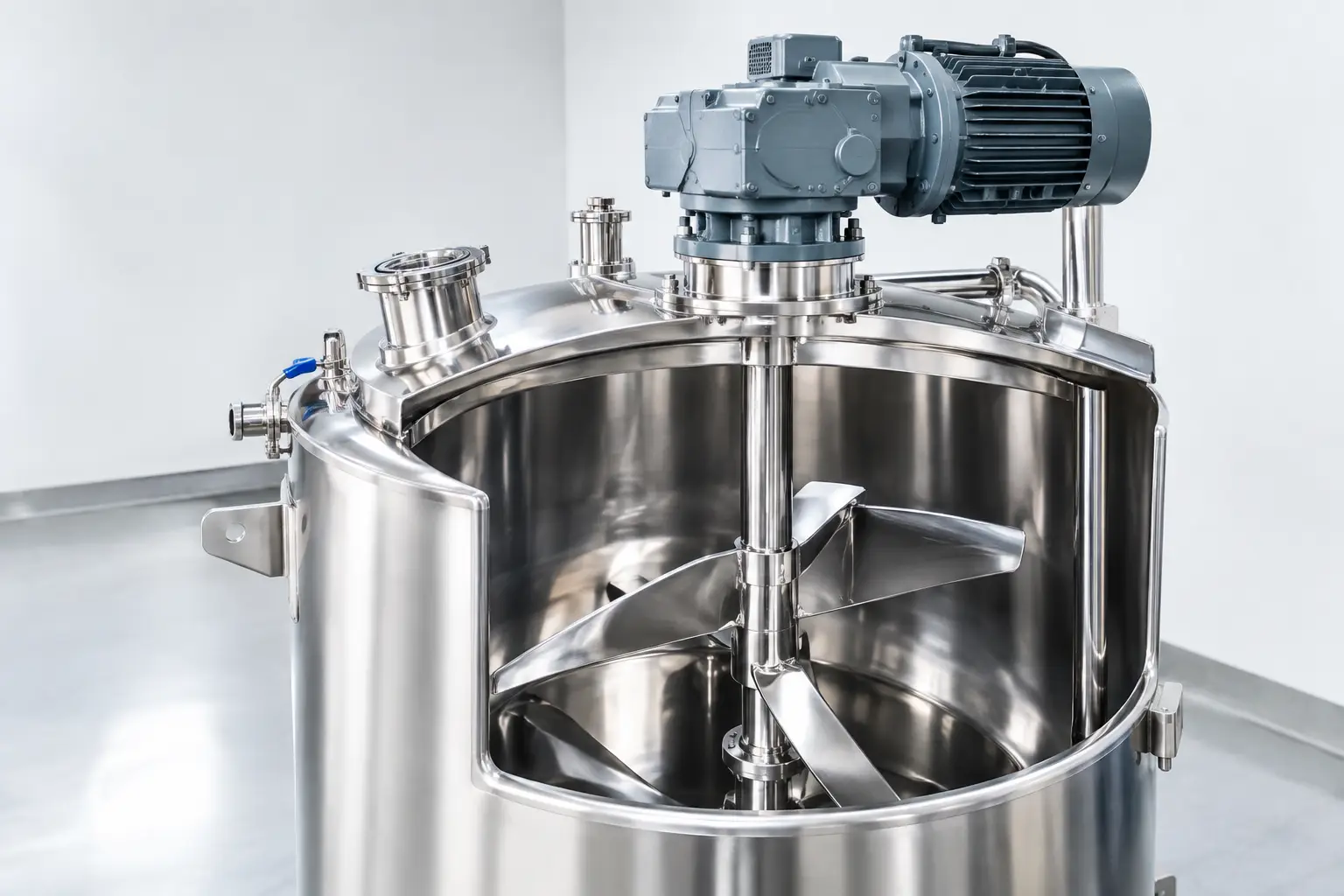
In vacuum ribbon mixers, that geometry supports more than homogenization. It keeps material moving across the heated vessel surface and continually exposes fresh product to the reduced-pressure environment. This is particularly valuable when the batch becomes more cohesive during drying. A poorly matched agitator can leave material stagnant near the walls, form lumps, or create an uneven moisture profile.
Configuration must follow the application. Ribbon dimensions, shaft speed, fill level, vessel finish, chopper options, and discharge design all affect results. For sticky products, engineers may specify additional features to break agglomerates or improve cleanout. For regulated applications, sanitary construction, clean-in-place provisions, validated finishes, and contained charging may be central to the design rather than optional upgrades.
How to Specify a Vacuum Mixer for Your Material
The specification process should begin with the product, not the equipment catalog. A useful starting point is to document bulk density, particle size, moisture content, viscosity, temperature sensitivity, abrasiveness, and any tendency to cake, smear, foam, or segregate. Include the full recipe and sequence of additions, since a mixer may need to handle dry powders at the start of the batch and a dense paste at the end.
Next, define the production requirement. Batch size alone is not enough. Consider annual throughput, target cycle time, available utilities, cleaning frequency, and the upstream and downstream equipment that governs the line. An oversized vessel run at an unsuitable fill level may perform less efficiently than a properly sized unit integrated into a realistic production schedule.
The vacuum requirement also deserves precise attention. Required operating pressure, leak tolerance, vapor load, solvent compatibility, and condenser duty all influence system design. If flammable solvents are present, the project may require explosion protection, inerting, grounded construction, and controls designed for the applicable classification. These requirements should be addressed early, not added after the mechanical layout is complete.
Finally, consider how the batch leaves the mixer. A discharge valve that works well with free-flowing powder may be unsuitable for a sticky, partially dried product. Discharge elevation, container handling, screw conveying, and dust or vapor containment affect both labor and yield. A mixer is most productive when it fits the material flow around it.
Operating Practices That Protect Batch Quality
Vacuum processing rewards disciplined operation. Charge materials in a sequence that prevents dry pockets and minimizes dusting. Start agitation at a speed appropriate for the initial material condition, then adjust as viscosity and moisture change. If heat is used, ramp jacket temperature with the product’s thermal sensitivity in mind rather than simply applying maximum available energy.
Monitor pressure, product temperature, mixer load, and drying trend throughout the cycle. These values provide a more reliable indication of process progress than elapsed time alone. A rising mixer load, for example, may signal that the product is approaching the desired consistency, while unexpected pressure behavior may indicate a leak, foaming event, or overloaded condenser.
Preventive maintenance is equally important. Seals, vacuum connections, valves, and instrumentation must remain dependable to maintain repeatable performance. A small air leak can lengthen drying cycles and introduce unwanted variability. Regular inspection protects both process efficiency and product quality.
For demanding blending, deaeration, and drying applications, a configured vacuum ribbon system can turn several difficult steps into one controlled batch operation. PerMix applies application-specific engineering to help manufacturers match vessel geometry, agitation, thermal performance, and vacuum capability to the material they actually process – creating a system built for dependable production rather than a compromise between isolated requirements.