When to Use Vacuum Mixing in Industrial Batches
A standard ribbon mixer can produce a uniform batch, but it cannot remove the air, vapor, or excess moisture that may compromise the product after mixing. Knowing when to use vacuum mixing begins with identifying whether the process needs more than particle distribution. If trapped air, solvent residues, oxidation, moisture variability, or thermal sensitivity are affecting quality, a vacuum-capable mixer can turn several process steps into one controlled operation.
For industrial processors, the decision is rarely about vacuum alone. It is about achieving repeatable product performance while reducing handling, contamination exposure, drying time, and equipment footprint. Vacuum ribbon mixing is particularly valuable where powders become pastes, pastes require degassing, or dry ingredients must be blended and dried under carefully managed conditions.
What Vacuum Mixing Changes in the Process
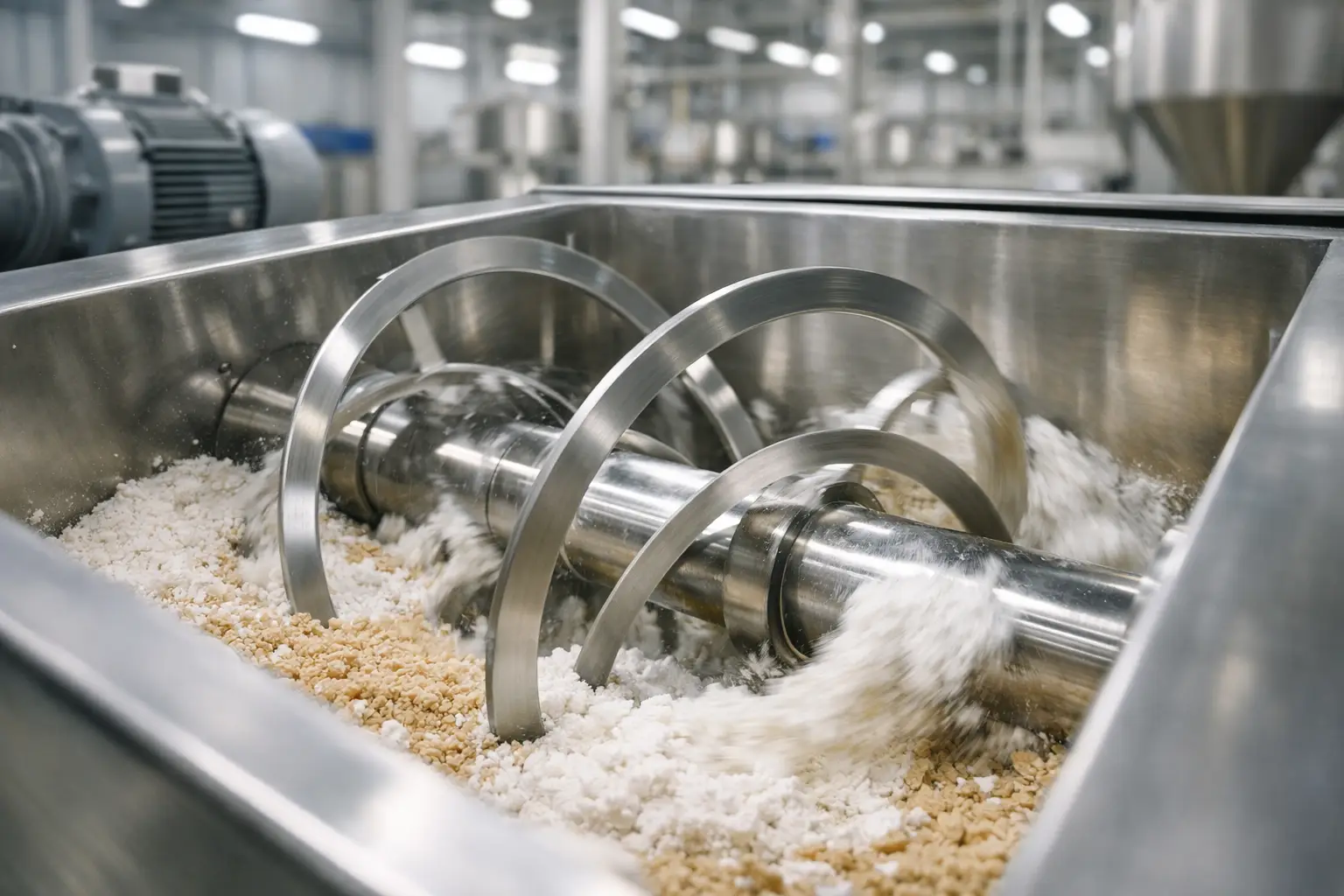
Vacuum mixing combines mechanical agitation with reduced pressure inside a sealed vessel. In a horizontal ribbon mixer, the inner and outer ribbons move material in opposing directions, promoting efficient circulation across the batch. Applying vacuum during or after this mixing action lowers the boiling point of volatile liquids and helps release entrained gases.
That change creates practical process advantages. Moisture and solvents can evaporate at lower temperatures, which protects heat-sensitive ingredients. Air bubbles can be drawn from viscous compounds that would otherwise retain voids. The closed vessel also limits the product’s exposure to ambient humidity and oxygen.
A vacuum mixer is not automatically the best answer for every dry blending application. If the materials are free-flowing, stable, and do not require moisture removal or deaeration, a conventional ribbon mixer may be more economical and easier to operate. Vacuum capability earns its place when it addresses a measurable production or quality risk.
When to Use Vacuum Mixing for Product Quality
The strongest case for vacuum mixing is when air, vapor, or uncontrolled moisture changes the finished product. This is common in applications where batch consistency must meet strict quality specifications or where downstream processing exposes hidden defects.
When entrained air causes defects
Pastes, slurries, adhesives, sealants, coatings, cosmetic creams, and certain food products can trap air as ingredients are charged and mixed. Those bubbles may create poor density control, irregular dispensing, pinholes in coatings, unstable texture, or inaccurate fill weights. In pharmaceuticals and specialty chemicals, entrained air can also complicate testing and packaging.
Vacuum applied after wetting and dispersion helps pull these gases from the mass. The timing matters. Pulling vacuum too early can cause light powders to fluidize or migrate toward the filter system before they are fully incorporated. A controlled sequence – charging, initial blending, liquid addition, wetting, then vacuum degassing – often provides better results than applying maximum vacuum from the start.
When residual moisture limits stability
Many powders are hygroscopic, meaning they absorb moisture readily from the air. Others must reach a specified moisture level before packaging, granulation, extrusion, or further blending. Conventional heated drying can work, but it may require high temperatures, longer residence time, or separate equipment.
Under vacuum, water and volatile liquids evaporate at lower temperatures. This is useful for moisture-sensitive products, materials that degrade with heat, and formulations where a narrow moisture target affects flowability, shelf life, compressibility, or reactivity. A vacuum ribbon mixer and dryer can blend the ingredients while creating the surface renewal needed for efficient evaporation.
When oxidation or contamination exposure is a concern
Some ingredients lose color, flavor, potency, or functional properties when exposed to oxygen. Others must be handled in a contained environment due to dust control, odor, hygiene, or operator-safety requirements. A sealed vacuum mixer supports a more controlled process than open mixing and transfer between separate units.
Vacuum operation does not eliminate the need for proper seals, sanitary design, dust filtration, and validated cleaning procedures. It does, however, reduce opportunities for ambient air and moisture to enter the batch. For regulated food, pharmaceutical, and cosmetics production, that additional control can support a more dependable operating standard.
Applications That Commonly Benefit
Vacuum mixing is often selected for products that transition between powder, granule, and paste-like states during processing. It is especially effective when mixing and drying must occur without moving the material to another vessel.
In chemical production, processors use vacuum mixing for resins, pigments, catalysts, additives, detergents, polymer compounds, adhesives, and specialty formulations containing solvents or reactive ingredients. The ability to blend under controlled temperature and pressure can improve batch uniformity while supporting solvent removal or deaeration.
Food and nutraceutical manufacturers may use vacuum mixing for seasoning systems, nutritional powders, beverage premixes, protein formulations, confectionery masses, and ingredients that need controlled moisture reduction. The equipment configuration must match sanitation requirements and product behavior, particularly where sticky materials, allergens, or frequent changeovers are involved.
Pharmaceutical and cosmetics operations often benefit when dense pastes, creams, ointments, powders, or active-containing blends require uniformity without excessive aeration. In these applications, surface finish, cleanability, validation support, and precise process control may be as important as the vacuum level itself.
Agricultural, mineral, and polymer processors may also use vacuum-capable mixers when the process includes liquid coating, binder addition, drying, or removal of residual volatiles. The common factor is not the industry. It is the need to manage the atmosphere inside the mixer as actively as the material movement.
Evaluate the Material Before Selecting a Vacuum Mixer
A productive vacuum mixing system starts with material data, not a generic equipment specification. Bulk density, particle size distribution, moisture content, viscosity, temperature sensitivity, vapor pressure, and flow behavior all influence mixer design and operating parameters.
Sticky or highly viscous products may require higher torque, heavy-duty ribbons, close-clearance design, and carefully selected discharge valves. Fine powders may need effective dust filtration and vacuum controls to prevent carryover. Abrasive materials can call for wear-resistant construction, while corrosive ingredients may require stainless steel grades or specialized contact materials.
The evaporation requirement is equally important. Removing a small amount of residual moisture is very different from drying a wet cake or solvent-heavy paste. Heat-transfer area, jacket design, allowable product temperature, condenser capacity, vacuum-pump selection, and cycle time must be evaluated as one system. A mixer that achieves a strong vacuum but lacks adequate heat transfer may not deliver the desired drying rate.
Vacuum Mixing Requires a Controlled Operating Strategy
Vacuum systems add capability, but they also require disciplined operation. Operators need a defined recipe for charging order, mixer speed, heating or cooling, vacuum ramp rate, hold time, and discharge conditions. These variables interact. Faster agitation can improve renewal at the heated vessel wall, yet it can also increase fines generation or cause sensitive granules to break down.
Foaming is another consideration. Some wet formulations expand significantly when pressure drops. A vessel should have sufficient freeboard, and the vacuum should be applied gradually when foam risk is present. Condensers and filters must be sized for the expected vapor load so that recovered solvent, moisture, and fines do not damage downstream vacuum equipment.
Maintenance planning also matters. Seals, valves, filters, vacuum lines, and condensers require inspection to maintain performance. A poorly sealed vessel can extend drying cycles and make process data unreliable. The right equipment partner will address these details during design rather than treating vacuum as an add-on feature.
Choosing Between a Standard and Vacuum Ribbon Mixer
A standard horizontal ribbon mixer is often the right choice for straightforward dry blending of compatible powders, granules, and low-viscosity additions. It offers efficient batch mixing, simple operation, and a practical cost structure for applications without a need for atmosphere control.
Choose a vacuum ribbon mixer or vacuum ribbon dryer when the batch must be degassed, dried, solvent-stripped, protected from ambient conditions, or processed at a lower effective evaporation temperature. The investment is justified when it replaces separate mixing and drying steps, prevents recurring quality losses, or improves throughput in a constrained production area.
The best choice may also be a configurable system rather than a fixed category. Vessel geometry, ribbon design, jacket configuration, chopper options, vacuum level, discharge arrangement, controls, and sanitary features should reflect the actual product and production target. PerMix works with process teams to match these design variables to demanding mixing and drying requirements.
Before committing to equipment, define the acceptable residual moisture, air content, temperature range, cycle time, batch size, and cleaning expectations. Those answers turn vacuum mixing from a broad capability into a dependable production advantage – one that protects the batch before quality problems reach packaging, customers, or the next process step.