Industrial Blender Equipment for Reliable Batches
A blend can look uniform at discharge and still fail where it matters most: in a finished tablet, a seasoning packet, a polymer compound, or a batch of agricultural treatment. Industrial blender equipment must do more than move material around a vessel. It must distribute minor ingredients accurately, manage difficult flow behavior, protect product integrity, and repeat that performance from batch to batch.
For plant managers and process engineers, the right mixer is therefore a production decision, not a commodity purchase. The vessel geometry, agitator design, fill level, discharge arrangement, material of construction, and control strategy all affect quality, throughput, cleaning time, and operating cost.
What Industrial Blender Equipment Must Accomplish
Industrial blending is often described as a simple operation, but the process changes significantly with the material. Free-flowing salt and sugar require a different approach than cohesive powders, fragile flakes, high-viscosity pastes, or ingredients with a wide range of particle sizes and bulk densities. A mixer that performs well for one formulation may create segregation, dead zones, or extended cycle times with another.
Effective industrial blender equipment should produce a homogeneous batch without damaging particles, generating excessive heat, or leaving material behind at discharge. In regulated operations, it should also support documented repeatability and practical cleaning procedures. In high-volume production, it must achieve those results without creating a maintenance burden that limits availability.
That is why equipment selection begins with the product, not the mixer category. Material flow properties, moisture content, bulk density, particle shape, batch size, addition sequence, and required mixing accuracy provide the basis for a sound design recommendation.
Ribbon Mixers for Demanding Bulk Materials
Horizontal ribbon mixers are widely used because they provide strong convective movement across the full batch. Inner and outer helical ribbons move material in opposing directions, creating a continuous circulation pattern that combines radial and axial mixing. This design is particularly effective for powders, granules, dry blends, and many paste applications.
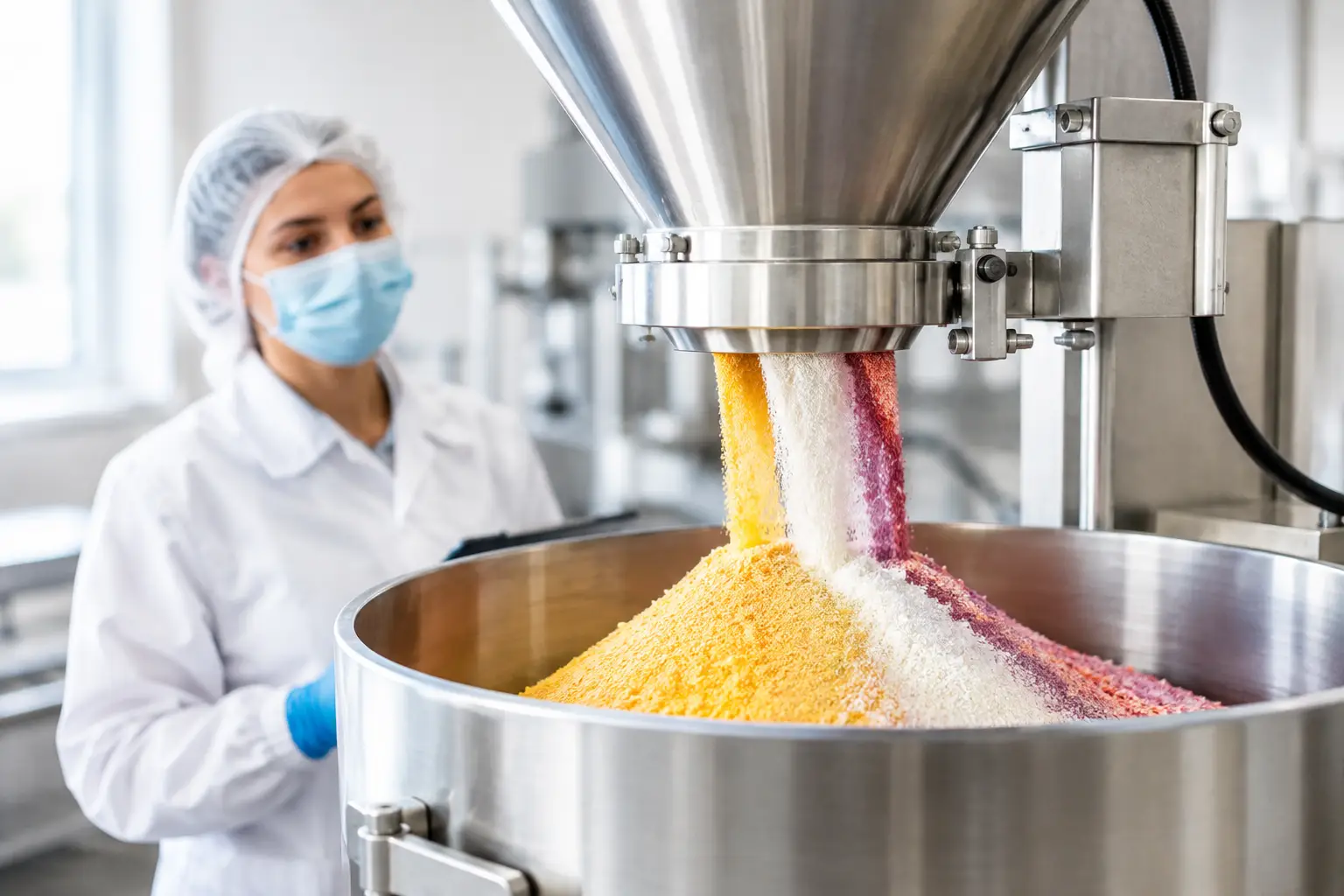
A properly configured horizontal ribbon mixer can deliver fast, consistent blending while maintaining a relatively compact footprint. It is also well suited to formulations that require the addition of liquids, colors, flavors, binders, or minor ingredients during the cycle. Spray bars, high-speed choppers, load cells, and specialized inlet arrangements can be incorporated when the process requires more than dry blending.
The trade-off is that ribbon mixers are not a universal answer. Highly fragile particles may require gentler handling, while very sticky products may call for different shaft, agitator, or discharge configurations. The best results come from matching ribbon geometry, speed, clearance, and vessel shape to the product’s actual behavior.
When Vertical Ribbon Mixers Make Sense
Vertical ribbon mixers use a vertical helical agitator to lift material from the bottom of the vessel and allow it to cascade downward through the batch. This action can provide excellent results for materials that benefit from low-shear handling, including products prone to breakage or segregation.
For facilities with limited floor space, a vertical configuration can be an attractive option because it uses a smaller footprint than many horizontal systems. It can also provide complete discharge through a bottom outlet, reducing retained material between batches. This is especially valuable when product changeovers are frequent or material recovery is a priority.
However, vertical equipment is not automatically better for every application. Batch size, loading method, cycle time expectations, and product rheology must be evaluated. A process with frequent liquid additions or dense paste-like materials may be better served by a horizontal design engineered for intensive mixing.
Vacuum Mixing and Drying in One System
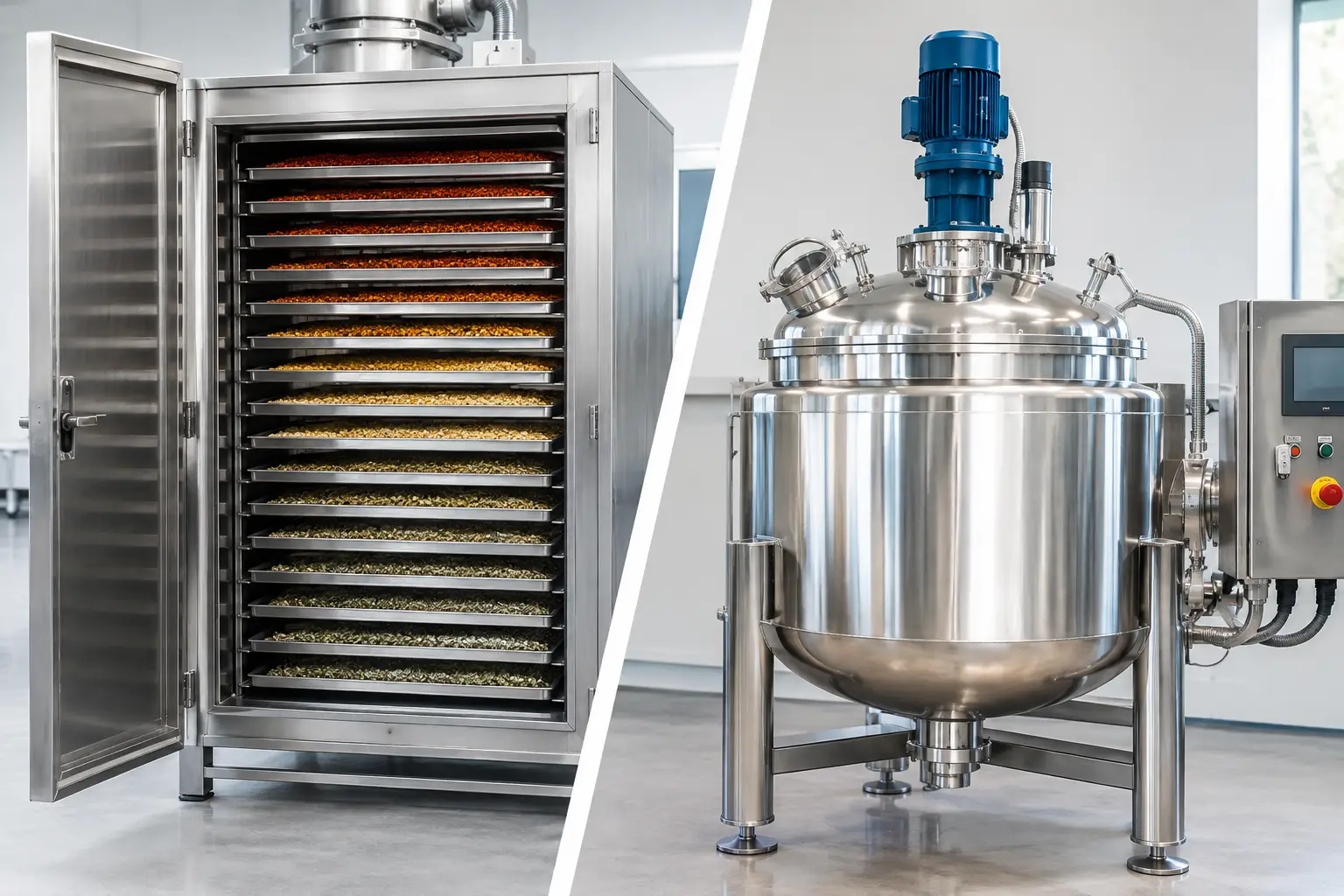
Some processes require more than blending. They require moisture removal, solvent recovery, deaeration, or controlled processing under vacuum. Vacuum ribbon mixers and dryers combine mixing with thermal and vacuum capability, allowing manufacturers to handle multiple process steps in one contained vessel.
This integrated approach can reduce material transfers, shorten handling time, and improve process control. It can be particularly useful in pharmaceutical, chemical, specialty polymer, and high-value ingredient applications where containment, cleanliness, and recovery are central concerns.
The added capability also brings added engineering considerations. Heating or cooling media, vacuum levels, vapor handling, seals, controls, and cleaning requirements must work together as a complete system. A vacuum mixer should be specified around the full process objective, not selected solely because it offers more features.
Key Factors That Determine Mixer Performance
The most reliable equipment decisions are based on test data and application details rather than assumptions. Even materials with similar names can behave differently because of particle distribution, moisture level, supplier variation, or storage conditions.
Start by defining the required batch range. A mixer may perform optimally at a specific working volume, so a process that frequently runs both small and large batches needs careful consideration. Overfilling can reduce circulation and extend blend time. Underfilling can limit agitator engagement and compromise uniformity.
Next, consider the ingredients themselves. Large differences in particle size or density increase the risk of segregation, including after a satisfactory blend has been achieved. The discharge, transfer method, and packaging operation must be considered alongside the mixing cycle. A well-mixed batch can separate again if it drops too far, vibrates excessively, or flows through unsuitable downstream equipment.
Cleaning requirements deserve the same level of attention. Food, pharmaceutical, cosmetic, and specialty chemical producers may need polished internal surfaces, sanitary seals, clean-in-place features, quick-access covers, or validated cleanout procedures. A mixer that is difficult to inspect and clean can consume more production time than it saves during the blend cycle.
Configurations That Support Production Efficiency
The base mixer is only part of the solution. Configurable industrial blender equipment can be adapted to improve safety, uptime, and product quality in specific production environments. Useful options may include variable-speed drives, liquid spray systems, high-speed intensifiers, temperature control jackets, dust-tight covers, safety interlocks, weighing systems, and specialized discharge valves.
Discharge design is especially important. A full-width bomb-bay door, slide gate, butterfly valve, or custom outlet can change how quickly material leaves the vessel and how much residue remains. The right choice depends on whether the material is free-flowing, cohesive, sticky, or sensitive to bridging. It should also match the receiving equipment below it.
Material selection matters as well. Carbon steel may be suitable for certain industrial applications, while stainless steel is often preferred where corrosion resistance, sanitation, or product purity are required. Surface finish, gasket selection, and shaft sealing should be aligned with the formulation and cleaning chemicals used in the plant.
Avoid Buying on Capacity Alone
A common mistake is specifying a mixer only by total vessel volume. Capacity is necessary, but it does not confirm blend quality, cycle time, cleanability, or compatibility with the full formulation. It can also lead to oversized equipment that runs inefficiently at typical production volumes.
Another mistake is focusing only on initial purchase price. Lower-cost equipment can become expensive when it produces inconsistent batches, needs frequent repairs, wastes product during changeovers, or lacks the flexibility to support future formulations. Total ownership cost includes energy use, maintenance access, spare parts, cleaning labor, production downtime, and the cost of quality failures.
A better approach is to review the entire process with an equipment specialist. Share representative samples, target throughput, required blend uniformity, current bottlenecks, and any regulatory or sanitation standards. When possible, conduct trials that reflect real production conditions, including liquid additions and downstream discharge behavior.
A Practical Path to the Right Mixer
The strongest mixer specifications connect process requirements to measurable outcomes. Define what an acceptable blend looks like, how quickly it must be produced, how it will be verified, and what happens after discharge. Then select equipment that can reliably meet those requirements with room for operational variation.
PerMix Ribbon Mixers applies this application-focused approach to horizontal, vertical, and vacuum ribbon mixing systems. The goal is not simply to supply a vessel with an agitator. It is to provide a durable, configurable mixing solution that supports consistent quality, efficient operation, and long-term production demands.
Before finalizing your next equipment purchase, examine the material, the process, and the cleaning reality on the production floor. The right mixer earns its value in every repeatable batch, every efficient changeover, and every shift that stays on schedule.