Choosing an Industrial Mixer for Paste Materials
A paste that looks uniform at the discharge point can still contain dry pockets, uneven ingredient distribution, or entrained air that creates downstream defects. Selecting an industrial mixer for paste materials means evaluating more than motor power or vessel capacity. The mixer must move a cohesive, high-resistance product through the entire batch while protecting its required texture, temperature, and formulation consistency.
For manufacturers of foods, chemicals, cosmetics, pharmaceuticals, polymers, and agricultural products, the right equipment decision affects yield, cycle time, cleanup effort, and product quality. Horizontal ribbon mixer systems are often a highly effective starting point, but the best configuration depends on how the paste behaves under shear, whether it must be heated or dried, and how the batch enters and exits the process.
Why Paste Mixing Requires a Different Approach
Pastes do not flow like free-moving powders or granules. They can stick to vessel walls, bridge over the agitator, resist circulation, and retain material in hard-to-reach areas. As viscosity rises, the force needed to move the mass increases sharply. A mixer that performs well with a dry blend may lack the torque, agitator geometry, or discharge design needed for a dense adhesive, dough, slurry, sealant, pigment compound, or cream.
The objective is not simply to turn the batch. Superior mixing performance requires controlled material exchange across the full working volume. Ingredients introduced at one end of the trough must be carried into the larger mass, broken apart where needed, and redistributed without leaving stagnant zones.
This is where engineered ribbon geometry provides meaningful value. In a horizontal ribbon mixer, inner and outer ribbons typically move material in opposing axial directions while also lifting and folding the product. That circulation pattern supports thorough blending across the trough and can produce a homogeneous batch without the excessive energy demand associated with some high-speed mixing methods.
The trade-off is that very high-viscosity or highly elastic materials may require added capabilities. A standard ribbon design is not a universal answer for every paste. Product testing and application-specific engineering remain essential.
Assess the Paste Before Selecting the Mixer
The most productive equipment discussions begin with the material, not the machine model. Viscosity is an important measurement, but it is only one part of the picture. Many pastes are non-Newtonian, meaning their resistance to flow changes when they are mixed, pumped, heated, or held at rest.
A shear-thinning cream may become easier to move during agitation. A thixotropic coating may thin under shear but rebuild its structure after mixing. A sticky dough may climb or wrap around an agitator if the mixer is not designed for its elasticity. A filled polymer compound can generate substantial torque as solids content increases.
Process teams should define the following operating conditions before finalizing a mixer design:
- Minimum, normal, and maximum batch size
- Viscosity range at processing temperature
- Material density, stickiness, and tendency to agglomerate
- Ingredient addition sequence and liquid addition rates
- Required blend uniformity and allowable mixing time
- Cleaning, sanitation, containment, and inspection requirements
These details influence trough dimensions, shaft design, motor sizing, seals, discharge valves, and control strategy. They also determine whether a horizontal, vertical, or vacuum-capable ribbon system is the most suitable path.
Batch Size Is More Than Rated Capacity
A mixer should not be selected solely by its maximum listed volume. Paste mixing depends on an effective fill level that allows the agitator to generate circulation without overloading the drive or forcing product into areas where it cannot move properly.
Operating too close to full capacity can reduce turnover and increase mixing time. Running batches that are consistently too small may also limit ribbon engagement. A properly sized system accounts for the expected production range rather than an idealized single batch size.
Selecting an Industrial Mixer for Paste Materials
For many cohesive paste applications, a horizontal ribbon mixer offers a favorable balance of mixing intensity, energy efficiency, and production practicality. Its horizontal trough supports a broad mixing zone, while the ribbon assembly creates axial and radial product movement. This design is particularly well suited to batches that need consistent ingredient distribution without aggressive particle destruction.
A horizontal ribbon mixer can be configured for applications involving wet powder incorporation, dough-like materials, concentrated slurries, paste formulations, and viscous blends. The equipment can also support process features such as spray bars, jacketed vessels, load cells, vacuum capability, and specialized discharge arrangements.
However, the application determines the final configuration.
Horizontal Ribbon Mixers for Controlled Batch Blending
Horizontal ribbon systems are often the preferred option when manufacturers need repeatable batch mixing with efficient material handling. Counter-flow ribbon action can reduce the risk of segregation and help distribute minor ingredients throughout a cohesive mass.
For a paste containing powders and liquids, the addition method matters as much as the agitator. Metering liquid through a spray system or multiple injection points can prevent localized overwetting and reduce the formation of lumps. Where powders tend to form hard agglomerates, the process may benefit from a chopper or high-shear intensifier. That feature should be selected carefully because increased shear can alter particle size, texture, or temperature.
Vertical Ribbon Mixers for Floor Space and Material Flow Needs
Vertical ribbon mixers can be appropriate when plant layout, product movement, or batch geometry favors a vertical configuration. Their design can offer a compact footprint and may work well for certain formulations that benefit from vertical lifting and folding action.
They are not automatically the best choice for every dense paste. Discharge behavior, cleaning access, and the product’s ability to move through the vessel should be reviewed in relation to actual viscosity and fill level. A sound decision comes from matching material behavior to agitator action rather than applying a one-size-fits-all equipment preference.
Vacuum Ribbon Mixers and Dryers for Integrated Processing
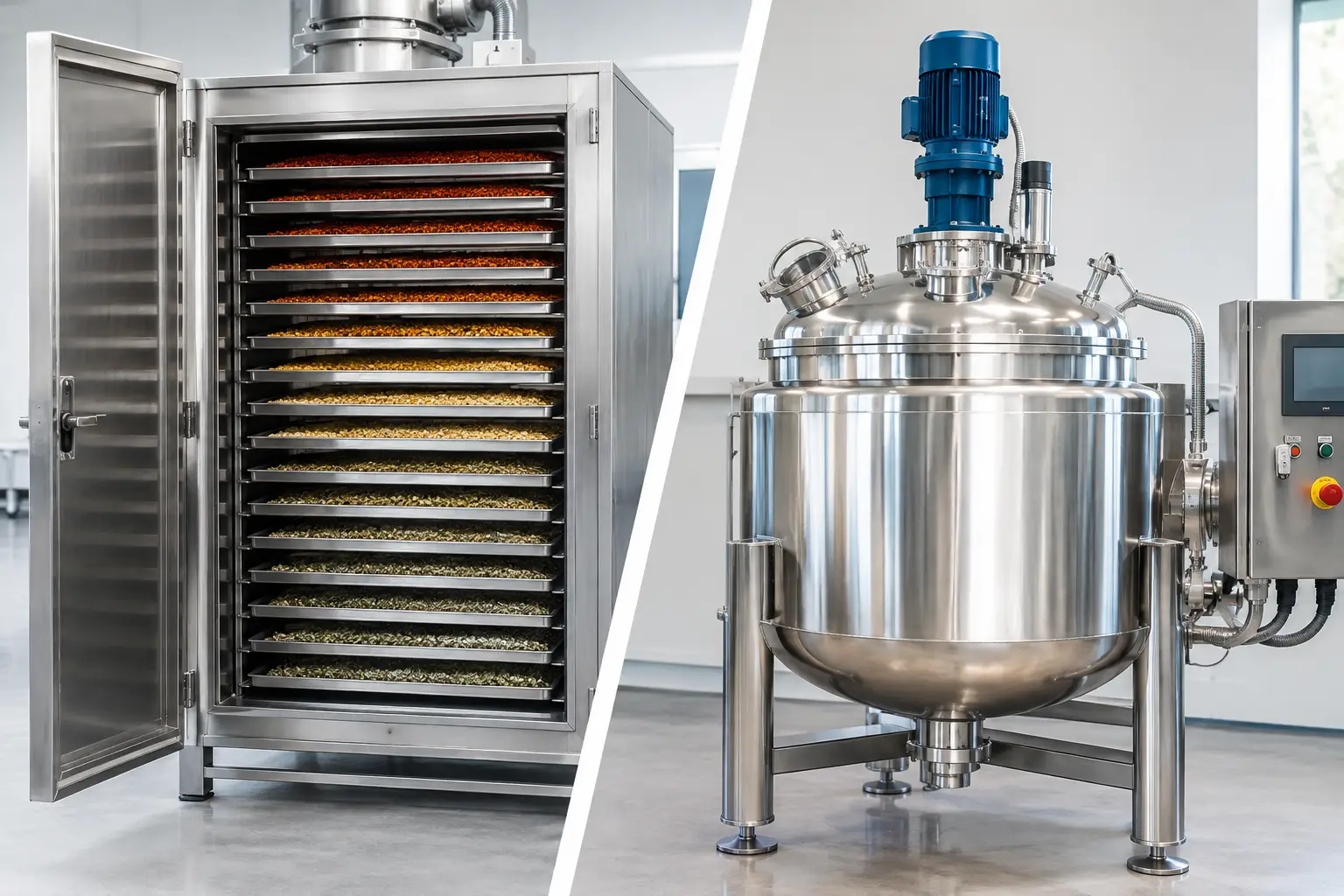
Some paste processes require more than blending. Vacuum ribbon mixers and dryers can combine mixing with moisture removal, deaeration, solvent handling, or temperature-controlled processing. This can reduce transfers between machines and help manufacturers maintain a more controlled production environment.
Vacuum processing is particularly valuable when air bubbles compromise finished-product appearance or performance, when low-temperature drying protects heat-sensitive ingredients, or when the process requires enclosed handling. The added capability does introduce more design considerations, including vacuum integrity, thermal requirements, vapor handling, controls, and cleaning procedures. For the right application, the operational benefits can justify the additional investment.
Design Features That Protect Product Quality and Uptime
The most effective paste mixer is engineered as a complete process system. Drive components need sufficient torque reserve for startup and for the highest expected viscosity, not just average running conditions. A variable-frequency drive can provide controlled startup, speed adjustment, and better flexibility during formula changes.
Shaft seals deserve close attention. Abrasive, sticky, sanitary, or hazardous materials may require specialized sealing arrangements to reduce leakage and prevent contamination. The discharge valve must also be selected for the product. A valve that works for a powder can become a production bottleneck when handling a dense paste that slowly releases from the trough.
For regulated food, pharmaceutical, and cosmetic operations, material finishes and cleanability are equally critical. Stainless steel construction, polished contact surfaces, sanitary access doors, clean-in-place provisions, and inspection-friendly geometry can shorten changeovers and support compliance. The appropriate standard depends on the process and product risk, so sanitation features should be specified early rather than added after the fact.
Thermal control may also be decisive. Jacketed troughs can heat a paste to improve flow, maintain a target processing temperature, or cool a blend after an exothermic addition. Temperature management is often the difference between a predictable batch and one that changes viscosity from run to run.
Validate Performance With Your Actual Formulation
Mixer selection should be supported by representative material trials whenever possible. A test should evaluate mixing time, final uniformity, power draw, temperature rise, cleanout, discharge rate, and product retention. It should also examine the difficult conditions: cold startup, maximum solids loading, smallest practical batch, and formula variations.
This approach reduces the risk of buying equipment based on nominal capacity alone. It also provides useful baseline data for production planning and control validation. A mixer that reaches uniformity quickly but leaves excessive heel material may not deliver the yield improvement the plant expects. Conversely, a slightly longer batch cycle may be worthwhile if it improves recovery, reduces cleanup labor, and produces more consistent finished product.
PerMix approaches these decisions as an engineering and process-fit discussion, with configurable ribbon mixing solutions designed around the material, production target, and plant requirements.
Build the Mixer Around the Process, Not the Catalog Page
An industrial mixer for paste materials should support the way your facility actually produces product: the formulations you run, the tolerances you must meet, the cleanup windows you have, and the output your customers expect. The right ribbon mixer combines appropriate agitator action, drive strength, vessel design, and process options into a reliable production asset.
When evaluating alternatives, bring your most demanding paste to the conversation. The formulation that challenges circulation, discharge, sanitation, or temperature control is the one that will reveal whether a proposed mixer is genuinely built for your operation.