Best Ribbon Mixers for Powders
A powder blend that looks uniform at discharge can still fail on density, active distribution, or downstream flow. That is why choosing the best ribbon mixers for powders is less about buying a standard machine and more about matching mixer geometry, fill level, discharge design, and material behavior to the process.
For plant managers and process engineers, the real question is not whether a ribbon mixer can blend powders. It is which ribbon mixer configuration will deliver repeatable homogeneity, practical throughput, and low downtime under real production conditions. Fine chemicals, bakery premixes, nutraceutical blends, mineral additives, and polymer compounds all behave differently. The right mixer for one product can be the wrong choice for another.
What defines the best ribbon mixers for powders
A ribbon mixer performs by moving material in opposing axial directions while creating radial flow through the trough. The outer ribbon typically pushes product one way, while the inner ribbon drives it back in the opposite direction. That counter-flow pattern is what makes ribbon mixers effective for many dry powder applications.
But the best units do more than rotate a well-made agitator. They maintain a consistent mixing zone across the batch, limit dead spots, discharge efficiently, and stand up to abrasive or sensitive materials over time. For industrial buyers, performance should be judged on blend uniformity, batch cycle time, cleanability, maintenance access, and how well the machine integrates with charging, discharge, and downstream handling.
A lower-cost machine may appear competitive on capacity alone, yet create losses through segregation, long cleanouts, or bearing wear. In regulated or high-value production, that trade-off rarely pays off.
Horizontal ribbon mixers remain the standard choice
For most powder blending operations, horizontal ribbon mixers are the starting point because they offer a practical balance of mixing efficiency, batch control, and scalable throughput. They are especially well suited for free-flowing to moderately cohesive powders, dry blends with minor liquid additions, and applications where a predictable batch cycle matters.
The strength of the horizontal design is process control. Operators can load to a defined percentage of working volume, run a validated mixing time, and discharge through a bottom outlet with minimal manual intervention. That matters in food, chemical, and pharmaceutical support processes where consistency drives yield and compliance.
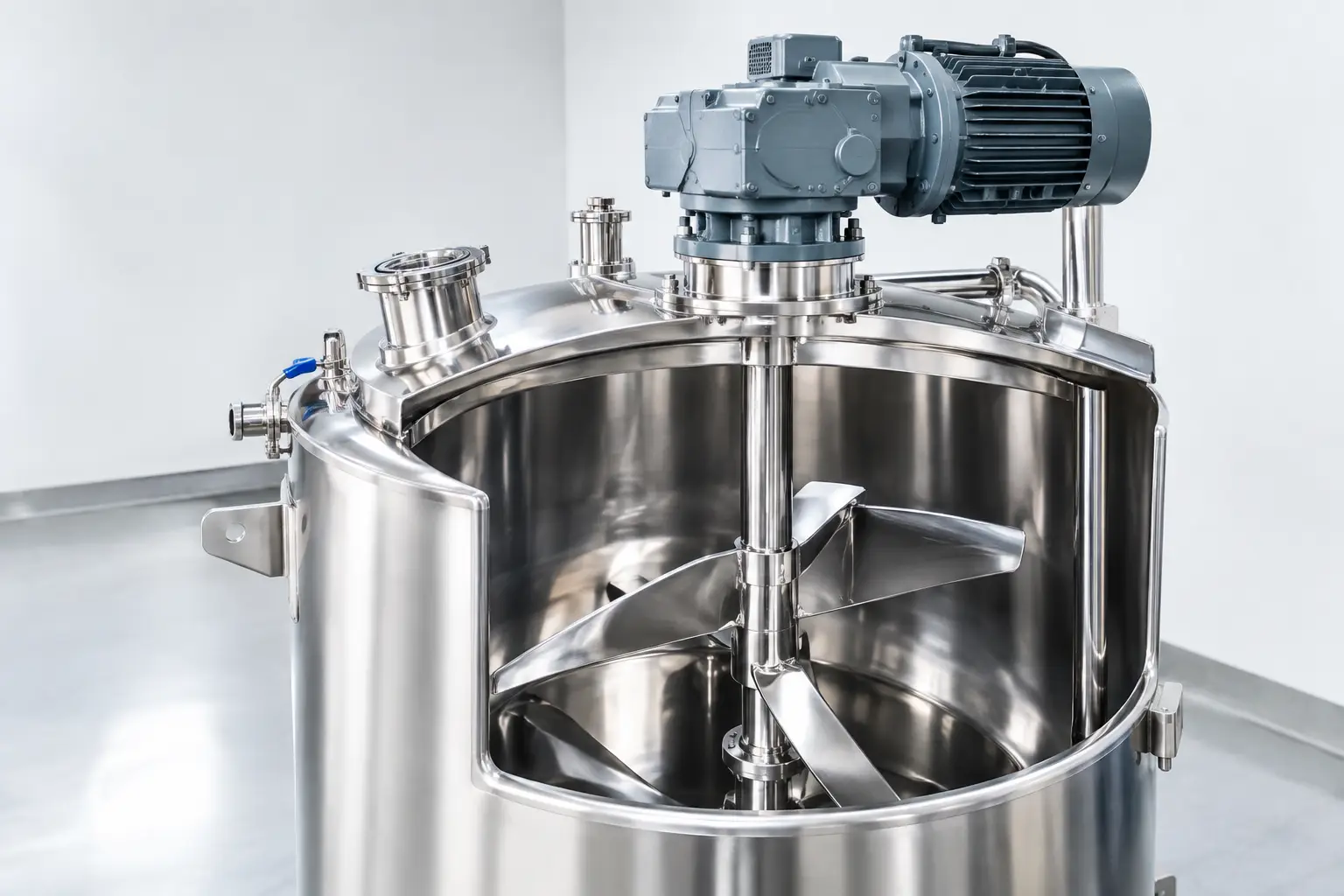
The best horizontal ribbon mixers for powders also allow design choices that improve production results. These include welded or polished interiors, spray nozzles for liquid addition, chopper systems for deagglomeration, dust-tight covers, and discharge valves selected for the material’s flow behavior. If a powder bridges, smears, or separates during unloading, the mixer is not really doing its job.
When vertical ribbon mixers make more sense
Horizontal units are common, but they are not always the best answer. Vertical ribbon mixers can be a strong fit when floor space is constrained, when gentle lifting action is preferred, or when the process benefits from a different material circulation pattern.
In some plants, the vertical footprint is easier to accommodate than a long horizontal trough. Certain formulations also respond well to the upward and downward movement created by a vertical screw or ribbon arrangement. That said, suitability depends on particle size, density difference, batch size, and discharge requirements.
This is where many buying decisions go off track. A vertical mixer may look more compact on paper, yet if the material requires faster batch turnover or easier washdown access, a horizontal system can still be the better operational choice. The best equipment decision is rarely about footprint alone.
Vacuum ribbon mixers and dryers for specialized powder processes
Some powder applications require more than atmospheric blending. Vacuum ribbon mixers and dryers are used when the process must combine mixing with drying, solvent removal, thermal treatment, or operation in a controlled environment.
These systems are common in chemical, pharmaceutical, and specialty material production where moisture control and product integrity are critical. By combining agitation with vacuum and heat transfer, they support multiple process steps in one machine. That can reduce handling, shorten total cycle time, and improve containment.
The trade-off is complexity. Vacuum systems require tighter engineering, more attention to seals and thermal performance, and process knowledge that goes beyond basic dry blending. For the right application, however, the productivity gain is significant.
Key selection factors that matter more than brochure specs
Capacity is important, but capacity alone does not identify the best ribbon mixer. Working volume, recommended fill level, and actual bulk density have a direct effect on usable batch size. A machine rated for a certain volume may deliver very different output depending on whether the powder is light, fluffy, dense, or prone to aeration.
Material behavior should be the next filter. Free-flowing powders are generally straightforward. Cohesive powders, fragile particles, or formulations with large density differences require more attention to agitator design, mixing intensity, and discharge strategy. If the blend contains trace actives, validation requirements become even stricter.
Construction details also matter. Internal weld quality, shaft sealing, access covers, and valve design all affect sanitation and uptime. In food or pharmaceutical environments, smooth surfaces and cleanability can outweigh small differences in quoted price. In mineral or abrasive chemical service, wear resistance and mechanical durability move higher on the list.
Then there is the issue of mixing time. Faster is not always better. Overmixing can damage particles or increase heat, while undermixing risks poor product uniformity. The best ribbon mixers for powders are designed to hit the required blend quality within a practical time window, not simply to turn faster.
Customization is often the difference between adequate and high performing
Industrial powder processing is rarely one-size-fits-all. Even two facilities making a similar product may need different inlet arrangements, discharge heights, support frames, controls, or finish levels.
That is why configurable equipment tends to outperform generic machines in the field. Options such as lump breakers, jacketed troughs, removable covers, CIP-compatible features, load cells, vacuum capability, and specialized ribbon geometries allow the mixer to match the process instead of forcing the process to adapt to the machine.
This is particularly relevant for manufacturers running multiple SKUs or planning future expansion. A mixer that fits the current batch but cannot support added ingredients, automation, or stricter sanitation requirements may become a bottleneck sooner than expected.
Reliability, energy use, and downtime should be part of the purchase decision
Buyers often focus on blend quality first, which is fair. But ownership costs are shaped just as much by reliability and maintenance burden. Bearing protection, drive sizing, seal selection, and access for inspection all affect how the mixer performs after months or years of production.
Energy efficiency also deserves attention. An oversized drive or inefficient design adds operating cost without necessarily improving the process. Well-engineered ribbon mixers can deliver strong mixing performance with sensible power consumption, especially when the agitator and trough geometry are matched to the application.
Downtime is where hidden costs show up fastest. A mixer that is difficult to clean, slow to discharge, or hard to service can reduce throughput even if its nameplate specifications look impressive. For high-volume plants, those losses add up quickly.
How to compare suppliers of the best ribbon mixers for powders
The strongest suppliers do not just quote a machine size. They ask about bulk density, particle size, moisture, temperature, cleaning method, batch frequency, and the consequences of segregation. They want to understand whether you are blending, coating, heating, drying, or all of the above.
That consultative approach matters because the machine is only one part of the result. Application-specific engineering, manufacturing quality, and post-sale support all influence long-term performance. A dependable supplier should be able to explain why one configuration fits better than another and where the limits are.
For that reason, many industrial buyers prefer working with a specialized manufacturer such as PerMix, where ribbon mixing is treated as a process solution rather than a catalog item. That distinction becomes especially valuable when the application is regulated, abrasive, heat-sensitive, or difficult to discharge.
The best choice usually comes down to a simple standard: will the mixer produce a repeatable blend, fit the plant, support the cleaning regime, and operate with low interruption over time? If the answer is uncertain, the specification is not finished yet.
A good ribbon mixer does not just blend powders. It protects product quality, supports throughput, and reduces avoidable production risk. The better the fit between mixer design and material behavior, the more value the equipment will deliver long after installation.