Choosing a Food Grade Ribbon Mixer Machine
A food grade ribbon mixer machine is rarely judged by its brochure specs alone. In food processing, the real test is whether it can deliver a uniform blend batch after batch, clean up without wasting production time, and hold up under daily operating demands without creating sanitation risks.
That is why mixer selection tends to sit at the intersection of product quality, compliance, throughput, and maintenance. For plant managers and process engineers, the wrong machine does not just mix poorly. It can create ingredient segregation, extend cleaning cycles, increase labor, and put pressure on production schedules. The right ribbon mixer, by contrast, supports consistent results and a more predictable operation.
What a food grade ribbon mixer machine is designed to do
Ribbon mixers are built for efficient convective blending of powders, granules, and selected wet or paste-like materials. Inside a horizontal trough, inner and outer helical ribbons move material in opposing directions. That counter-flow action helps distribute ingredients across the full vessel length while promoting a fast, homogeneous mix.
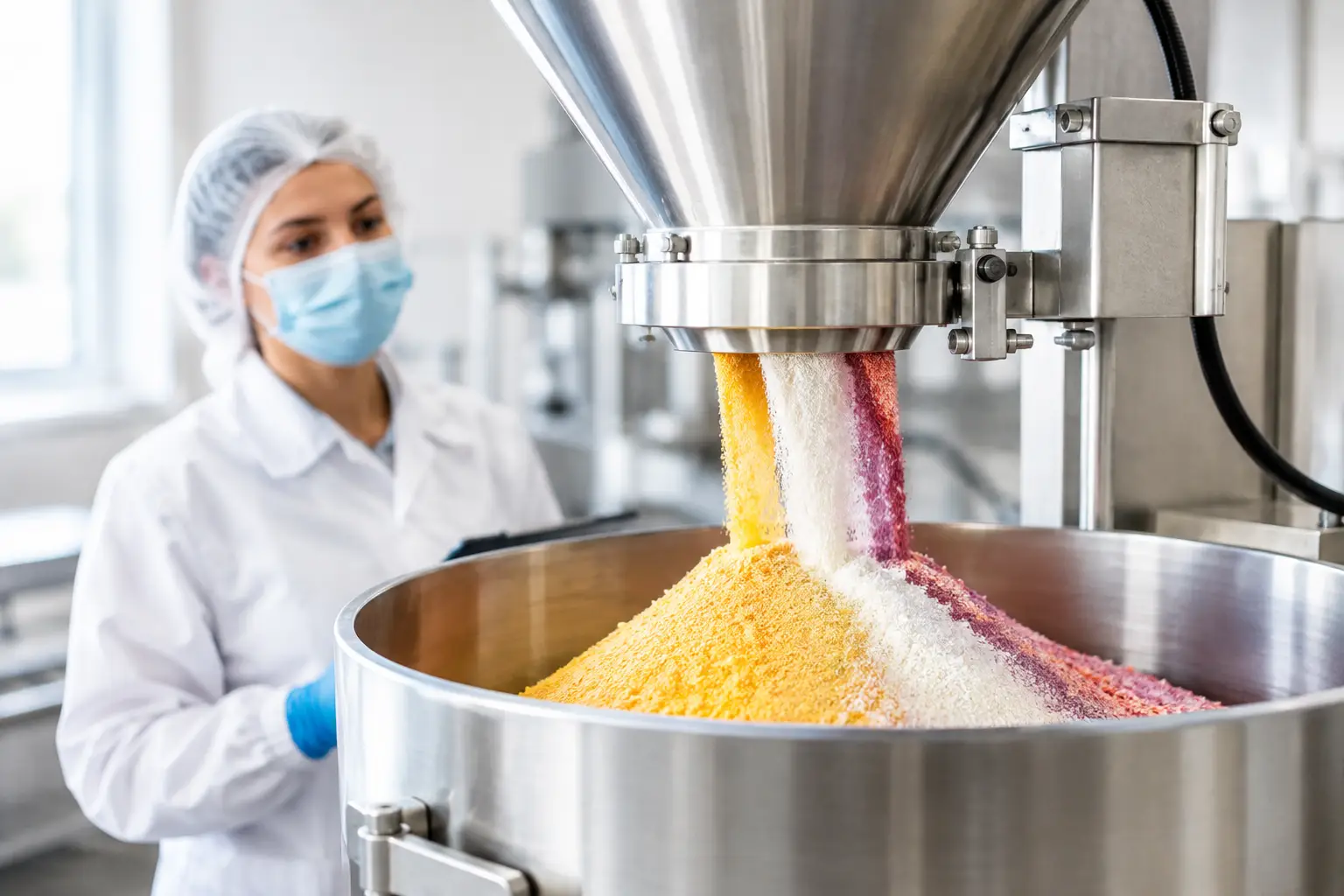
In food applications, this matters because many formulations are more complex than they first appear. A dry seasoning blend may include fine powders, larger spice particles, salt, sugar, anti-caking agents, and trace ingredients. A baking premix may require tight distribution of micronutrients or flavors. Even when ingredient percentages are small, poor dispersion can affect taste, appearance, label compliance, and downstream processing.
A properly specified food grade ribbon mixer machine is intended to manage that complexity while meeting sanitary expectations. Construction materials, weld quality, discharge design, shaft seals, interior finish, and cleanability all become part of the performance equation.
Why food processors choose ribbon mixing
Food manufacturers often select ribbon mixers because they offer a strong balance of blending quality, batch efficiency, and mechanical simplicity. They are well suited for dry mixing and can also accommodate liquid addition when the application is engineered correctly. Compared with some alternative mixer types, ribbon mixers are often easier to integrate into established batch processes and can be configured for a wide range of capacities.
That said, ribbon mixers are not the answer for every product. Extremely fragile materials, formulas prone to smearing, or applications requiring very aggressive deagglomeration may call for a different mixing approach. This is where application-specific engineering matters. The best results come from matching mixer geometry, ribbon design, speed, fill level, and discharge configuration to the actual product behavior, not just the production target.
Key design features that matter in a food grade ribbon mixer machine
Not all food-grade equipment performs the same way in production. Buyers should look past the broad label and focus on how the machine is built.
Sanitary construction
For food use, stainless steel contact surfaces are the starting point, not the finish line. Surface finish affects cleanability and residue buildup. Continuous welds are preferable to designs that create traps for product accumulation. Rounded internal corners and properly designed covers, ports, and discharge zones can reduce the chance of retained material.
Sanitary shaft seals also deserve close attention. Seal failures can lead to contamination risks, product loss, and unplanned downtime. In demanding environments, a lower upfront price can quickly disappear if the sealing system is not suited to washdown, abrasive ingredients, or frequent sanitation cycles.
Mixing consistency
Ribbon design determines how material moves through the trough. The mixer should create reliable axial and radial movement without dead zones. For food processors, consistency is not just about visual uniformity. It affects flavor distribution, nutritional accuracy, product texture, and customer acceptance.
This becomes especially important with minor ingredients. If your formula includes vitamins, colors, preservatives, or flavor compounds at low inclusion rates, the mixer must distribute them evenly without overprocessing the batch.
Discharge efficiency
A mixer that blends well but discharges poorly creates a hidden cost. Retained product means lower usable yield, more frequent cross-batch cleaning, and longer turnaround times. Full-width or optimized discharge systems can support faster emptying and reduce leftover material in the trough.
Capacity and fill level
A larger machine is not always better. Ribbon mixers generally perform best within an intended working volume range. If the vessel is underfilled, mixing action may be less effective. If it is overfilled, turnover can suffer and cycle time may increase. Throughput targets should be balanced against actual bulk density, batch frequency, and upstream and downstream handling.
Matching the mixer to the food application
This is where many purchasing decisions become either highly effective or unnecessarily expensive. Two food products may look similar on paper but behave very differently in the mixer.
Free-flowing powders are typically straightforward, but cohesive ingredients can form lumps or resist movement. Granules may segregate if particle size and density vary too much. Liquid addition can improve product functionality, but it can also create localized wet spots if spray placement and mixing intensity are not well matched. Heat-sensitive products may need gentler processing or shorter cycles.
A seasoning manufacturer may prioritize fast batch turnover and complete discharge between flavor profiles. A bakery ingredient producer may focus on precise dispersion of low-percentage additives. A nutraceutical food processor may need tighter sanitary design and documentation. The machine should be configured around these realities.
This is why a solution-oriented supplier adds value beyond the equipment itself. When a manufacturer evaluates ingredient characteristics, batch size, cleanout expectations, and plant constraints before finalizing the build, the result is usually better long-term performance.
Horizontal, vertical, and vacuum options
The term food grade ribbon mixer machine often refers to a horizontal ribbon mixer, and for good reason. Horizontal units are widely used because they offer efficient batch mixing, practical discharge, and strong versatility across food categories.
Vertical ribbon mixers can be a better fit where floor space, product flow behavior, or batch handling requirements point in that direction. They may suit some applications where a different movement pattern is beneficial or where facility layout limits horizontal equipment installation.
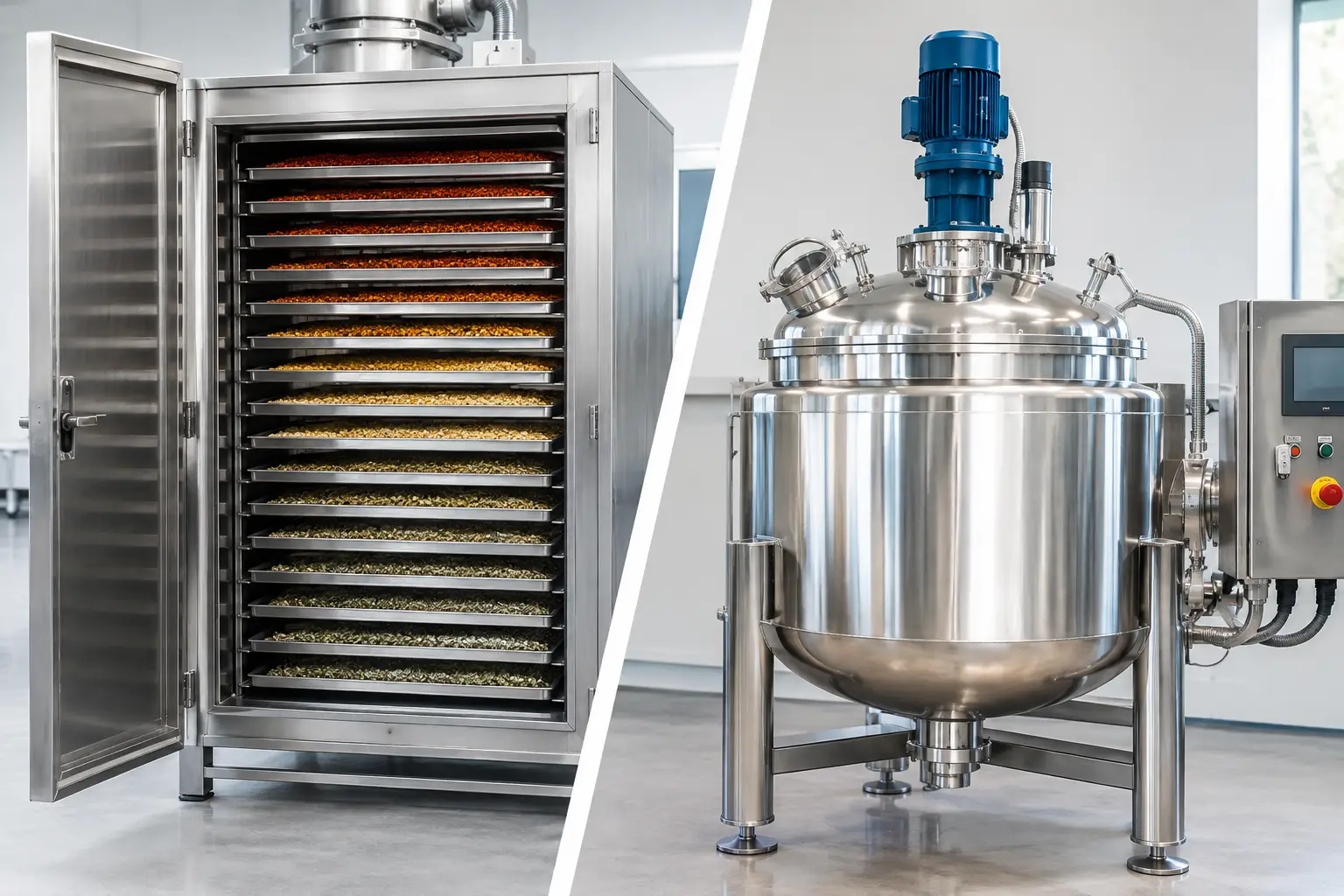
Vacuum ribbon mixers and dryers serve more specialized processing needs. If the product requires drying, solvent removal, or controlled processing under reduced pressure, a vacuum design may support both quality and process efficiency. These systems are more application-specific, but for the right product they can consolidate steps and improve control.
Operational benefits beyond blend quality
A well-designed ribbon mixer supports more than the finished product. It can also improve day-to-day plant performance.
Lower energy use matters when mixers operate across multiple shifts. Durable construction matters when maintenance windows are tight. Reduced cleaning time matters when product changeovers are frequent. Reliable repeatability matters when customer specs are narrow and rework is expensive.
These gains are cumulative. A mixer that consistently hits the target blend in the expected cycle time reduces operator intervention. A sanitary, accessible design can shorten washdown and inspection. A dependable drivetrain and properly engineered components can help limit service interruptions. For operations leaders, those practical advantages often have as much value as the mixing result itself.
What to ask before requesting a quote
A productive equipment discussion starts with the application, not the price sheet. Buyers should be ready to define product type, particle characteristics, bulk density, batch size, target throughput, required cleanability, and whether liquid addition is part of the process. It also helps to clarify available floor space, utility constraints, and how the mixer will connect with feeders, conveyors, or packaging lines.
If the product is sensitive, abrasive, sticky, or segregation-prone, say so early. Those details affect ribbon configuration, motor sizing, discharge selection, seal design, and sanitation features. A supplier that asks detailed technical questions is usually trying to prevent a mismatch, not slow down the sale.
For companies evaluating long-term value, it is also worth looking at serviceability, replacement part availability, and overall build quality. Downtime in food production is costly, and equipment that is easy to maintain often delivers a better return over its life cycle.
When the right mixer becomes a competitive advantage
Food manufacturing margins are shaped by consistency, efficiency, and uptime. A food grade ribbon mixer machine contributes to all three when it is correctly specified and properly built. It helps protect formulation accuracy, supports sanitation goals, and keeps batch production moving with less waste and fewer interruptions.
For processors handling demanding blends, the best mixer is not the one with the broadest claims. It is the one engineered around the product, the plant, and the production target. That is where experienced manufacturers such as PerMix can make a measurable difference – by delivering tailored solutions that support superior mixing performance and dependable results over time.
If you are evaluating new mixing capacity or replacing an underperforming unit, start with the realities of your process. The strongest equipment decision is usually the one that solves the specific problem you have now while giving your production line room to grow.