Pharmaceutical Mixer Documentation Guide
A mixer can produce a visually uniform blend and still create a documentation problem that delays qualification, complicates an audit, or weakens confidence in product quality. A pharmaceutical mixer documentation guide gives engineering, quality, validation, and operations teams a common framework for proving that the equipment is suitable for its intended use – from initial specification through routine production.
For ribbon mixing systems, the documentation package must do more than identify motor size and vessel capacity. It should demonstrate hygienic design, material traceability, controllable performance, cleanability, and repeatable operation for the actual formulation being processed. The right level of detail depends on product risk, regulatory strategy, installation scope, and whether the mixer is a new asset, replacement unit, or part of a larger validated process.
Start With a Clear User Requirements Specification
The User Requirements Specification, or URS, is the document that prevents expensive assumptions later. It defines what the mixer must accomplish in the pharmaceutical process, rather than simply describing a preferred equipment configuration. Procurement can use it to compare supplier proposals fairly, while quality and validation teams can trace each design and test decision back to a defined requirement.
A useful URS identifies the product family, batch-size range, bulk density, particle characteristics, allowable temperature range, and expected blend uniformity. It should also state whether the process handles dry powders, granules, pastes, or materials requiring vacuum drying. Product-contact requirements need equal attention: define the required stainless-steel grade, surface finish, gasket materials, drainability expectations, and any restrictions on lubricants or elastomers.
The operational requirements should be equally specific. State required cycle times, discharge method, dust-control needs, cleaning method, electrical classification, utility connections, and control-system integration. If the mixer must support recipe control, electronic batch records, access levels, or data integrity requirements, include those needs before the equipment design is finalized.
Avoid writing a URS that demands features without explaining their purpose. For example, a requirement for an intensifier bar, load cells, vacuum capability, or nitrogen blanketing should connect to a formulation or process need. This gives the equipment supplier room to recommend a tailored solution without losing the discipline of a controlled specification.
Build the Pharmaceutical Mixer Documentation Package
A complete package is not a single manual delivered with the equipment. It is a controlled set of documents that connects design, manufacture, installation, testing, operation, and maintenance. The precise contents should follow the site quality system and risk assessment, but several records are typically central to pharmaceutical mixer qualification.
Design and fabrication records
General arrangement drawings should show the mixer footprint, vessel geometry, working volume, discharge arrangement, access doors, support structure, and utility connections. Process and instrumentation documentation should identify instruments, valves, sensors, control loops, alarms, and interlocks. Electrical drawings should match the actual control panel and field wiring supplied.
For product-contact components, request material certificates that clearly identify the material grade and traceability. Documentation for product-contact welds may include weld maps, welding procedures, welder qualifications, inspection results, and passivation records where applicable. Surface-finish records should identify the specified finish and the method used to verify it.
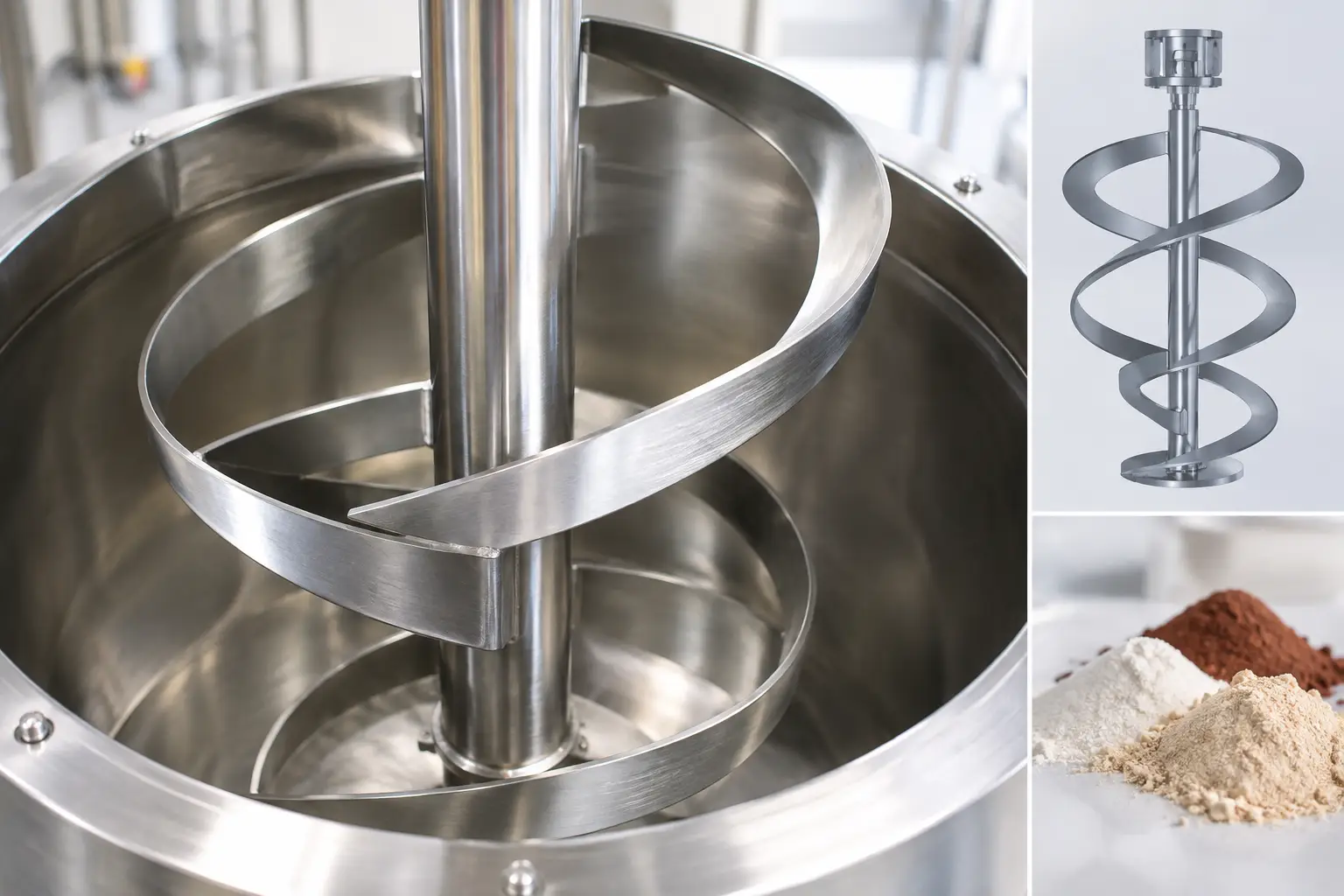
These details matter because a ribbon mixer has multiple product-contact surfaces beyond the main trough. The ribbon agitator, shaft, end plates, discharge valve, seals, door assemblies, and optional choppers all require a review appropriate to their product contact and cleaning exposure. A polished vessel is not enough if a difficult-to-clean discharge assembly or seal area creates a retention risk.
Component and vendor documentation
The package should include data sheets and manuals for motors, gear reducers, bearings, seals, variable-frequency drives, load cells, vacuum components, and other critical purchased items. Calibration certificates are needed for instruments used to establish or maintain critical process conditions, such as temperature probes, pressure gauges, vacuum transmitters, and weighing systems.
Not every component needs the same level of traceability. A risk-based approach is more practical than treating every fastener as a critical item. Focus effort on components that contact product, affect containment, influence blend consistency, control a critical parameter, or could compromise safe operation.
Operating, cleaning, and maintenance procedures
Supplier manuals provide a foundation, but site procedures must translate that information into controlled work instructions. The operating procedure should establish charging sequence, fill level, mixer speed, mixing time, discharge steps, and response to alarms. It should also identify conditions that require batch hold, investigation, or escalation.
Cleaning documentation must reflect the actual product and cleaning strategy. A dry-cleaned powder process needs clear instructions for access, inspection, disassembly where necessary, and prevention of cross-contamination. Wet cleaning or clean-in-place applications require defined parameters for detergent concentration, flow, temperature, contact time, rinse acceptance, and drying. Cleaning validation belongs to the pharmaceutical manufacturer, but equipment design documentation should provide the information needed to assess cleanability.
Preventive maintenance procedures should cover lubricant control, seal inspection, gearbox service, bearing checks, fastener inspection, and verification of safety devices. Controlled maintenance records help demonstrate that the qualified equipment remains in a suitable state during routine operation.
Use Qualification Documents to Verify the Right Things
Qualification should not become a paperwork exercise. Each protocol needs to test a requirement that matters to process performance, product quality, safety, or compliance. A traceability matrix linking URS requirements to design documents, factory tests, site tests, and final reports makes this relationship visible.
Design Qualification, or DQ, verifies that the selected mixer design meets the URS. This review is where teams confirm that capacity, ribbon geometry, drive power, material construction, controls, and cleanability are appropriate for the intended process. It is also the right stage to resolve concerns about product segregation, dead zones, heat sensitivity, or dust containment.
Installation Qualification, or IQ, confirms that the delivered equipment matches approved drawings and specifications. Typical checks include equipment identification, utility connections, component verification, software and drawing revisions, instrument calibration status, material certificates, safety guarding, and availability of manuals.
Operational Qualification, or OQ, demonstrates that the mixer operates consistently across defined ranges. Tests may cover agitator rotation, speed range, interlocks, emergency stops, alarms, discharge operation, vacuum performance, temperature control, and control-system functions. When electronic records or recipe controls are used, OQ should address the relevant access, audit trail, and data-management requirements.
Performance Qualification, or PQ, demonstrates that the installed mixer performs successfully with representative product under routine operating conditions. Blend uniformity sampling plans, acceptable mixing windows, fill levels, mixing times, and discharge behavior should be scientifically justified. A successful water test or placebo blend does not automatically prove performance with a cohesive, low-dose, moisture-sensitive, or segregation-prone formulation.
Factory Testing Should Reduce Site Risk
Factory Acceptance Testing, or FAT, is one of the most efficient opportunities to identify issues before the mixer reaches the production floor. The test protocol should be approved in advance and should verify the configuration actually ordered, including drive operation, controls, safety devices, rotation direction, discharge function, and instrument response.
For more complex systems, FAT can also confirm vacuum integrity, jacket performance, load-cell operation, automated sequences, and documentation completeness. Photographs, completed test records, deviation reports, and corrective actions should be retained in the turnover package. Site Acceptance Testing then confirms that transport, installation, utilities, and site integration have not changed the equipment’s intended performance.
PerMix supports application-specific ribbon mixer configurations, but the pharmaceutical owner should retain responsibility for defining process requirements and approving the validation strategy. Supplier expertise is most valuable when it is engaged early enough to shape the equipment design, not after the purchase order has fixed critical decisions.
Address the Limits of Ribbon Mixing Early
Horizontal ribbon mixers are highly effective for many pharmaceutical powders, granules, and paste-like materials because they create broad convective movement with efficient batch processing. Yet they are not automatically the best choice for every formulation. Highly cohesive materials may require intensification or a different mixing principle; fragile granules may need lower shear; potent compounds may require enhanced containment; and formulations prone to segregation require careful charging and discharge studies.
Documentation should record these decisions and the evidence behind them. If blending performance depends on a narrow fill range, a defined order of addition, or a specific discharge rate, those conditions are part of the validated process. Leaving them as operator preference introduces avoidable variability.
A well-controlled documentation package does more than prepare a plant for inspection. It gives the operating team a practical record of how the mixer was designed to perform, how that performance was proven, and which process boundaries must be protected as production demands change.