How to Test Mixing Homogeneity in Ribbon Mixers
A ribbon mixer can appear to deliver a uniform batch long before the material is truly consistent from one location to another. For manufacturers handling active ingredients, seasonings, pigments, polymers, or fine chemical powders, a reliable test mixing homogeneity program verifies what visual inspection cannot: whether every discharge portion meets the required composition.
The result affects more than product appearance. Poor homogeneity can cause failed quality checks, off-spec batches, uneven potency, customer complaints, rework, and unnecessary material loss. A well-designed test method gives process teams the evidence needed to set mixing time, validate equipment performance, and identify problems before they reach production.
What Mixing Homogeneity Actually Measures
Mixing homogeneity is the degree to which a target component is distributed consistently throughout a batch. In a powder blend, that component may be a low-dose active, salt, vitamin premix, colorant, lubricant, or other critical ingredient. In a paste or wet blend, it may be moisture, a liquid addition, binder, or a functional additive.
The objective is not always perfect uniformity. Every process has practical limits based on particle size, density, ingredient concentration, sampling error, and the end-use specification. The right goal is a statistically demonstrated level of variation that is appropriate for the product, process risk, and regulatory requirements.
For example, a food seasoning blend may tolerate a different degree of variation than a pharmaceutical formulation containing a low-dose active ingredient. A plastics compound with visible pigment variation may have tight requirements for color consistency, while an agricultural blend may focus more heavily on nutrient distribution. Acceptance criteria should be based on product function, not an arbitrary mixer benchmark.
How to Test Mixing Homogeneity Correctly
A useful homogeneity study starts with a clear question: Is the mixer distributing the critical ingredient evenly throughout the working volume? The answer depends on representative sampling, a suitable analytical method, and disciplined interpretation of the results.
Select a Measurable Tracer or Critical Ingredient
The most meaningful approach is to measure the ingredient that presents the greatest quality risk. If a formulation contains a low-concentration active, that ingredient should usually be the focus. If direct measurement is costly or impractical during trials, a tracer may be used.
A tracer should behave similarly to the ingredient it represents. It should have comparable particle size, density, shape, and flow behavior. Using a fine, free-flowing colored powder to represent a cohesive micronized active can create misleadingly favorable results. The tracer must also be detectable at the required concentration by the chosen test method.
Common analytical options include chemical assay, moisture analysis, color measurement, conductivity testing, near-infrared spectroscopy, sieve analysis, and particle-based imaging. The method must be sensitive enough to distinguish real blend variation from normal measurement error.
Build a Representative Sampling Plan
Taking one sample from the top of the mixer is not a homogeneity test. Material can circulate through a ribbon mixer in complex flow patterns, and local consistency does not prove full-batch uniformity.
A proper sampling plan captures material from multiple positions throughout the batch. During development or qualification, samples may be collected from the front, center, and rear sections of the vessel, at different depths, and from early, middle, and late discharge points. This approach helps reveal dead zones, incomplete axial movement, or segregation that occurs during discharge.
The number of samples depends on batch size, product risk, and the confidence level required. For many industrial evaluations, 10 or more samples provide a practical starting point. Higher-risk applications may require a more extensive plan developed with quality and process engineering teams.
Sample size matters as much as sample location. If the sample is too small relative to the particle size or concentration of the critical component, natural particle variability can dominate the result. The sample should be large enough to represent the blend while still matching the capacity of the analytical method.
Measure Variation, Not Just Average Content
After samples are tested, calculate the mean concentration, standard deviation, and relative standard deviation, often called RSD or coefficient of variation. The RSD shows how much the individual results vary relative to their average.
A low RSD generally indicates more uniform mixing, but the acceptable value depends on the application. Process teams should define a justified acceptance range before reviewing the data. They should also evaluate individual sample results, not only the average. A batch can show an acceptable mean while still containing one or more unacceptable pockets of concentrated or deficient material.
When reviewing the results, ask whether variation is random or follows a pattern. Repeatedly low results near one end of the vessel, for instance, may point to fill sequence issues, insufficient mixer loading, ribbon clearance concerns, or poor material movement in that zone. Late-discharge variation may indicate segregation after mixing rather than incomplete mixing itself.
Establish the Right Mixing Time
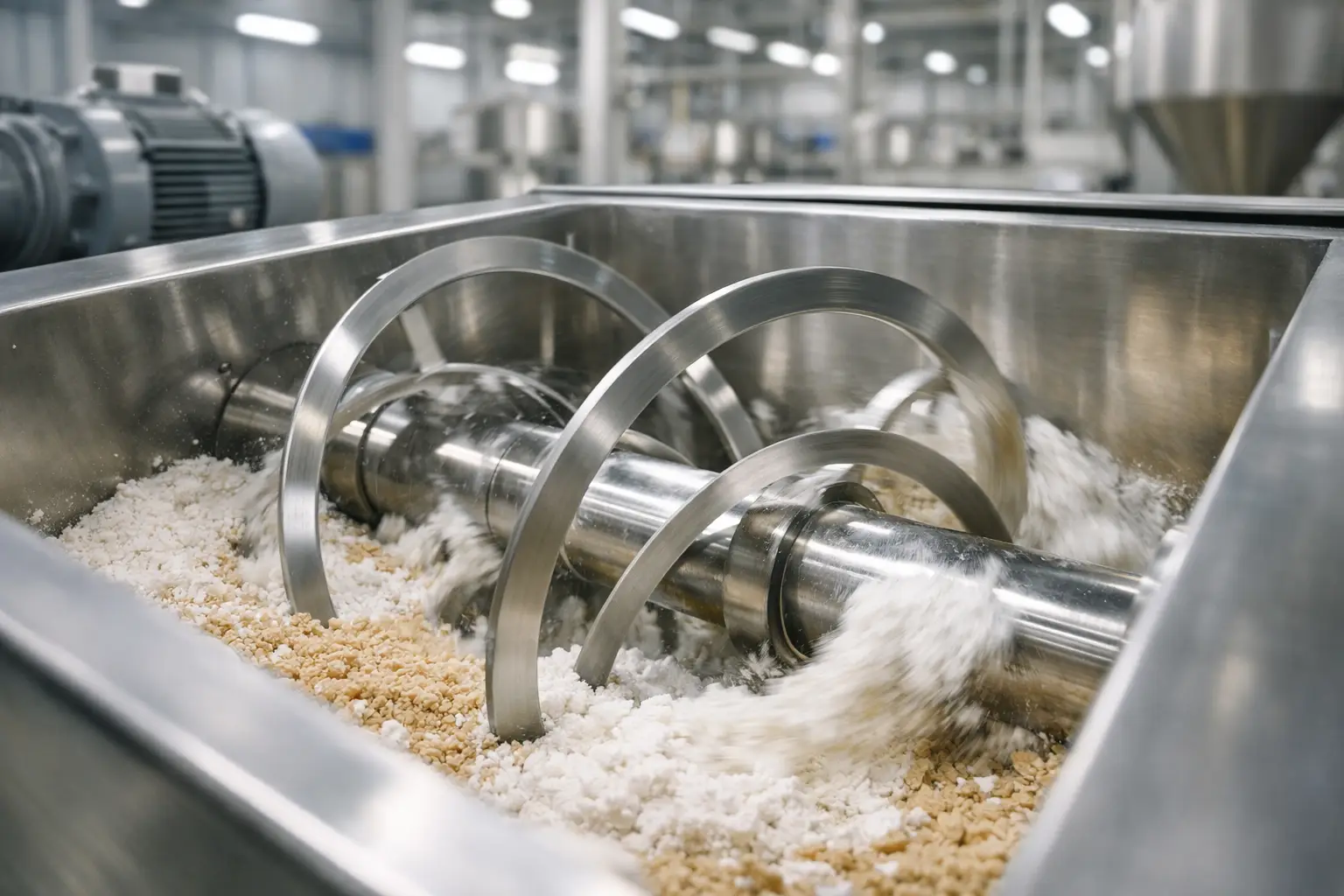
More mixing time does not always produce a better blend. Ribbon mixers typically achieve efficient convective mixing through the combined action of inner and outer ribbons, which move material in opposing directions. Once the blend reaches its optimum state, extended mixing can sometimes create segregation, particle attrition, heat buildup, or overworking of sensitive materials.
A mixing time study identifies the point at which the batch first meets the homogeneity requirement and remains stable. Run the same formulation at several time intervals, such as two, four, six, and eight minutes, then test each batch using the same sampling plan. The shortest repeatable time that meets the acceptance criteria is usually the most efficient operating target.
This study should be performed at the intended fill level and operating speed. A mixer that performs well at 60 percent capacity may behave differently at 30 percent or near its maximum working volume. For production planning, validate the range of batch sizes the facility expects to run rather than assuming one test applies to every load.
Factors That Can Distort Homogeneity Results
When a blend fails testing, the mixer is not automatically the root cause. Material properties and upstream handling often determine whether a formulation is easy or difficult to blend.
Particle size mismatch is a frequent issue. Fine particles can fill void spaces between larger particles, while broad particle-size distributions can promote segregation. Density differences can also cause heavy materials to settle and lighter components to rise during charging, mixing, transport, or discharge. Moisture, static charge, agglomeration, and poor flowability add further complexity.
Ingredient addition order is equally important. A small quantity of an active ingredient added directly into a large powder mass may not distribute as effectively as a preblend. Preblending the minor component with a compatible carrier can increase its effective volume and improve dispersion. Liquid additions may require spray bars, nozzles, choppers, or a controlled addition rate to prevent localized wet spots.
Equipment condition should also be checked. Worn ribbons, damaged shafts, incorrect ribbon-to-trough clearance, buildup on internal surfaces, and inconsistent rotational speed can change mixing performance. A process that once produced a uniform batch may drift over time if preventive maintenance and cleaning controls are not maintained.
Using Discharge Sampling to Catch Segregation
A blend may pass in-mixer samples yet become nonuniform while leaving the machine. This is especially common with free-flowing blends containing particles of different sizes or densities. The movement from mixer to tote, conveyor, hopper, or packaging line can separate the formulation after it was properly mixed.
Discharge sampling is therefore an essential part of a complete test mixing homogeneity protocol. Collect samples at the beginning, middle, and end of discharge. If results shift across the discharge sequence, investigate transfer height, valve design, chute geometry, conveying method, and downstream hopper behavior.
Reducing drop distances, controlling discharge rate, minimizing vibration, and avoiding unnecessary intermediate transfers can help preserve blend quality. For some materials, the best solution is not longer mixing but a revised handling path after the mixer.
Document a Repeatable Validation Method
Once the process is proven, convert the trial into a controlled operating standard. The batch record should define the formula, ingredient specifications, addition sequence, target batch size, fill level, mixer speed, mixing time, liquid addition procedure, sampling locations, test method, and acceptance criteria.
Documenting these conditions makes future troubleshooting faster. If a later batch shows high variation, the team can compare actual operating data against the validated baseline instead of relying on assumptions. It also supports quality audits and provides procurement and operations teams with clearer criteria when evaluating new equipment or production changes.
For challenging formulations, mixer design should be evaluated alongside the test results. Horizontal ribbon mixers are well suited to many dry powders, granules, and pastes, while vertical and vacuum ribbon configurations can address different space, processing, drying, or handling requirements. PerMix works with process teams to match ribbon mixer configuration, material behavior, and production targets before performance expectations are set.
A homogeneity test is most valuable when it becomes a decision tool, not a one-time qualification exercise. Test the formulation under realistic production conditions, follow the material through discharge, and use the data to refine the complete process. That discipline turns consistent mixing from a claim into a measurable production advantage.