How to Prevent Powder Segregation in Batches
A blend can leave the mixer within specification and still fail before it reaches packaging, tableting, extrusion, or the next process step. To prevent powder segregation in batches, manufacturers must manage the full material path – not just the mixing cycle. Particle movement during loading, discharge, conveying, storage, and refill can separate ingredients that appeared homogeneous only minutes earlier.
For operations in food, pharmaceuticals, chemicals, polymers, cosmetics, and agriculture, segregation is not a minor housekeeping issue. It can create dosage variation, color inconsistency, off-spec performance, rejected lots, rework, and avoidable downtime. The right strategy combines material characterization, mixer selection, controlled operating procedures, and transfer equipment designed to preserve the blend.
Why Powder Batches Segregate After Mixing
Powder segregation occurs when components with different physical properties respond differently to movement, vibration, air flow, or gravity. A batch containing particles of unequal size, density, shape, or surface texture is naturally prone to separation. Fine particles may migrate downward through voids between coarse particles, while large particles can rise toward the surface during vibration or flow. This is often called percolation or sifting segregation.
Other mechanisms are equally relevant. Dense ingredients can concentrate in areas of high-energy movement, while very fine or low-density materials may become airborne and deposit elsewhere. During rapid discharge, particles can separate by trajectory. In a hopper, funnel flow can allow material near the center to exit first while stagnant material remains along the walls, producing concentration differences from the first container to the last.
The severity depends on the formulation and the process. A free-flowing premix with similar particle properties may tolerate conventional handling. A low-dose active ingredient, a pigment concentrate, or a blend containing broad particle-size distributions requires far tighter control. The practical question is not whether a material can segregate. It is where, when, and how much separation the finished product can tolerate.
Start With the Powder, Not the Mixer
An effective segregation-control program begins with measurable material data. Before specifying equipment or changing cycle times, evaluate particle-size distribution, bulk density, moisture content, flowability, particle shape, and electrostatic behavior for every major ingredient. Screen analysis and bulk-density testing often reveal risks that are invisible during routine production.
Large differences in particle size are a common warning sign. If one ingredient is a fine powder and another is a coarse granule, the material may segregate during handling even after excellent mixing. Density differences can create similar problems, particularly where the process includes long drops, pneumatic conveying, or vibration. Moisture adds another variable: it can improve cohesion and limit separation in one formula, then create lumps, wall buildup, or inconsistent flow in another.
When formulation changes are possible, reducing the gap between component particle sizes and densities is often the most reliable answer. Granulation, agglomeration, milling, or selecting a compatible grade of raw material may reduce segregation potential substantially. These changes involve cost, validation, and supplier considerations, but they can be more effective than trying to correct a highly unstable blend with more aggressive mixing.
Select Mixer Geometry for Blend Uniformity
A mixer should generate the necessary movement to distribute ingredients efficiently without damaging particles or creating conditions that encourage later separation. Horizontal ribbon mixers are widely used for dry powders and granules because their inner and outer ribbons move material in opposing directions while creating radial turnover. This action supports rapid, repeatable blending across the vessel.
For many batch applications, a properly configured ribbon mixer provides strong convective mixing with controlled energy input. The design can be tailored through ribbon pitch, shaft speed, fill level, vessel geometry, discharge configuration, and optional intensifier systems. Those details matter because a mixer that performs well with a detergent blend may not be suitable for a fragile food inclusion, a cohesive pharmaceutical powder, or a high-density mineral formulation.
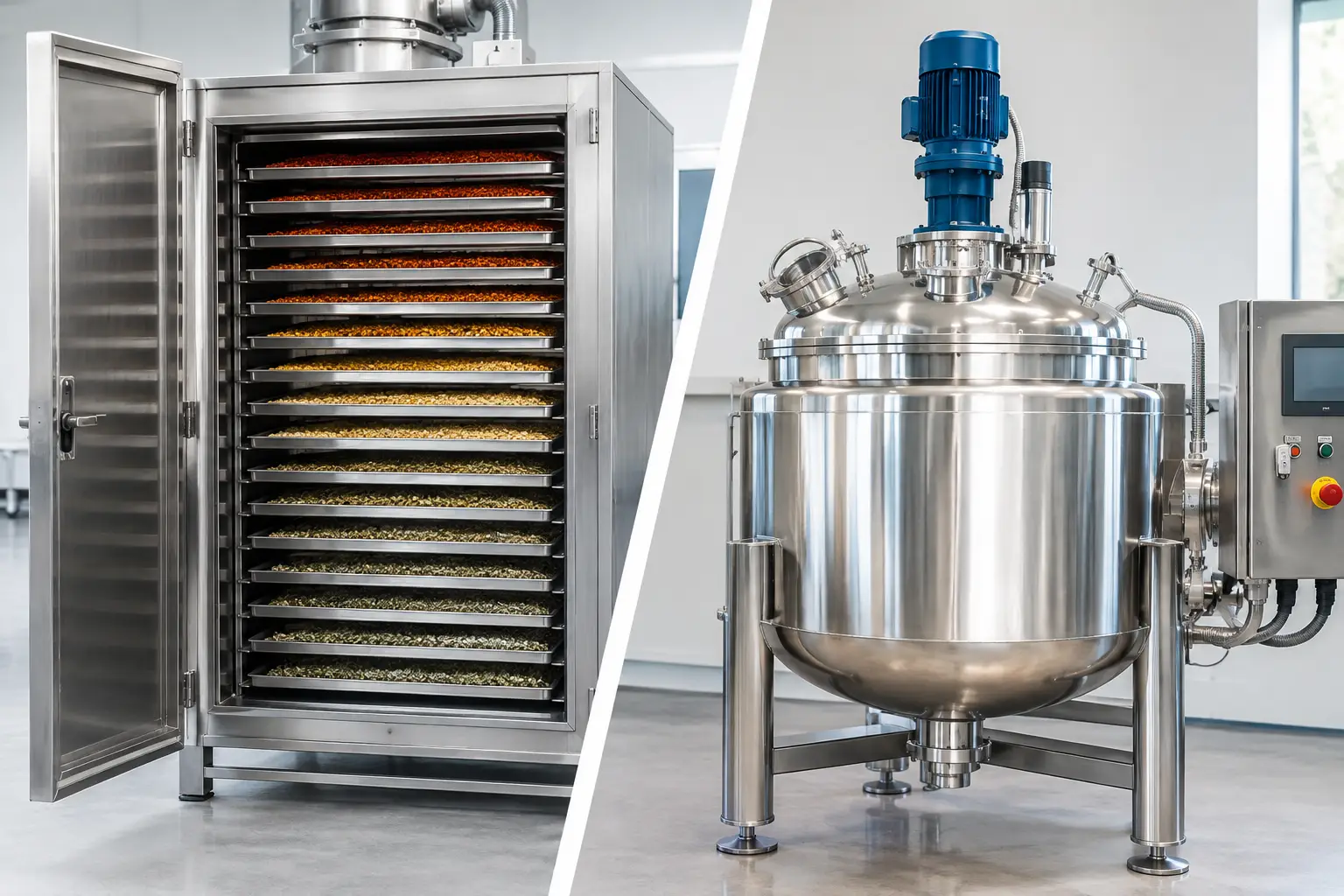
Vertical ribbon mixers may be a better fit where floor space is limited, batches vary significantly in size, or the material requires a different flow pattern. Vacuum ribbon mixers and dryers can support processes where drying and blending must occur in a controlled environment, reducing transfer steps that could otherwise expose the batch to moisture pickup or separation.
More mixing is not automatically better. Extended cycles can cause attrition, generate fines, break agglomerates, or alter particle shape. Each of those effects can increase the material’s tendency to segregate downstream. Establish the minimum validated mixing time that achieves the required uniformity, then protect that uniformity through the rest of the process.
Prevent Powder Segregation in Batches During Loading
The batch can begin separating before the mixer starts. Charging ingredients from excessive heights, feeding them at uncontrolled rates, or adding major components in isolated layers can create localized concentration zones that require more time and energy to correct.
Sequence matters. In many formulations, introducing a portion of the base material first creates a bed that cushions later additions. Low-inclusion ingredients may need preblending with a compatible carrier before they enter the main mixer. This approach is especially useful for minor ingredients that must distribute evenly through a large batch.
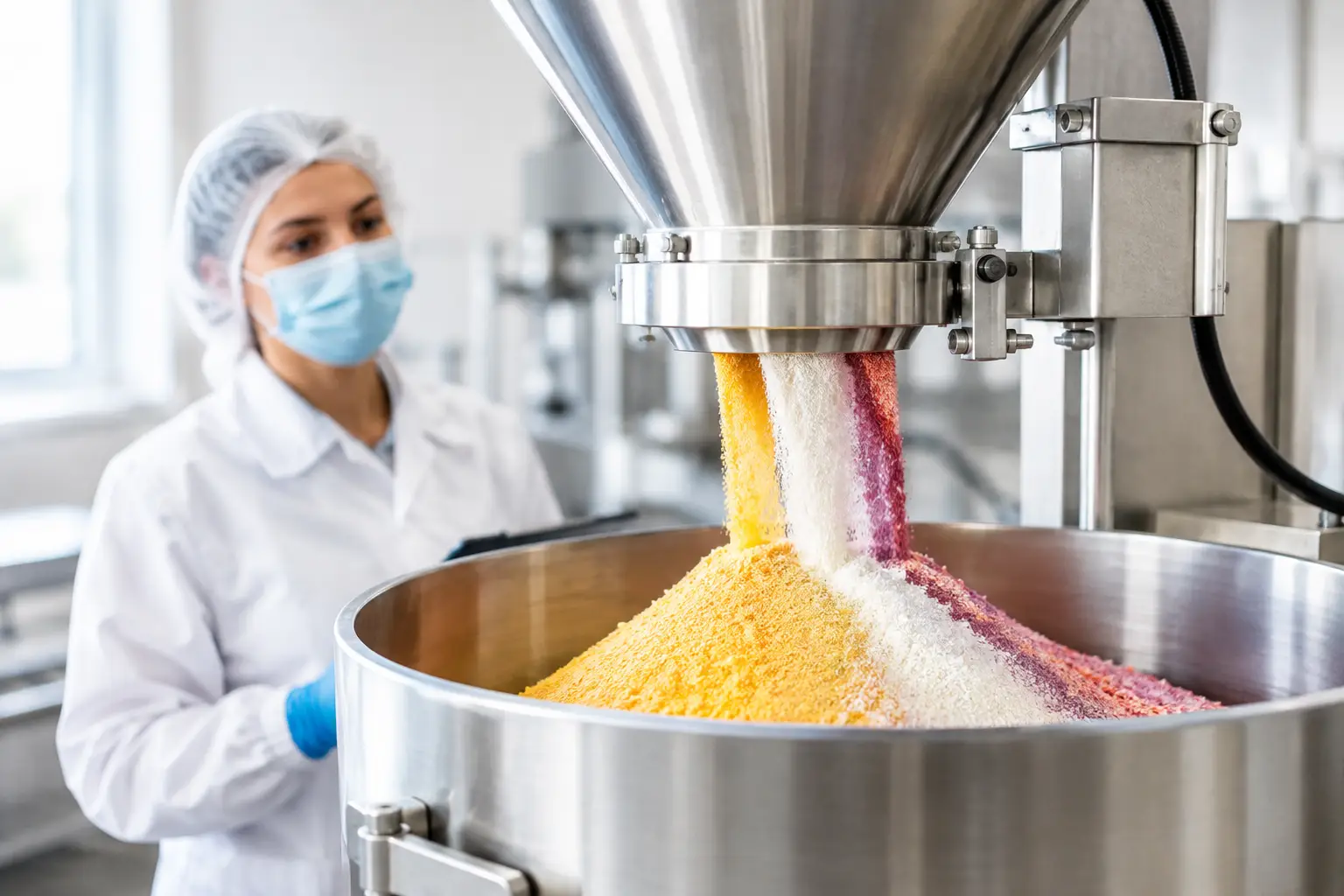
Avoid dumping fine and coarse materials into the vessel from separate high points when possible. A controlled feed arrangement reduces airborne dust, minimizes particle bounce, and limits size-based separation at the start of the cycle. For difficult formulations, gravimetric feeding or metered additions can improve repeatability and support documented batch control.
The operating fill level must also be controlled. An underfilled mixer may not develop the material bed needed for efficient turnover. An overfilled mixer can restrict movement and leave dead zones. The usable capacity depends on material characteristics and mixer geometry, so production teams should validate fill levels rather than rely only on nominal vessel volume.
Protect the Blend During Discharge and Transfer
Discharge is one of the most overlooked sources of segregation. A blended batch may be uniform in the mixer, but a long free fall into a tote or hopper can separate fine particles from coarse material. Rapid flow through restrictive valves, abrupt direction changes, and vibration from surrounding equipment can compound the problem.
Keep transfer distances short and drops low. Where practical, use enclosed, low-velocity transfer methods that limit air entrainment and particle classification. A properly designed screw conveyor can be effective for some powders, but excessive speed or a long conveying path can alter the blend. Pneumatic conveying offers process advantages in certain plants, yet it requires careful validation because air velocity and pipeline conditions can classify particles by size and density.
Receiving hoppers deserve the same engineering attention as the mixer. Mass-flow hopper design promotes first-in, first-out movement and reduces stagnant zones. Funnel-flow hoppers can be acceptable for stable materials, but they may worsen segregation in sensitive blends because material along the center channel discharges preferentially.
For tote filling, distribute material across the container instead of allowing a single high central pile to form. Consider fill heads, controlled spouts, or level management where batch uniformity is critical. If a filled container must be moved, reduce unnecessary vibration and avoid repeated handling before final use.
Control Dust, Fines, and Static
Dust collection is necessary for personnel safety, product recovery, and plant cleanliness, but poorly balanced air movement can remove fines from a batch or draw lightweight ingredients toward a vent point. Verify that dust-control systems capture airborne material without creating unwanted classification during charging or discharge.
Fines are particularly significant because they often carry colorants, active ingredients, flavors, or other high-value components. If the process creates fines through milling, conveying, or overmixing, investigate the source rather than repeatedly extending the blend cycle. Equipment wear can also contribute particles or change flow behavior over time, making preventive maintenance part of blend-quality control.
Electrostatic charge can cause fine powders to cling to vessel walls, transfer lines, filters, and packaging equipment. Grounding, humidity control where appropriate, conductive components, and suitable surface finishes can reduce this effect. The best approach depends on the powder and the operating environment, especially in facilities handling combustible dusts or moisture-sensitive materials.
Validate Uniformity Where It Matters Most
A single sample from the top of a mixer is not proof that a batch will remain uniform through packaging. Sampling plans should reflect the actual process risk. Take samples from multiple locations and, when practical, from early, middle, and late discharge. This identifies whether the issue originates in mixing, discharge, transfer, or packaging.
Define acceptance criteria based on the formulation’s functional and regulatory requirements. For a pharmaceutical product, this may involve strict assay uniformity. For a dry food blend, the relevant measures may include seasoning distribution, color consistency, particle ratio, or moisture. Trend results by lot, operator, raw-material supplier, and equipment condition to identify recurring causes before they become production failures.
A pilot trial is often the fastest way to resolve uncertainty. Testing the actual formulation in a production-representative mixer can establish cycle time, fill level, addition sequence, discharge behavior, and the value of optional features. PerMix applies this application-specific approach to help manufacturers select ribbon mixing systems that deliver consistent performance without unnecessary process complexity.
The most dependable way to protect a powder blend is to treat it as a system, from raw-material receipt through final discharge. When mixer design, material properties, and handling methods are aligned, uniformity becomes a controlled production outcome rather than a result that must be recovered after the fact.