What Drives Better Mixer Performance in Production?
A blend can look uniform at the discharge gate and still fail downstream. A variation in particle size, ingredient concentration, moisture, or bulk density may appear only in packaging, tableting, extrusion, or final product testing. That is why mixer performance should be evaluated as a production outcome, not simply by whether the machine turns or completes a batch on schedule.
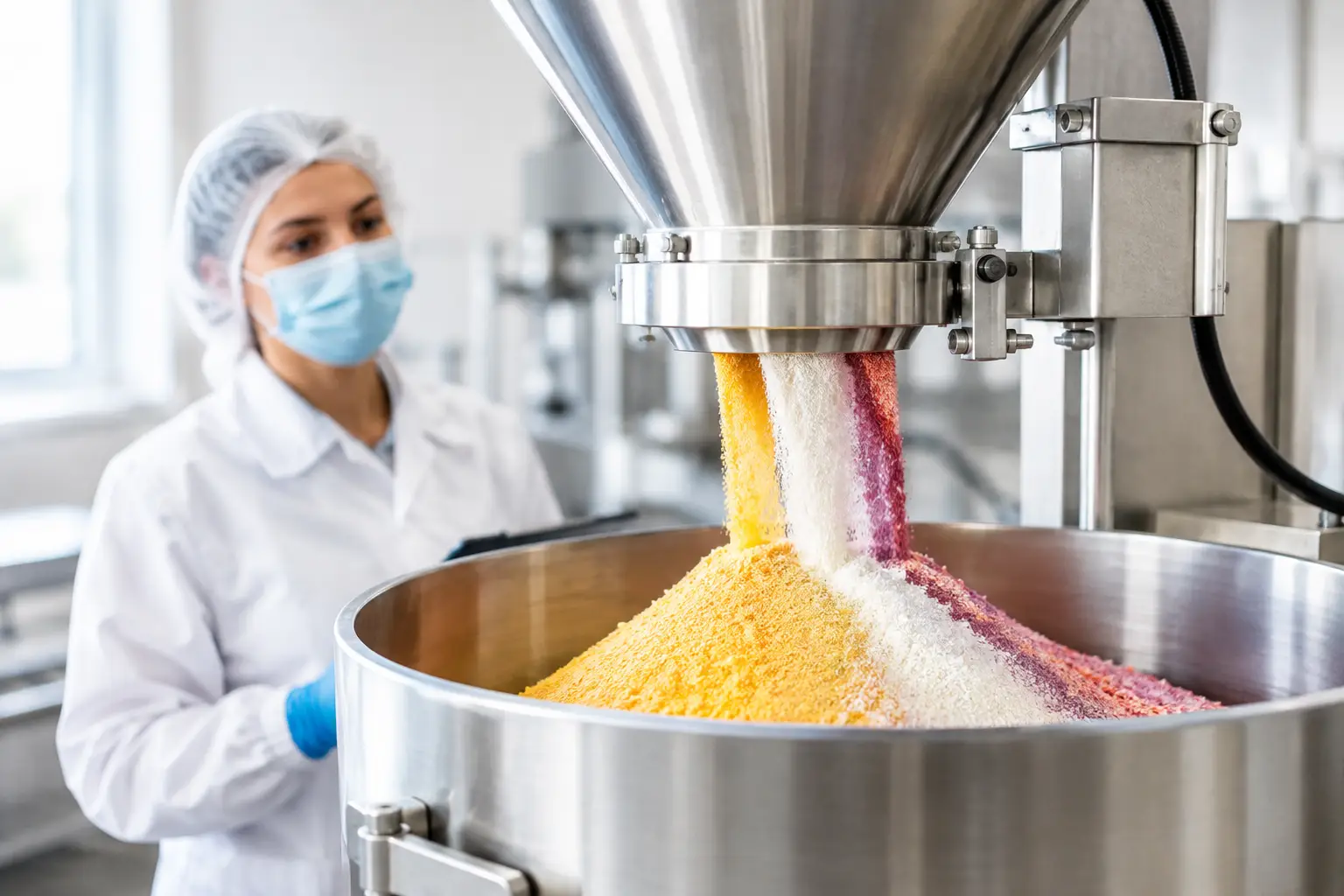
For manufacturers handling powders, granules, bulk solids, and pastes, high-performing mixing equipment supports more consistent quality, higher usable throughput, and less material loss. The right mixer configuration also reduces the operational compromises that create excess cycle time, product segregation, difficult cleaning, and avoidable maintenance.
What Mixer Performance Really Measures
Mixer performance is the ability to achieve the required degree of homogeneity within a practical cycle time while preserving the material’s physical properties. This definition is deliberately broader than blend uniformity. A mixer that produces an acceptable blend only at a very low fill level, with an excessive mixing time, or after damaging fragile particles may not be an effective production solution.
Process teams should evaluate performance through several connected measures: blend uniformity, batch-to-batch repeatability, cycle time, discharge efficiency, energy consumption, and equipment availability. The priority assigned to each measure depends on the application. Pharmaceutical and nutraceutical manufacturers may place blend consistency and cleanability first. Food processors may focus on sanitation, allergen changeover, and throughput. Chemical, polymer, and agricultural operations may need reliable handling of wide particle-size distributions, abrasive materials, or variable bulk densities.
The target is not necessarily the fastest possible mixing action. Excessive speed or mixing time can create heat, break particles, smear ingredients, or separate a blend that was previously homogeneous. Superior results come from matching the mixing mechanism to the product and controlling the process window.
Material Properties Set the Performance Ceiling
Before selecting a ribbon mixer design, define how the material behaves. Flowability, bulk density, particle shape, particle-size distribution, moisture content, cohesiveness, and fragility all affect the way ingredients move through the mixing zone.
Free-flowing powders generally respond well to the broad convective movement created by a horizontal ribbon agitator. The outer ribbon moves material in one direction while the inner ribbon moves it in the opposite direction. This counterflow continuously exchanges material between the vessel ends and through the center of the batch. When properly configured, it produces efficient distribution without relying on high tip speed.
Difficult materials require more analysis. Fine cohesive powders may form agglomerates rather than distribute evenly. Dense minor ingredients can migrate or settle if they are added at the wrong point or mixed too long. Pastes and damp materials can cling to vessel surfaces, affecting both mixing and discharge. A vertical ribbon mixer may be the stronger option when a process benefits from lower residual material, gentle lifting action, or efficient handling of materials that do not flow freely in a horizontal trough.
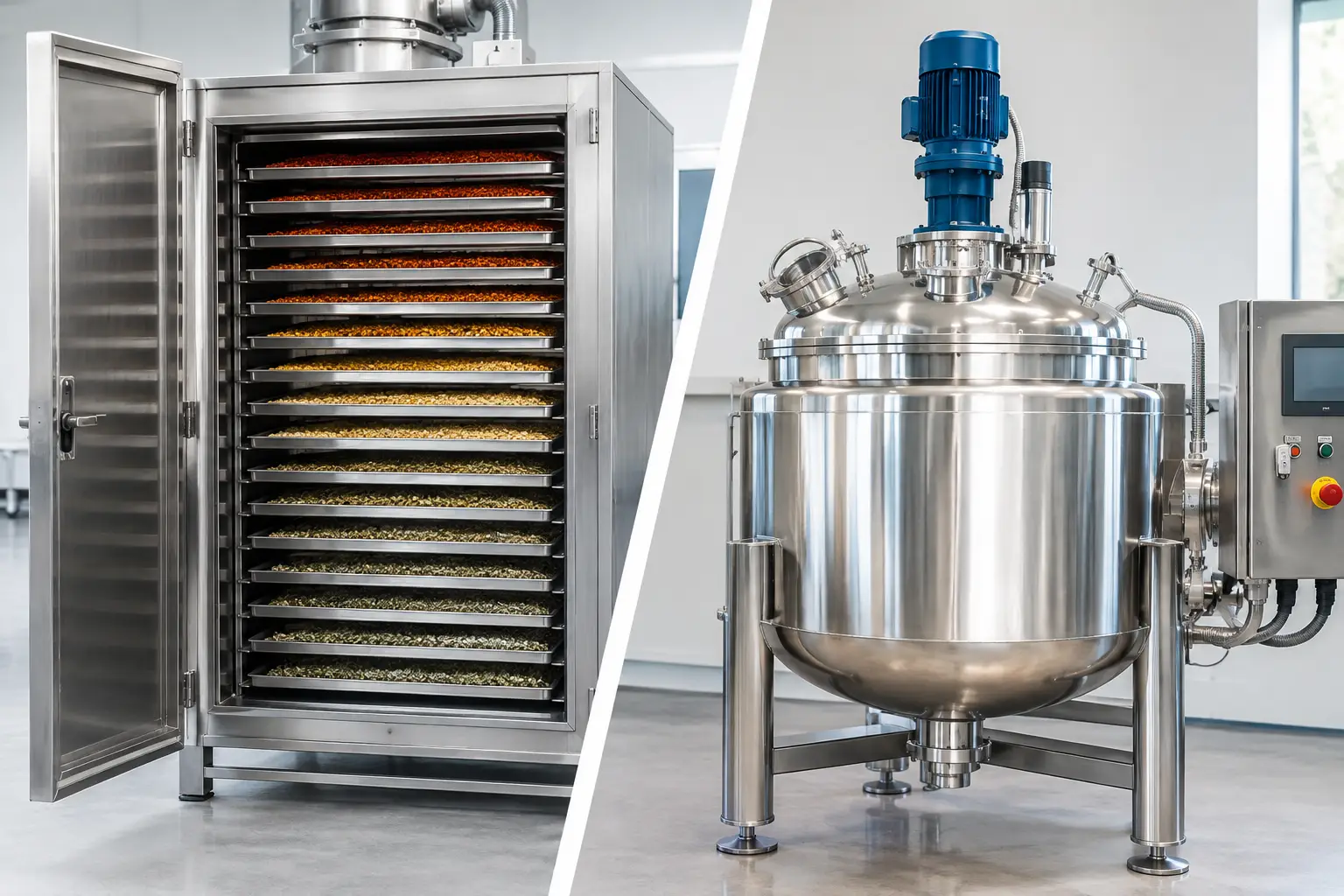
Vacuum ribbon mixers and dryers add another layer of capability for processes that combine blending with drying, evaporation, degassing, or solvent recovery. Here, performance is determined by the relationship among agitation, vacuum level, heat transfer area, jacket design, and the material’s changing condition throughout the cycle.
Ribbon Design and Vessel Geometry Matter
A ribbon mixer is not a commodity machine with a single universal arrangement. Ribbon pitch, ribbon width, clearance to the vessel wall, shaft design, agitator speed, and trough geometry influence material movement and the usable batch volume.
Close clearances can improve sweeping action and minimize hold-up, but they must be engineered with the product, thermal expansion, and wear conditions in mind. Abrasive materials may require more durable contact surfaces or specialized alloys. Sticky products may benefit from features that improve wall cleaning and reduce material accumulation. The discharge valve must also be sized and positioned to avoid turning an efficient blend into a slow, segregating discharge process.
For many dry blending applications, a horizontal ribbon mixer provides a practical balance of mixing intensity, batch capacity, and energy use. However, that balance changes with the product. Fragile inclusions, fibers, flakes, or coated particles may require gentler agitation or a different mixer configuration. Materials with significant liquid addition may need spray bars, choppers, or other features designed around wetting and dispersion requirements.
A supplier should review the full process duty rather than recommend equipment based only on nominal volume. Working volume, ingredient sequence, required batch time, upstream feed consistency, downstream receiving equipment, and cleaning method all influence the correct design.
Fill Level Is a Critical Operating Variable
Even a well-designed mixer can underperform when operated outside its intended fill range. Underfilling may reduce the material-to-ribbon interaction needed for efficient convective movement. Overfilling can restrict circulation, create dead zones, increase power demand, and extend the time required to reach uniformity.
The best operating range depends on mixer geometry and material behavior. It should be verified during process development and protected through production procedures. If batch sizes frequently vary, a plant may need a mixer sized around the most common production volume, not only the maximum theoretical batch. Choosing an oversized vessel to accommodate an occasional large batch can create recurring performance problems on everyday runs.
Fill level also affects liquid addition. A spray pattern that reaches and distributes properly at one batch volume may concentrate liquid at another. This is especially relevant for food seasoning blends, detergent powders, agricultural formulations, and other products where small additions must be dispersed consistently.
Speed, Time, and Sequence Must Work Together
Mixing speed is often treated as the main adjustment when a blend result is inconsistent. It is only one part of the process. Higher speed may shorten a cycle for some materials, but it can also increase heat generation, particle attrition, and energy use. For cohesive products, additional speed alone may not break agglomerates if the agitator and vessel are not designed for the required shear level.
Ingredient addition sequence is equally important. Minor ingredients should enter where they can disperse rapidly through the moving bulk material. Liquid additions should be introduced in a controlled manner and at a point that supports distribution rather than localized wetting. Components prone to damage may need to be added late in the cycle, after the base blend has reached the required uniformity.
A repeatable recipe should define fill weight, ingredient order, mixer speed, mixing duration, liquid-addition rate, and discharge procedure. Those parameters create a usable operating standard. Without them, operators may compensate for normal raw-material variation by extending mixing time, which can hide the actual cause of a quality issue and lower capacity.
Verify Performance With Representative Testing
A credible performance assessment begins with representative materials. Testing a simple, free-flowing surrogate can provide a basic mechanical demonstration, but it cannot confirm results for a product containing cohesive fines, low-dose additives, or ingredients with major density differences.
Sampling plans should account for the way material moves through the mixer and through discharge equipment. Samples taken only from the top surface can miss variation elsewhere in the vessel. Depending on the application, teams may use tracer studies, assay results, moisture analysis, particle-size checks, or other product-specific methods to establish blend quality.
The goal is to identify the shortest reliable mixing time, not merely prove that a uniform blend is possible eventually. A performance curve that compares uniformity against time is valuable because it shows when the blend reaches its acceptable range and whether continued mixing offers a benefit or introduces risk.
During scale-up, maintain attention to geometry and process conditions rather than assuming results transfer directly by batch weight alone. Agitator speed, tip speed, fill percentage, ingredient feed location, and material condition should be reviewed as a connected system.
Protect Performance Through Maintenance and Controls
Mechanical condition directly affects mixing consistency. Worn ribbons, excessive shaft movement, damaged seals, buildup on internal surfaces, and discharge valve issues can alter material flow and create contamination or downtime risks. Preventive inspections should focus on the components that affect product contact, agitation, and reliable discharge.
Controls also provide a practical path to better repeatability. Variable-frequency drives allow operators to apply validated speed settings. Recipe-based controls reduce variation in time and sequence. Load monitoring can indicate unexpected changes in material behavior, such as increased moisture, bridging, or an overfilled batch. For regulated operations, documented parameters support a more controlled and traceable process.
PerMix designs configurable ribbon mixing systems around these operating realities, with equipment options selected for the product, plant layout, sanitation needs, and production target rather than a generic specification.
Choose the Design Around the Process, Not the Nameplate
The most productive mixing investment begins with clear process data: the full ingredient list, physical characteristics, batch range, target uniformity, liquid-addition requirements, cleaning expectations, and expected production schedule. Those details determine whether a horizontal ribbon mixer, vertical ribbon mixer, or vacuum ribbon mixer and dryer is the right fit.
When quality variation or throughput losses are already affecting the line, treat the mixer as part of the entire process rather than an isolated vessel. A well-defined material trial and an application-specific engineering review can turn blending from a recurring source of uncertainty into a controlled, cost-effective production step.