Ribbon Mixer Jacket Design Guide for Process Teams
A jacket can turn a horizontal ribbon mixer from a blending machine into a controlled thermal processing system. This ribbon mixer jacket design guide explains the decisions that determine whether a batch heats or cools predictably, protects product quality, and fits the realities of plant utilities, cleaning procedures, and production schedules.
For powders, granules, pastes, and moisture-sensitive materials, jacket design is not an accessory decision. It affects cycle time, energy demand, temperature uniformity, product discharge behavior, and the mechanical specification of the vessel itself. The right design begins with the material and process objective, not with a default heating medium or jacket style.
Start With the Thermal Duty, Not the Jacket Type
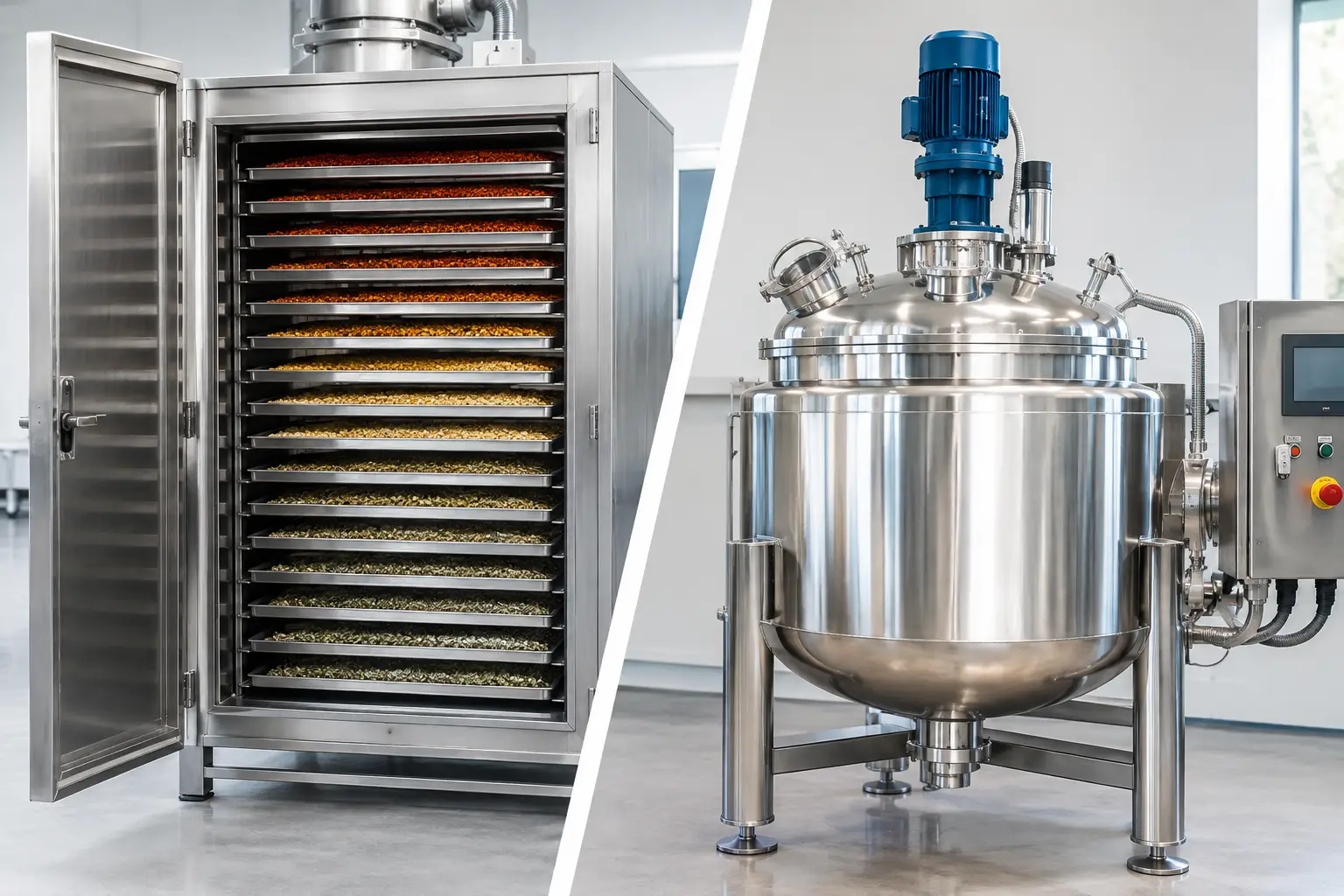
The first question is simple: what must happen to the product during the batch? Some processes need gentle warming to reduce viscosity before blending or discharge. Others need cooling to prevent heat-sensitive ingredients from degrading, clumping, or volatilizing. In vacuum ribbon mixer and dryer applications, the jacket may supply the energy required to remove moisture at controlled product temperatures.
Define the target batch weight, starting and final product temperatures, required cycle time, material heat capacity, moisture content, and whether phase change is involved. A dry powder warming from 70°F to 120°F presents a very different duty than a wet paste being dried under vacuum. The product’s bulk density and fill level also matter because they influence how much of the vessel wall remains in contact with the moving material.
A practical thermal design estimates the heat load and then evaluates whether available transfer area, the overall heat-transfer coefficient, and the temperature difference between media and product can deliver it within the required time. In simplified terms, heat-transfer rate depends on U x A x delta T. The calculation is only as useful as the assumptions behind it. Product-side heat transfer is often the limiting factor, especially with low-conductivity powders, cohesive pastes, or partially filled mixers.
Ribbon agitation improves wall contact by continuously moving material through the mixing zone. It does not eliminate the need to account for product behavior. A free-flowing granular material may respond quickly to a jacket. A high-viscosity paste may require longer residence time, additional thermal surface, or a different combination of agitator speed and fill level.
Ribbon Mixer Jacket Design Guide: Select the Right Construction
The jacket construction must match the thermal duty, operating pressure, temperature range, sanitation requirements, and fabrication standard. Three common approaches are conventional full jackets, dimple jackets, and half-pipe coil jackets.
A conventional full jacket creates an annular space around the mixing trough. It can provide broad heat-transfer coverage and is often appropriate for moderate utility pressures and temperatures. Its performance depends on circulation design. Poorly directed flow can create stagnant areas that reduce heat transfer and make temperature response less consistent.
Dimple jackets use formed dimples to create structured flow paths between the vessel shell and jacket skin. They are compact, mechanically efficient, and well suited to many sanitary or corrosion-resistant vessel designs. For applications where product quality depends on even temperature control, dimple geometry can support more consistent media distribution than a simple open annular jacket.
Half-pipe coil jackets use a pipe section welded to the vessel exterior in a continuous pattern. They are often selected for elevated pressures, demanding thermal-fluid service, or applications requiring strong mechanical integrity. The trade-off is that coverage and fabrication cost can differ from a full or dimple jacket. A half-pipe design should be laid out to avoid leaving critical product-contact zones without effective thermal support.
The best option depends on the process. A food manufacturer cooling a blended filling with chilled glycol may prioritize sanitation, responsive control, and drainability. A chemical processor using high-temperature thermal oil may prioritize pressure capability, expansion management, and weld integrity. Selecting a jacket solely because it is familiar can create a costly mismatch between the vessel and the process.
Choose the Heat-Transfer Medium Around the Product
Steam, hot water, thermal fluid, chilled water, and glycol mixtures all have valid uses. The preferred medium should support the required product temperature without creating avoidable risk or excessive operating cost.
Steam provides high heat-transfer potential and fast heating where plant steam is available. However, it can be too aggressive for heat-sensitive products if pressure and temperature are not tightly controlled. Steam systems also require proper condensate removal, trapping, and drainage. Standing condensate reduces performance and can cause unstable temperature response.
Hot water is often a practical choice for moderate-temperature processes that benefit from gentler heat input. It is generally easier to control than steam in narrow product-temperature windows. Thermal fluid is appropriate when temperatures exceed water-based utility limits or when the process requires stable, indirect heating without high pressure. Its higher viscosity and operating requirements must be considered when sizing pumps, piping, and controls.
For cooling, chilled water can work well when the product target is above the facility’s chilled-water supply temperature. Glycol-water mixtures are used where lower temperatures or freeze protection are required. Cooling duty can be more challenging than heating because the product may continue generating heat from friction, reaction, or incoming ingredients. Design the system around the highest expected load, not only the nominal recipe.
Zone Coverage and Flow Direction Matter
A single jacket zone may be sufficient for straightforward batch warming or cooling. More demanding processes can benefit from separate zones along the trough, particularly on larger mixers or where the batch has distinct loading, mixing, and discharge phases.
Zoning allows operators to control heat input where product contact is greatest and reduce energy use where it is not needed. For example, the central trough may require the most active thermal control during blending, while the discharge end may need targeted heating to preserve flowability before emptying. Separate zones can also help limit overheating near the product surface during low-fill operation.
Inlet and outlet placement must encourage complete circulation through the jacket. Specify vents at high points to remove air or vapor pockets and drains at low points to remove condensate, cleaning water, or residual utility media. The jacket should be designed for the installed orientation of the mixer, not only the vessel drawing. A minor routing mistake can become a permanent source of poor heat transfer and maintenance calls.
Design for Control, Safety, and Cleanability
A jacket delivers process value only when operators can measure and control the result. Product temperature measurement should reflect the actual material mass, not just the jacket outlet temperature. Depending on the application, this may mean a product probe in the trough, multiple sensors, or an insulated instrument connection that prevents misleading readings.
The control strategy should match the sensitivity of the product. Simple on-off control may be acceptable for noncritical bulk materials. Pharmaceutical, food, cosmetic, and specialty chemical applications often require modulating valves, temperature ramping, batch records, and carefully tuned control loops. A fast utility response is not automatically an advantage if it causes overshoot or localized product damage.
Pressure protection is equally important. Jacket pressure and temperature ratings must account for the selected medium, maximum utility conditions, thermal expansion, and potential blocked-in scenarios. Applicable vessel codes, relief devices, pressure testing, and documentation should be determined early in engineering. Retrofitting safety provisions after fabrication is inefficient and may compromise the original design.
For sanitary service, use smooth external welds, accessible connections, appropriate surface finishes on product-contact components, and a design that supports cleaning and inspection. While the jacket is outside the product zone, its connections, insulation, and support details still affect washdown access and long-term maintainability. In corrosive environments, the material selection for both the vessel and jacket must be evaluated against utility chemistry and ambient exposure.
Account for Mixing Mechanics and Insulation
Ribbon mixer performance and thermal performance are linked. Higher agitator speed can increase product turnover at the vessel wall, but it may also add frictional heat, increase particle attrition, or alter the blend behavior. The right operating speed is the one that provides homogeneous mixing and adequate thermal contact without damaging the product.
Do not overlook insulation. A properly insulated jacket reduces heat loss, improves operator safety, and makes temperature control more stable. Insulation is particularly valuable for long batches, high-temperature thermal-fluid applications, and chilled processes operating in warm or humid production areas. The insulation system should be removable where inspection or maintenance access is required and protected by cladding suited to the plant environment.
Specify the Jacket as Part of the Complete Process System
A well-designed ribbon mixer jacket requires more than a vessel drawing. The specification should identify the product duty, batch size range, utility medium and supply conditions, jacket pressure and temperature design limits, required heat-up or cool-down time, insulation needs, instrumentation, control philosophy, and applicable sanitary or regulatory requirements.
PerMix engineers jacketed ribbon mixing systems around these process variables, helping manufacturers avoid oversizing, underperforming thermal surfaces, and utility configurations that create unnecessary operating cost. The goal is a tailored solution that supports repeatable production rather than a mixer that merely includes a jacket.
Before releasing a purchase specification, review the thermal assumptions with the equipment supplier and the plant team responsible for utilities and controls. That conversation can identify limits in steam pressure, chilled-water capacity, available floor space, or cleaning access while changes are still inexpensive. A jacket designed around the real process gives operators a more dependable path to consistent batches, shorter cycles, and lower downtime.