Best Powder Mixer for Chemicals: What Fits?
A chemical blend that looks uniform in the discharge chute can still fail in the bag, reactor, or downstream line. That is why choosing the best powder mixer for chemicals is less about buying a popular machine and more about matching mixer geometry to material behavior, process risk, and production targets.
In chemical manufacturing, the wrong mixer creates expensive problems fast – inconsistent active content, dust exposure, segregation after discharge, long batch times, and cleaning delays that cut into throughput. The right mixer does the opposite. It improves homogeneity, supports safe handling, reduces energy waste, and gives operators a repeatable process they can trust from batch to batch.
What makes the best powder mixer for chemicals?
The best powder mixer for chemicals is the one that fits the product, not the one with the broadest marketing claim. Chemical powders behave very differently depending on particle size, bulk density, moisture level, flowability, abrasiveness, and whether minor ingredients must be distributed at very low inclusion rates.
A free-flowing mineral blend and a cohesive specialty chemical do not need the same mixing action. Neither does a dry blend that must stay cool compared with one that requires heating, vacuum drying, or liquid addition. That is where mixer selection becomes an engineering decision instead of a catalog exercise.
For most chemical producers, the decision comes down to a few practical questions. Do you need fast batch blending or gentle handling? Is the formula prone to clumping or segregation? Are you introducing pigments, binders, or trace additives? Do you need a sanitary finish, inerting capability, pressure resistance, or vacuum operation? Once those answers are clear, the right mixer type usually becomes much easier to identify.
Why ribbon mixers are often the best powder mixer for chemical processing
For a wide range of dry chemical and powder blending duties, ribbon mixers are often the strongest fit because they combine reliable convection mixing with flexible batch performance. A horizontal ribbon mixer uses inner and outer helical ribbons to move material in opposing axial directions while also creating radial movement. That combination supports fast, consistent blending across many powder and granule formulations.
This matters in chemical plants because production rarely runs one ideal material forever. The same line may handle fine powders, denser granules, additives, and occasional liquid spray introduction. A well-designed ribbon mixer can adapt to that range without forcing a compromise in throughput or blend quality.
Horizontal ribbon mixers are especially effective when the goal is homogeneous batch blending in a predictable cycle time. They are commonly selected for formulations that need even distribution of bulk ingredients and minor components while maintaining practical loading, discharge, and cleaning access. In many facilities, that balance of performance and operating simplicity is exactly what defines the best powder mixer for chemicals.
Vertical ribbon mixers can also be a strong option, particularly where floor space, batch size, or specific material flow patterns make a vertical configuration more practical. They are often considered when a plant needs a compact footprint or a different style of material circulation than a horizontal trough provides.
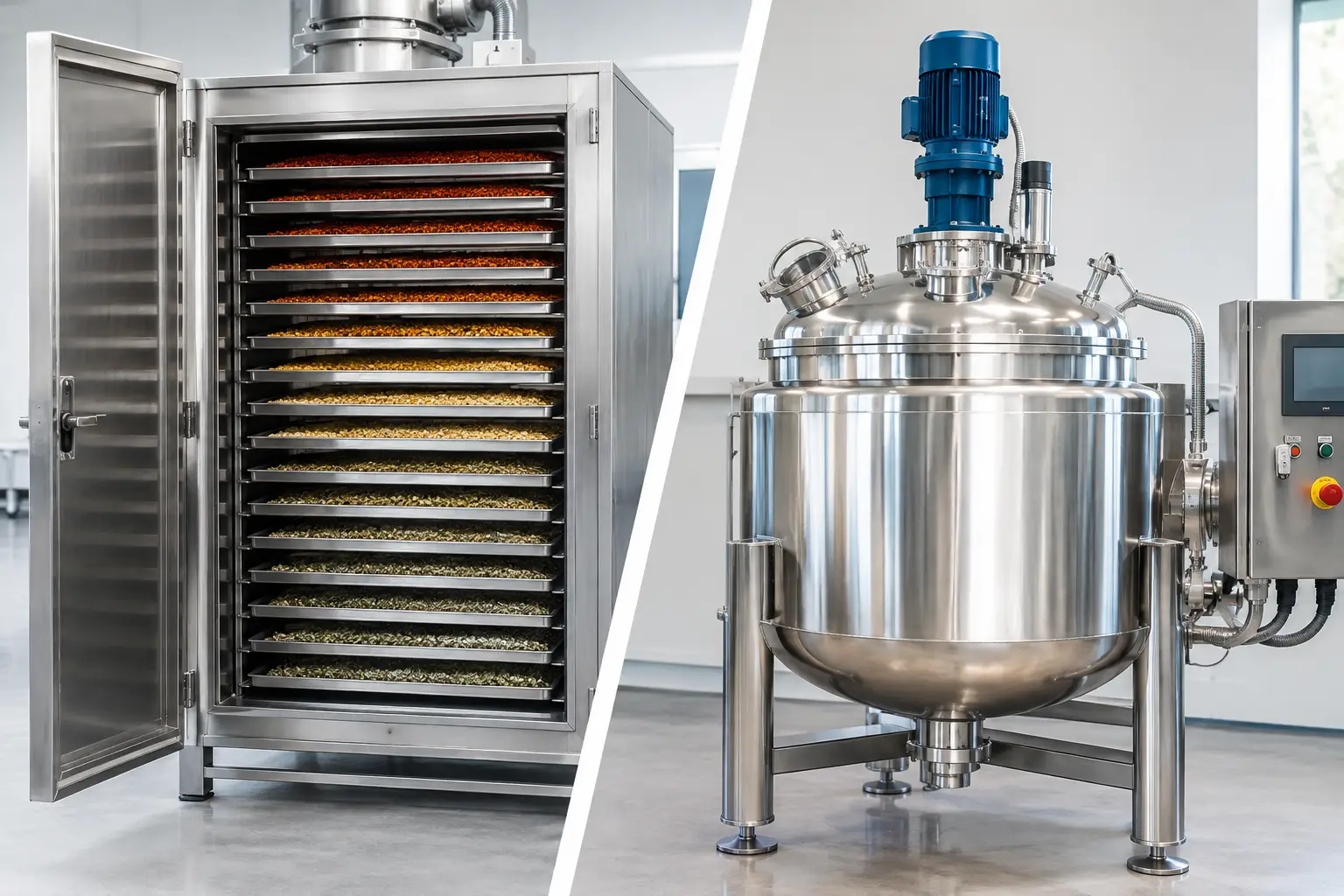
Vacuum ribbon mixers and dryers move into a more specialized category. If the process requires drying, solvent recovery support, temperature-sensitive handling, or controlled atmospheric conditions, a vacuum-capable design may be the better investment. It costs more up front, but in the right application it can replace separate process steps and improve product consistency.
Material behavior should drive mixer selection
Chemical powders do not fail to mix for random reasons. They fail because the equipment does not match how the material actually behaves.
If the product is free-flowing and similar in particle size and density across ingredients, a standard ribbon mixer is often highly effective. If the formula includes ultrafine additives, pigments, or actives at very low percentages, the mixer must generate enough movement to distribute them evenly without creating dead zones. If the material is cohesive, sticky, or moisture-sensitive, the design may need stronger agitation, optional choppers, heating or cooling capability, and a construction standard that supports reliable cleaning.
Bulk density differences are another major factor. A heavy powder mixed with a lightweight additive may appear blended inside the trough but segregate during discharge or packaging. In that case, the best powder mixer for chemicals is not simply the one that mixes fastest. It is the one that produces a stable blend and works with the rest of the process, including downstream transfer.
Abrasive materials also change the equation. Standard internal surfaces may wear prematurely when handling aggressive chemical solids. Hard-facing, upgraded materials of construction, and shaft seal selection become part of the mixer decision. Ignoring wear is a common way to turn a capital purchase into a maintenance problem.
Batch size, cycle time, and plant economics
Mixer selection should always connect back to production economics. A machine that produces an excellent blend but takes too long to load, mix, discharge, and clean may not be the best choice for a busy plant.
That is why throughput should be evaluated as total batch cycle time, not just mixing time. In chemical operations, changeovers, dust control steps, sampling, and cleaning often add more time than the blend itself. The best equipment supports the whole cycle with dependable discharge, manageable access, and controls that help operators repeat the process with less variation.
Overbuying capacity can also be a mistake. Large mixers running far below their intended fill level may not perform as expected. Underbuying is just as risky because pushing oversized batches through an undersized machine usually hurts blend quality and accelerates wear. A tailored solution is usually more cost-effective than forcing a standard machine into the wrong duty.
Containment, safety, and compliance are not secondary issues
Chemical powder mixing often involves dust hazards, operator exposure concerns, and ingredients that demand careful containment. In these environments, the best powder mixer for chemicals must support more than blend uniformity.
Dust-tight construction, seal integrity, explosion protection strategy, and compatibility with inert gas blanketing may all be necessary depending on the formulation. Some plants need vacuum operation to manage solvent-sensitive processes or to support integrated drying. Others need polished finishes, clean-in-place options, or validation-friendly design features for regulated environments.
These requirements affect total system performance. A mixer that looks economical at first can become far more expensive if it requires extra containment measures, frequent manual cleaning, or modifications to meet site safety standards. Industrial buyers know that equipment value is measured over years of operation, not on initial price alone.
Configuration matters more than brand labels
Many buyers start by asking which mixer type is best. A better question is which mixer configuration is best for the process.
The same ribbon mixer platform can be configured very differently depending on the application. Trough geometry, ribbon pitch, agitator speed, motor sizing, discharge valve design, surface finish, jacketed construction, vacuum rating, and control integration all influence the result. This is why two machines with the same basic name can perform very differently in actual production.
For chemical processors, application-specific engineering usually delivers better outcomes than off-the-shelf selection. A supplier that understands powder behavior and asks detailed process questions will typically recommend a more reliable solution than one pushing a generic machine. That consultative approach is especially important when formulas are sensitive, hazardous, abrasive, or difficult to clean.
PerMix focuses on that kind of engineered fit, particularly in ribbon mixing applications where consistency, durability, and process customization matter to plant performance.
How to evaluate the right mixer before purchase
A serious mixer evaluation should start with the product and end with measurable operating outcomes. Material samples, batch volumes, target homogeneity, fill levels, cleaning expectations, and utility constraints all need to be reviewed. If liquid addition is part of the process, that should be tested as well.
Buyers should also ask how the mixer will perform after six months of production, not just on installation day. How accessible are seals and wear components? How complete is discharge? How much residue remains between batches? Does the design support quick maintenance and low downtime? Those questions often reveal the real cost of ownership.
Factory testing or application review is especially valuable for chemical powder blending because small differences in material behavior can produce very different results at scale. When the process is critical, evidence matters more than assumptions.
The right answer is usually specific
If your process involves general dry powder blending, minor ingredient distribution, and repeatable batch production, a horizontal ribbon mixer is often the leading candidate. If space constraints or batch geometry point in another direction, a vertical ribbon design may be more practical. If the application includes drying, thermal sensitivity, or controlled atmosphere requirements, a vacuum ribbon mixer may be the stronger long-term choice.
So what is the best powder mixer for chemicals? The honest answer is that it depends on the formula, the plant, and the operating standard you need to meet. The good news is that when mixer design is aligned with actual process demands, the result is not just better blending. It is better uptime, safer handling, lower operating cost, and a more dependable production line.
The smartest buying decision is usually the one that treats mixing as a process solution, not just a piece of equipment.