Mixer Capacity Planning for Reliable Throughput
A ribbon mixer that looks properly sized on a layout drawing can become a production constraint the moment actual materials, cleaning requirements, and discharge time enter the calculation. Effective mixer capacity planning begins with the finished production target, then works backward through batch size, bulk density, fill level, mixing time, and material flow behavior. The result is a system sized for dependable output rather than nominal vessel volume.
Mixer Capacity Planning Starts With Required Output
The first question is not, “What mixer volume do we need?” It is, “How much finished product must leave the process each shift?” Define the required output in pounds, kilograms, or tons per hour, then account for planned operating hours, production days, and realistic equipment availability.
For example, a plant requiring 20,000 pounds of blended product in an eight-hour shift does not necessarily need a mixer capable of producing 2,500 pounds every hour. Changeovers, ingredient staging, charging, sampling, discharge, sanitation, and routine inspection all consume time. If the mixer is expected to operate for six productive hours within that shift, the required average output rises to approximately 3,333 pounds per productive hour.
This distinction matters when evaluating a mixer based solely on its stated capacity. A vessel’s total volume is a physical dimension. Production capacity is the amount of acceptable product it can process repeatedly within the available schedule. The right design must satisfy both.
Calculate Batch Size From the Actual Process Window
Once hourly throughput is established, determine the batch size that fits the process window. Larger batches can reduce the number of cycles, but they may create operational issues if material delivery, downstream packaging, quality testing, or cleaning procedures cannot keep pace.
Smaller batches offer more flexibility and can reduce the financial impact of an off-spec batch. They may also be preferable for high-value formulations, frequent product changes, or applications where precise ingredient additions are critical. The trade-off is more charging and discharge events, which can reduce overall throughput if they are not efficiently managed.
A practical capacity plan evaluates several batch-size scenarios rather than assuming that the largest possible batch is automatically the most efficient. The best choice is usually the batch size that supports the required output with sufficient schedule margin, not the one that maximizes vessel fill on paper.
Convert Material Density Into Usable Mixer Volume
Mixer manufacturers commonly state capacity in volume, while production requirements are often stated by weight. Bulk density connects the two, but it must be the correct density measurement.
Loose bulk density can differ substantially from tapped or compacted density. Powders may aerate during conveying, settle during storage, or change density with moisture content and particle size. A formulation containing light fibers, fine powders, pellets, granules, or liquids added to dry solids can also behave very differently from a single raw ingredient.
The basic calculation is straightforward:
Required working volume = batch weight ÷ bulk density
If a 1,000-pound batch has a bulk density of 40 pounds per cubic foot, it requires 25 cubic feet of working volume. That does not mean a 25-cubic-foot mixer is the correct selection. The mixer needs operating headspace and an appropriate fill level to create the material movement needed for homogeneous blending.
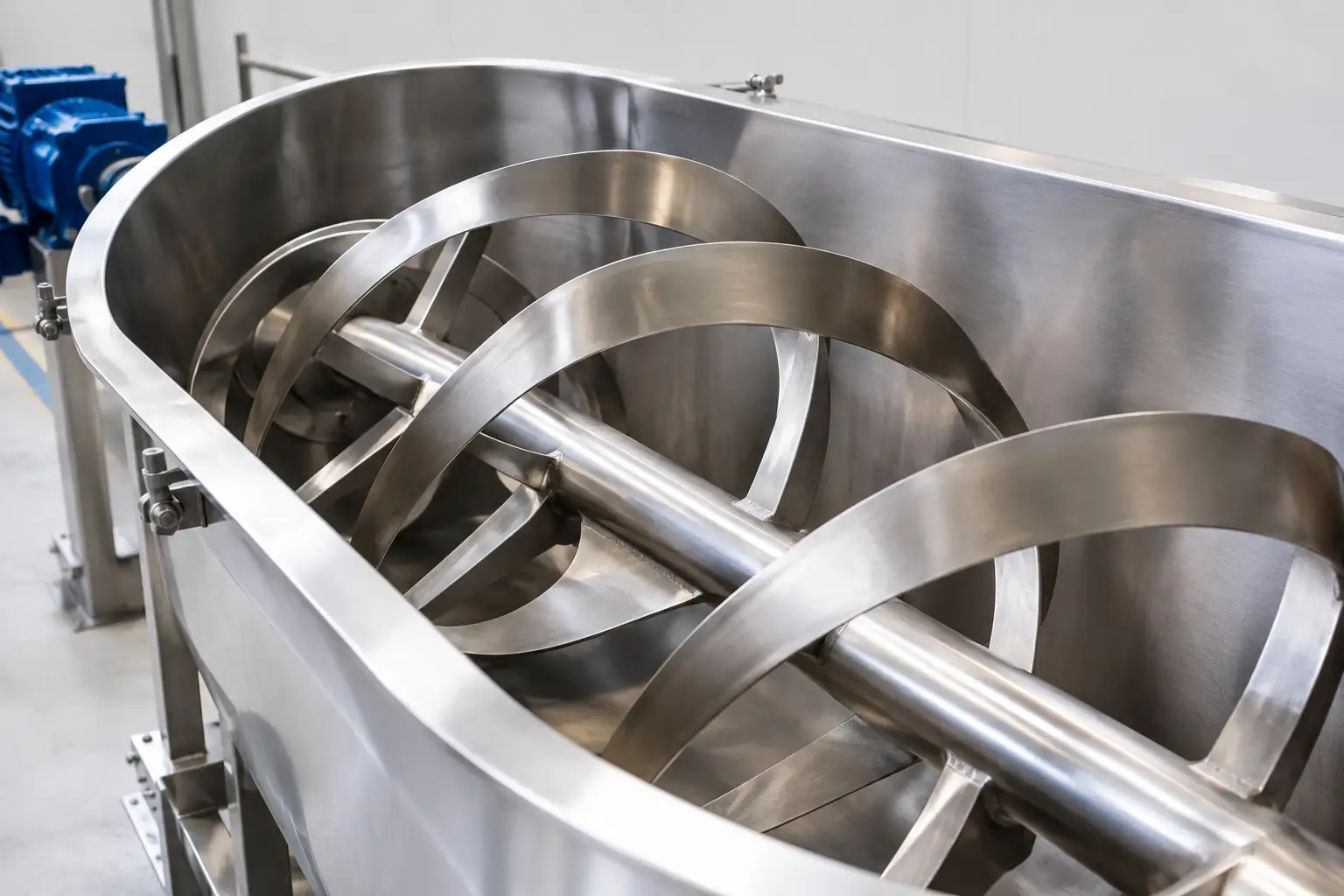
Horizontal ribbon mixers are generally selected based on usable working capacity, not total shell volume. The appropriate fill level depends on material characteristics, the degree of mixing required, liquid addition needs, and the mixing action required for the application. Overfilling can restrict circulation and leave ingredients insufficiently distributed. Underfilling may reduce ribbon engagement, increase mixing time, and make repeatable results more difficult.
For this reason, capacity planning should use the formulation’s anticipated bulk density range, not a single optimistic number. Engineering for a reasonable low-density condition helps prevent capacity shortfalls when raw material variability occurs.
Account for the Entire Batch Cycle
A mixer’s blending time is only one part of its cycle time. For reliable throughput, capacity planning must include every activity between the start of one batch and the start of the next.
A complete cycle typically includes ingredient charging, dry blending, liquid addition if required, final mixing, quality sampling, discharge, and preparation for the next batch. In sanitary, allergen-sensitive, pharmaceutical, or specialty chemical operations, cleaning and verification time may be equally significant. Batch documentation and material traceability requirements can add time as well.
Consider a mixer with a 10-minute blend time. If charging takes 12 minutes, liquid addition and final mixing take 8 minutes, discharge takes 10 minutes, and reset takes 5 minutes, the total cycle is 45 minutes. The equipment can theoretically complete slightly more than 10 cycles in an eight-hour period, but that estimate still assumes consistent material availability and no interruptions.
A sound plan includes a realistic allowance for normal operating variation. Building a process around perfect cycle times often leads to overtime, delayed orders, and unnecessary pressure on operators. Sizing with practical margin is usually more cost-effective than relying on a mixer to run continuously at its theoretical limit.
Material Behavior Can Change the Capacity Decision
Two products with the same batch weight and bulk density may require different mixer configurations. Material behavior affects fill level, mixing time, drive requirements, discharge design, and the need for specialized features.
Free-flowing granules and dry powders may blend efficiently in a standard horizontal ribbon mixer. Cohesive powders, sticky pastes, moisture-sensitive compounds, or formulations with high liquid loading may require a different ribbon arrangement, heavier-duty drive system, jacketed vessel, chopper, or a vacuum-capable configuration.
Particle size and density differences deserve particular attention. A blend may look uniform immediately after mixing but segregate during discharge, conveying, or packaging. In these cases, capacity planning must extend beyond the mixer itself. The discharge valve, hopper geometry, transfer method, and downstream equipment should preserve the blend quality created in the vessel.
Temperature can also be a deciding factor. Products that require heating, cooling, drying, or vacuum processing need a capacity calculation that reflects heat-transfer time and not simply mechanical mixing time. A vacuum ribbon mixer dryer, for example, may deliver exceptional process control, but its cycle must include evacuation, heating or cooling phases, vapor removal, and safe product discharge.
Match the Mixer Configuration to the Process
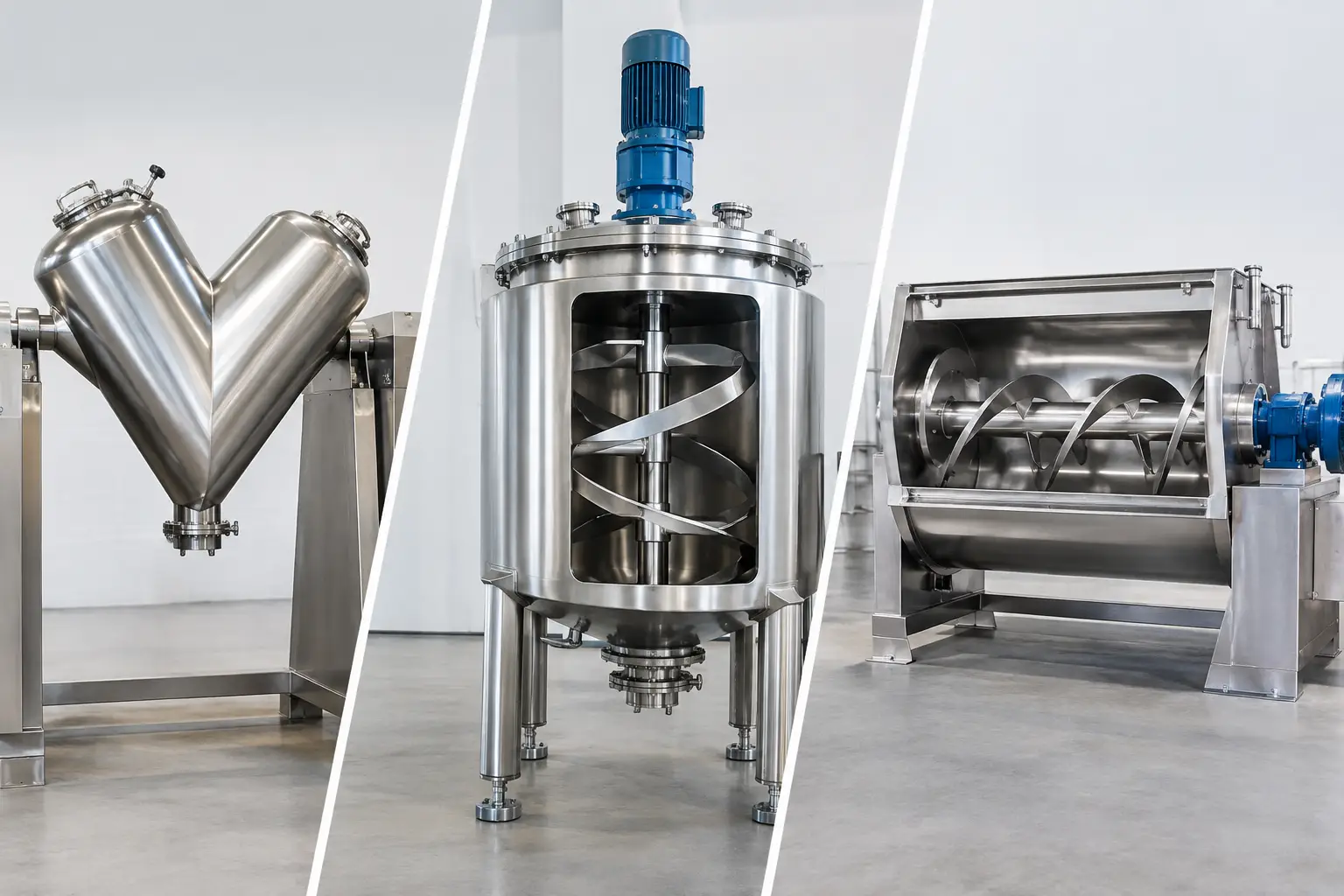
The equipment selection should support the material and the production objective together. Horizontal ribbon mixers are a strong fit for many batch blending applications involving powders, granules, and paste-like products. Their ribbon agitators promote controlled material circulation and can be configured for efficient, repeatable processing across a wide range of industries.
Vertical ribbon mixers can be advantageous where floor space is limited, where vertical material movement benefits the product, or where integration with upstream and downstream handling systems favors a vertical layout. Vacuum ribbon mixers and dryers are suited to processes that combine mixing with drying, deaeration, thermal treatment, or vacuum operation.
The configuration decision should also address practical plant requirements. Consider available headroom, charging access, dust collection, maintenance clearance, discharge elevation, controls integration, and the sanitation standard required for the product. A mixer that meets capacity requirements but complicates loading, cleaning, or maintenance can create avoidable downtime throughout its service life.
PerMix evaluates these factors as part of an application-specific equipment recommendation. The goal is not simply to provide a larger mixer. It is to provide a tailored solution that delivers superior mixing performance at the production rate the operation requires.
Validate Capacity Before Final Specification
Before issuing a final equipment specification, review the process with production, quality, engineering, and maintenance stakeholders. Confirm the expected batch weights, density range, ingredient addition sequence, target blend time, allowable residual product, discharge expectations, and cleaning method.
Pilot testing or material trials are especially valuable for challenging formulations. They can verify blend uniformity, identify segregation risk, establish realistic cycle times, and determine whether a proposed working volume provides the right material movement. Testing may also reveal that a change to ingredient order, liquid addition method, or discharge configuration improves results without increasing mixer size.
The final specification should define usable capacity rather than relying on gross vessel volume. It should also document the operating assumptions behind the throughput calculation. This creates a clear basis for evaluating performance after installation and gives plant teams a more reliable production plan from the first batch.
A well-planned ribbon mixing system gives operators room to run consistently, quality teams confidence in every batch, and management a clearer path to scalable production. When capacity is aligned with the real process, the mixer becomes a productive asset instead of the next bottleneck.