Bulk Solids Mixing Problems Explained
A batch that looks uniform in the mixer can still fail in packaging, tablet pressing, extrusion, or downstream dosing. That is why bulk solids mixing problems are rarely just a mixing department issue. They affect product quality, line efficiency, rework rates, and customer confidence across the entire operation.
For plant managers and process engineers, the challenge is not simply to mix harder or longer. In many cases, more time creates new problems, including particle attrition, heat buildup, or segregation after discharge. The real question is whether the mixer design, fill level, material behavior, and process conditions are aligned with the product being handled.
Why bulk solids mixing problems happen
Powders and granules do not behave like liquids. They differ in particle size, density, shape, moisture level, flowability, and surface texture. When materials with different characteristics are introduced into a batch, each variable influences how particles move and whether they stay mixed.
A common issue is segregation. Even if ingredients are blended to an acceptable level inside the vessel, they may separate during transfer, discharge, or filling. Fine particles can migrate differently than coarse particles. Dense components may settle. Fragile granules may break down, changing the original particle size distribution and creating inconsistency from one portion of the batch to another.
Flow behavior also matters. Free-flowing powders may circulate quickly but can separate just as quickly. Cohesive materials may resist movement and create dead zones where ingredients remain unmixed. Materials with trace liquids or variable moisture content often bridge, smear, or agglomerate, which changes the mixer’s ability to generate a repeatable blending pattern.
This is why the same equipment can perform well on one product and poorly on another. Bulk solids mixing is application-specific, and the root cause of poor blending is often a mismatch between process requirements and mixer geometry.
The most common bulk solids mixing problems in production
Inconsistent blend uniformity is usually the first symptom operators notice. Lab samples from different points in the batch may show unacceptable variation, or the problem may only appear in finished goods. This often points to insufficient convective movement, poor ingredient distribution at loading, or an agitator design that does not create complete vessel coverage.
Overmixing is another frequent problem. Many teams respond to a poor blend by extending cycle time, but longer mixing does not always improve homogeneity. At some point, a batch can begin to segregate again, especially when ingredient densities vary. Extended cycles can also damage friable particles, reduce product quality, and waste energy.
Dead zones are equally costly. These are areas in the vessel where material movement is limited, allowing product to remain partially mixed or untouched. Dead zones are often linked to improper ribbon clearance, incorrect trough design, insufficient fill level control, or material buildup on internal surfaces.
Heat generation can become an issue in formulations sensitive to temperature. Mechanical energy from mixing may raise product temperature enough to affect flavor systems, active ingredients, coatings, or moisture balance. In food, chemical, and pharmaceutical processing, even a moderate temperature shift can alter product performance.
Residue retention is another practical concern. If material remains in the mixer after discharge, one batch can contaminate the next. This is especially serious in regulated environments or any operation with frequent changeovers. A mixer that is difficult to clean may create sanitation risk and increase downtime between runs.
Material properties matter more than most teams expect
When evaluating the source of blend inconsistency, the product itself deserves close attention. Particle size distribution is often the starting point. A formulation with a broad particle size range is more prone to segregation, particularly during handling after mixing. If one ingredient is extremely fine and another is coarse or dense, the process may require a mixer that provides strong convective action without excessive particle degradation.
Bulk density is just as important. Large density differences can make homogeneous mixing harder to achieve and harder to maintain. A lightweight additive can disperse poorly if it is added too quickly or loaded in the wrong sequence. A denser component may concentrate in one region of the batch unless the mixer continuously redistributes material throughout the vessel.
Moisture content introduces another layer of complexity. Small moisture changes can shift a powder from free-flowing to cohesive, especially with hygroscopic materials. This can increase wall buildup, form lumps, and reduce effective mixing volume. In some applications, vacuum mixing or controlled drying within the process can stabilize product behavior and improve consistency.
Equipment design is often the deciding factor
Not all mixers solve the same problem. Equipment selection should be based on how the material needs to move, how quickly the blend must be achieved, and what happens after mixing.
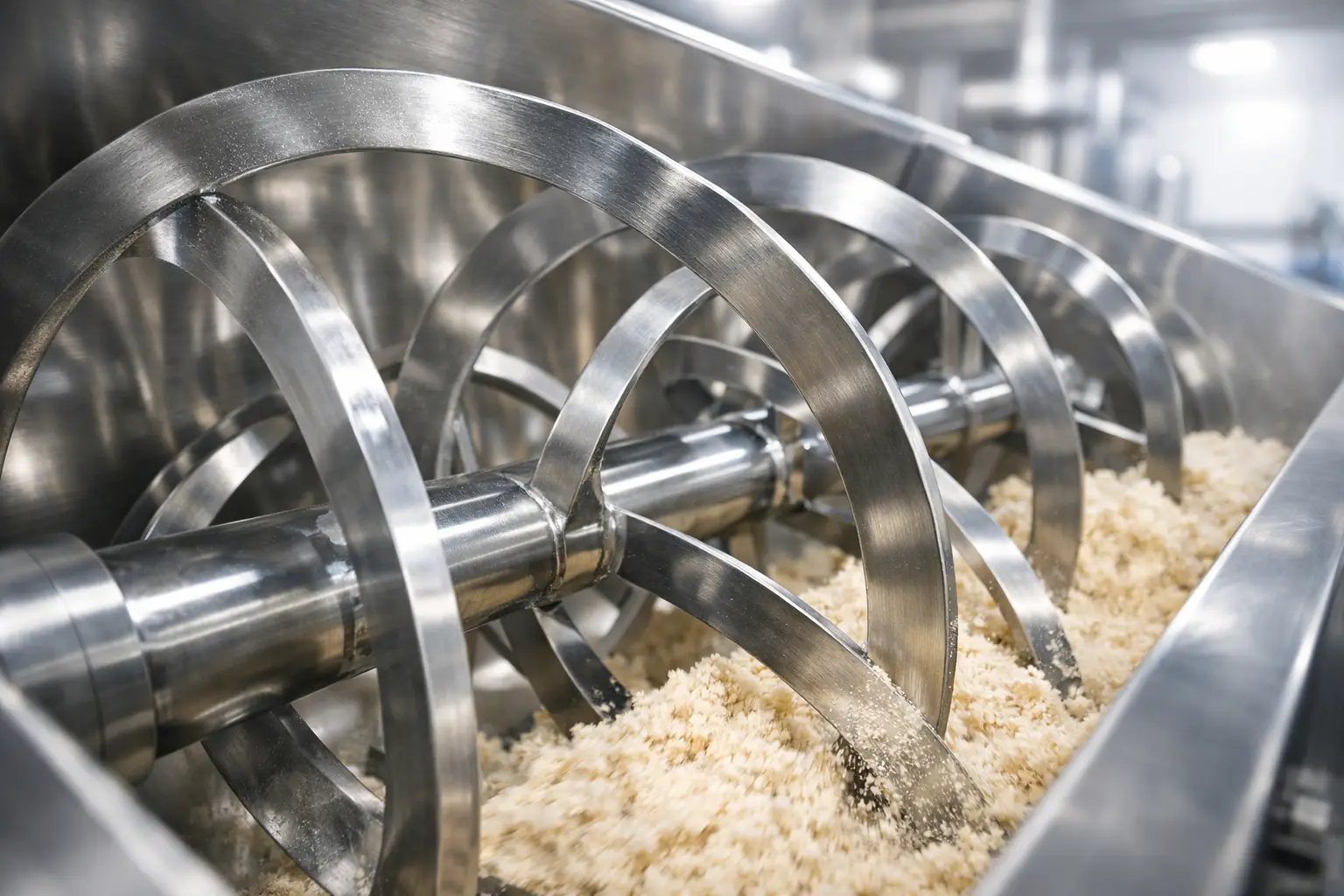
Horizontal ribbon mixers are widely used because they generate strong axial and radial movement, making them effective for many powders, granules, and light paste applications. A properly engineered ribbon agitator moves material in opposing directions, helping create uniform blending across the full trough. For many industrial processors, this design offers a strong balance of mixing performance, batch efficiency, and cost-effective operation.
Vertical ribbon mixers can be a better fit when floor space, batch geometry, or product handling requirements point toward a vertical configuration. They are often considered where gentle lifting action and compact footprint are priorities. The trade-off depends on the application. Some products benefit from the movement pattern, while others require the faster, broader convective action typical of a horizontal design.
Vacuum ribbon mixers and dryers become relevant when the process requires both blending and moisture removal or when temperature-sensitive materials need controlled treatment. Combining functions can reduce material handling steps and improve process efficiency, but only if the equipment is matched to the formulation and throughput target.
The key point is simple: if the machine does not match the product, bulk solids mixing problems tend to persist no matter how carefully the batch is timed or loaded.
Process variables that quietly create blend failure
Even with the right mixer, process settings can undermine results. Fill level is one of the most common examples. Underfilled mixers may not generate the intended mixing pattern, while overfilled vessels can restrict material circulation and increase cycle times. Manufacturers often see inconsistent results simply because actual operating fill levels drift from the validated range.
Ingredient addition sequence also matters. Minor ingredients introduced at the wrong stage may not distribute evenly, especially if they are added in concentrated pockets. In some formulations, pre-blending a micro-ingredient or changing the charging order can significantly improve uniformity without changing the machine.
Mixer speed is another variable that should be evaluated carefully. Higher speed may shorten blend time, but it can also increase dusting, heat, or particle damage. Lower speed may be gentler, yet insufficient to eliminate localized concentration differences. The best setting depends on the product’s behavior, not on a generic operating rule.
Discharge design deserves attention as well. A well-mixed batch can segregate if discharge is uneven or if downstream handling introduces excessive drop height and vibration. Solving the problem may require looking beyond the mixer itself and assessing the full path from blending to packaging or processing.
How to diagnose bulk solids mixing problems
The fastest way to waste time is to treat every poor blend as a mixer issue. Effective diagnosis starts with a structured review of the formulation, equipment, and operating method.
Sampling should be taken from multiple batch locations and, when possible, after discharge rather than only inside the vessel. This helps distinguish poor mixing from post-blend segregation. Teams should also compare successful and failed batches for changes in raw material lot characteristics, moisture, particle size, and loading sequence.
Equipment inspection is equally important. Worn ribbons, altered clearances, shaft deflection, buildup on internal surfaces, and discharge valve issues can all reduce mixing efficiency. What appears to be a formulation problem may actually be a maintenance problem.
In many plants, the most productive step is an application review with an equipment specialist. Material testing and process evaluation can reveal whether the issue is residence time, agitator geometry, discharge behavior, or a more fundamental design mismatch. That is where a solution-oriented manufacturer adds value beyond simply supplying standard equipment.
What a better mixing solution should deliver
A strong mixing system should do more than produce an acceptable blend on a good day. It should deliver repeatable uniformity, predictable cycle times, easy cleaning access, durable construction, and operating efficiency that supports long-term throughput goals.
For industrial buyers, that means evaluating total process performance rather than purchase price alone. A mixer that shortens blend time, reduces rework, lowers energy use, and minimizes downtime often delivers the stronger business case. It also gives production teams more confidence when handling complex or regulated formulations.
PerMix approaches this challenge with application-specific ribbon mixing solutions designed around material behavior, production demands, and plant realities. That kind of engineering focus matters because solving bulk solids mixing problems usually requires more than a catalog specification.
If your process is producing inconsistent blends, segregation, or unnecessary downtime, the next step is not guesswork. It is a closer look at how your material moves, how your equipment performs, and whether the mixing system is truly built for the job.